Ireland Calls in Army as Protesters Block Roads, Ports and Oil Refinery
Ireland called in its army on Friday as fuel price protesters blockaded the country's only oil refinery, locked up half the nation's fuel supply, and left more than 100 forecourts dry.
Ireland's government ordered the Defence Forces to clear fuel blockades on Friday as a four-day wave of protests over surging pump prices locked up roughly half the country's fuel supply, choked Dublin's streets and left more than 100 petrol stations running dry.
Justice Minister Jim O'Callaghan announced that "the blocking of critical national infrastructure will not be permitted to continue and the assistance of the Defense Forces has been requested." He warned that protesters who refused to move would have their vehicles removed by force and "should not complain later about any damage caused to those vehicles."
The demonstrations, which began on Tuesday, centred on three choke points in Ireland's fuel network. Protesters in trucks, tractors and other large vehicles blockaded Dublin city centre, formed slow-moving convoys on key motorways, and blocked ports in Galway and Limerick, as well as the country's only refinery at Whitegate, near Cork, which processes imported oil to meet around 40 percent of Ireland's fuel demand.
The cost of petrol, diesel and marked gas oil has soared as a result of the war in the Middle East and its impact on supplies through the Strait of Hormuz. Just over two weeks before the protests broke out, Ireland's ruling coalition signed off on a range of measures to reduce fuel costs, including a temporary excise duty reduction for motor fuels, expansion of the diesel rebate scheme for hauliers and bus operators, and an extension of the fuel allowance. Protesters dismissed those steps as insufficient and demanded an outright cap on fuel prices.
Numbers maintaining the blockade on the road leading to Irving Oil's refinery at Whitegate continued to grow through Friday morning, with around a dozen trucks and four tractors narrowing the entrance. Fuels for Ireland CEO Kevin McPartlan warned that 50 percent of Irish households and businesses would not have access to fuel if the depot blockades continued, adding that a significant proportion of the country's emergency strategic fuel supply could not be accessed.
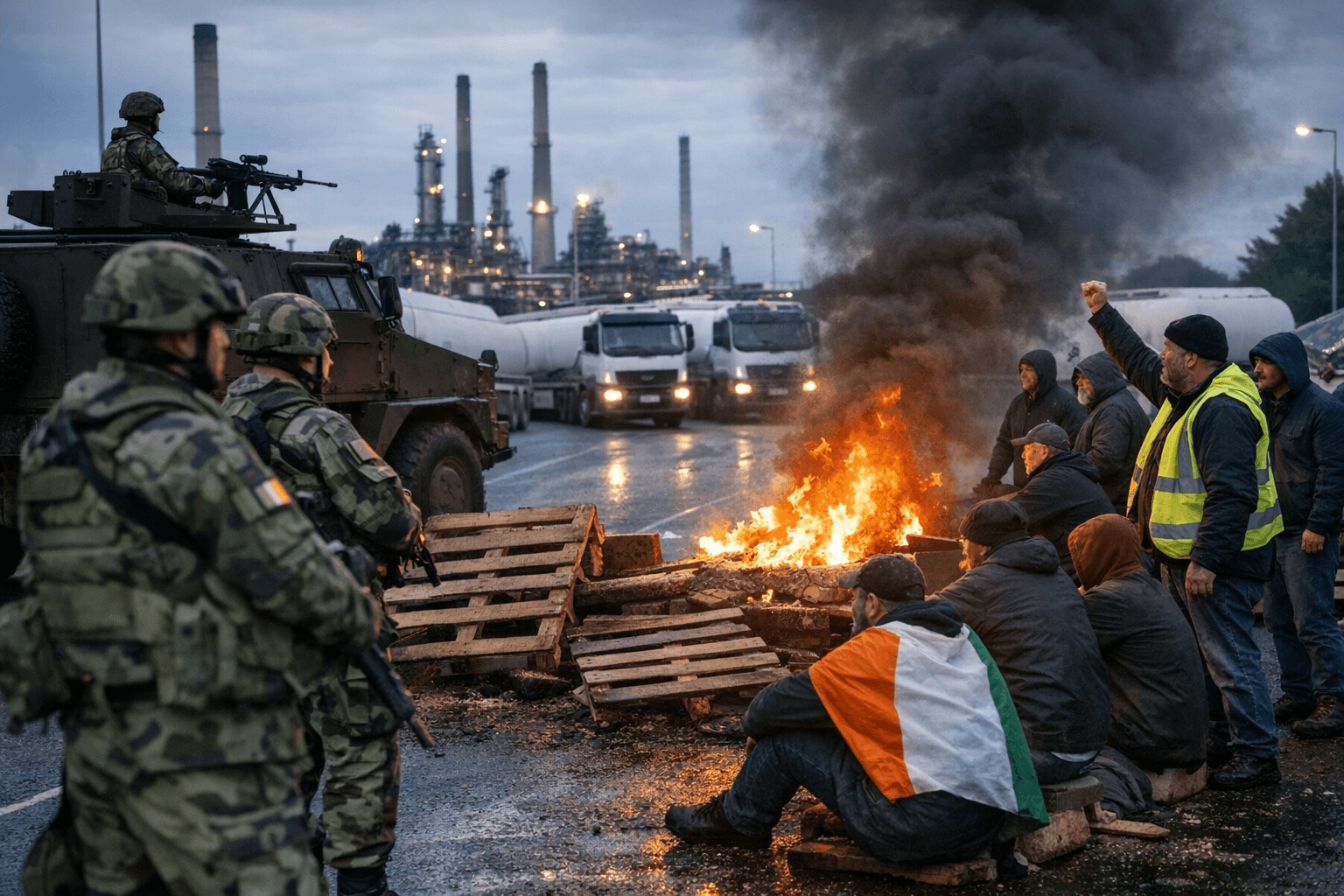
Gardaí were attempting to escort an empty fuel truck into the Whitegate refinery, saying the public order unit would only be used as a measure of last resort. The Defence Forces confirmed their assistance had been requested in the form of "heavy vehicle recovery," and said they would not provide further comment until the operation was concluded.
Taoiseach Micheál Martin, who had already branded the Whitegate blockade "an act of national sabotage" that "will directly impact the people of Ireland," said the government remained open to talks, but only after the blockades ended. Martin indicated the government was open to examining further measures to ease fuel prices and could do so "through established negotiating channels," but he made clear engagement would not happen while critical infrastructure remained obstructed.
Sinn Féin leader Mary Lou McDonald said the government was wrong to "escalate and aggravate" the protests by sending in the Defence Forces, calling instead on Martin to meet the protesters and act to reduce fuel costs. Sinn Féin's Matt Carthy said the Taoiseach's decision to enlist the army had "escalated and antagonised" the situation and called on Martin to de-escalate.
The Irish Farmers' Association and the Irish Road Haulage Association were not involved in the protests, which were primarily organised by a loose group of independent figures including James Geoghegan, Anthony Kelleher and Mark Troy. Protest organiser Geoghegan, speaking on RTÉ's Liveline, said the government's lack of action "proves how weak a leader Micheál Martin is" and called on him to step down as Taoiseach. A limited deal was struck Friday for emergency services' fuel to be released from the Whitegate refinery, even as the broader standoff between protesters and government showed no sign of swift resolution.
This article was produced by Prism’s automated news system from verified source data, official records, and press releases, then run through automated quality and moderation checks before publishing. The system is built and supervised by the people who set the standards it runs under. Read our full AI policy.
Did this article answer your question?


