WHO warns Congo Ebola outbreak is far larger than first reported
WHO now says Congo’s Ebola outbreak may already include almost 750 suspected cases, after the virus spread to Uganda and killed at least one traveler.

A Congo Ebola outbreak first flagged in a remote health zone now appears far larger than the early case count suggested, with the World Health Organization warning that weeks of undetected spread have left health workers racing to catch up.
As of May 16, WHO had counted 8 laboratory-confirmed cases, 246 suspected cases and 80 suspected deaths in Ituri Province, with suspected cases reported across Ituri and North Kivu. By May 22, the agency said the DRC was facing almost 750 suspected cases and 177 suspected deaths, a jump that underscored the uncertainty created by weak surveillance in a region where people move quickly between towns, mines and informal care centers. WHO has raised the national risk level to very high, while keeping the regional risk high and the global risk low.
The outbreak is caused by Bundibugyo virus disease, a species of Ebola virus that has no approved vaccine or specific treatment. WHO says early supportive care can save lives, but the lack of targeted medicine makes containment depend heavily on fast detection, safe burials, isolation and contact tracing.
The first signal came on May 5, when WHO was alerted to a high-mortality cluster of unknown illness in Mongbwalu Health Zone, including deaths among health workers. On May 14, the Institut national de recherche biomédicale in Kinshasa tested 13 blood samples from Rwampara Health Zone and confirmed Bundibugyo virus disease in 8 of them the next day. WHO said the pattern was unusual because deaths with Ebola-like symptoms were appearing across several health zones at once, while the true scale of the epidemic was still being uncovered.
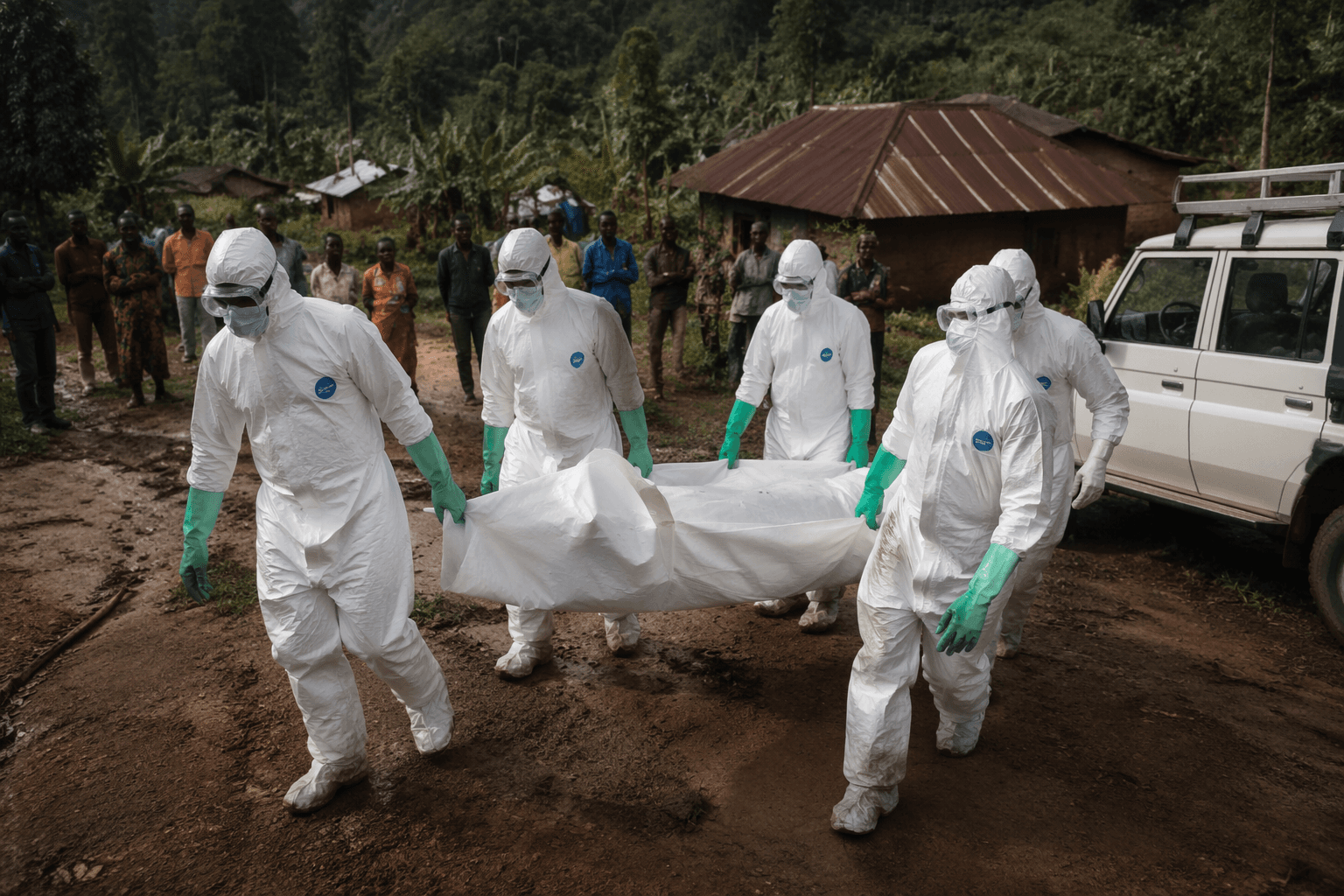
The outbreak has now touched Bunia, Rwampara and Mongbwalu, in a part of eastern Congo where insecurity, humanitarian crisis, population displacement and a wide network of informal health facilities complicate containment. WHO said more than 100,000 people have been newly displaced in the area, adding more fuel to the risk of spread. The agency also said the outbreak had crossed into Uganda, where two confirmed cases, including one death, were reported among people who had traveled from the DRC.
WHO declared the event a public health emergency of international concern on May 17, citing the extraordinary nature of the outbreak, the high number of suspected deaths, the spread to Uganda and the possibility of further regional transmission. The response has since accelerated. On May 22, the United Nations released up to $60 million from its Central Emergency Response Fund, and the United States pledged $23 million to support efforts in Congo and Uganda, including funding for as many as 50 Ebola treatment clinics.
The pressure is already showing on the ground. On May 21, angry residents in Rwampara set fire to part of an Ebola treatment center after being blocked from retrieving the body of a man believed to have died from the disease. The attack captured the central challenge now facing responders: stopping transmission in communities where mistrust, grief and displacement can move faster than the virus itself.
Know something we missed? Have a correction or additional information?
Submit a Tip