Why Trump Keeps Invoking McKinley, Tariffs and American Power
Trump is turning McKinley into a tariff-age icon. The match flatters his trade agenda, but the historical record is far more complicated.
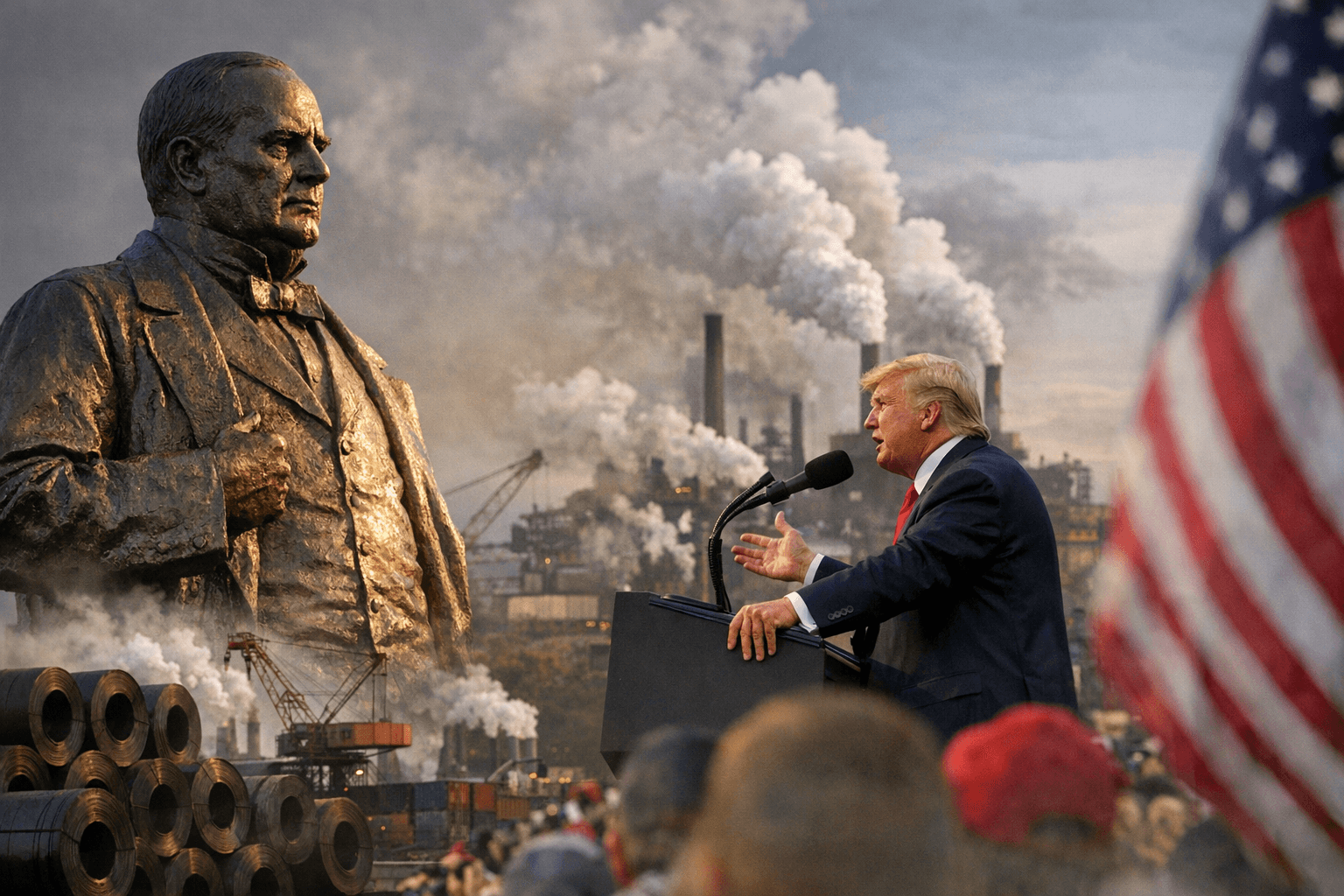
Trump’s McKinley fixation is about more than history
Donald Trump is not just reaching for a Republican president from the past. He is using William McKinley as a symbol for the kind of governing story he wants voters to believe now: that tariffs build wealth, industrial strength, and national pride. In his January 20, 2025 inaugural address, Trump said McKinley “made our country very rich through tariffs,” then signed an executive order that day restoring the name Mount McKinley.
That pairing matters. Trump did not merely invoke McKinley as a historical reference; he tied him to an agenda of trade protection, patriotic branding, and executive action. The White House later sharpened that message in January 2026, saying Trump had “proudly restored the rightful name of Mount McKinley to America’s highest peak” and linking McKinley’s “historic legacy” to an industrial policy that puts “American workers, manufacturers, and industries first.”
Why McKinley fits Trump’s political mythology
McKinley offers Trump a rare combination of symbols that work well together: tariffs, nationalism, and a forceful presidential brand. McKinley was the 25th president, serving from 1897 to 1901, and his name is attached to a period often remembered for rising American confidence, protectionist trade policy, and expanding global reach. For a president who likes to cast trade as a test of national strength, McKinley provides a ready-made ancestor.
The fit is political as much as economic. Trump’s use of McKinley suggests he wants voters to see tariffs not as a cost, but as a tool of national revival. By reviving a name from the 19th century, he casts his own trade agenda as part of a larger American tradition, not a break from it. That is a powerful framing device, especially when the policy itself invites criticism over higher prices and retaliation.
What McKinley actually did on tariffs
The historical record is more complicated than Trump’s shorthand suggests. McKinley was the principal sponsor of the McKinley Tariff of 1890, a law that sharply raised protective duties. Britannica says the act was designed to protect American manufacturers, but it also increased the cost of many goods, and the tariff contributed to agrarian backlash.
That backlash matters because it shows the political limits of protectionism even in the era Trump admires. Farmers and rural communities often bore the brunt of higher prices, while the promise of industrial protection was easier to sell than the household costs that followed. McKinley’s tariff politics were not a simple story of easy enrichment; they were part of a contested struggle over who benefited from federal power and who paid for it.
The comparison gets even more complicated in 1897, when the Dingley Tariff became the highest protective tariff in American history up to that time. That reinforces why McKinley appeals to Trump. The record gives him a president associated with aggressive trade barriers, not free trade caution. Yet it also shows how tariff politics can escalate beyond symbolism into sweeping economic intervention with broad consequences.
McKinley was also a president of empire, not just commerce
Trump’s tribute tends to flatten McKinley into a tariff icon, but McKinley’s presidency mattered far beyond trade. Under McKinley, the United States went to war with Spain in 1898 and acquired Puerto Rico, Guam and the Philippines. Britannica notes that this made McKinley a key figure in the rise of U.S. global power.
That part of the story helps explain the emotional charge around McKinley for Trump’s circle. The name evokes a period when the United States was not just protecting domestic industry, but asserting itself abroad. It is easy to see why that fits a broader message about American strength. Trump can present McKinley as proof that bold leadership, economic nationalism, and national prestige all belong to the same political package.
Still, the imperial dimension complicates the tribute. McKinley’s legacy is not just about pride or prosperity. It is also about war, territorial expansion, and the exercise of power over places and people far beyond the continental United States. That tension sits just below the surface of Trump’s invocation, even when the White House frames McKinley as a champion of workers and manufacturers.
Why the Mount McKinley renaming is part of the same message
The renaming of Mount McKinley shows how seriously Trump takes political branding. Alaska’s geographic board changed the mountain’s name to Denali in 1975, and the question has remained politically charged ever since. AP reported that Ohio Republicans have periodically pushed to restore the Mount McKinley name, including around McKinley’s 175th birthday.
By restoring the old name on his first day back in office, Trump turned a geographic label into a declaration about historical memory. The White House’s 2026 messaging made that explicit, tying the renaming to a broader industrial policy and to the idea that the president was restoring “American greatness.” In that sense, the mountain is not just a mountain. It becomes a public marker of whose version of history gets to define the present.
The renaming also shows how Trump blends policy and spectacle. Tariffs are often dense, technical, and hard to sell. A mountain rename is immediate, visible, and emotionally legible. It lets Trump collapse trade policy, nationalism, and personal authority into one action that voters can easily grasp.
Where the comparison breaks down
McKinley’s record does not map neatly onto Trump’s pitch. The biggest break comes from McKinley’s own ending. His final speech before his assassination in Buffalo, New York, in September 1901 emphasized tariff reform, which suggests a more complicated and less rigid view of trade than Trump’s tribute implies.
That detail matters because it interrupts the mythic version of McKinley as a pure tariff zealot. Trump’s telling turns him into a fixed symbol of protectionism. The historical McKinley was operating in a much messier political world, one in which tariff policy had already produced backlash, and in which the demands of governing pushed beyond slogans. His legacy cannot be reduced to a single line about tariffs, no matter how useful that line may be for modern politics.
McKinley’s presidency also sits at the intersection of industrial growth and imperial expansion, a combination that does not fit neatly into Trump’s more selective branding. He was not simply a hero of domestic manufacturing. He was a war president, an architect of U.S. territorial expansion, and a political figure whose record includes both economic protection and costly conflict. That complexity is exactly what gets lost when his name becomes a shorthand for Trump’s trade agenda.
What Trump wants voters to hear when he says McKinley
When Trump invokes McKinley, he is asking voters to hear three things at once: tariffs as prosperity, America as a nation that protects its own, and presidential power as a force that can rename, reshape, and reclaim. The historical McKinley offers enough raw material for that message to work, but not enough to make it simple.
That is the real significance of the comparison. Trump is not trying to produce a full historical account. He is building a governing mythology in which McKinley stands for industrial strength, patriotic confidence, and the right to use federal power as a branding tool. The comparison holds because McKinley did embrace protective tariffs and presided over an assertive America. It breaks because the real McKinley was more conflicted, more expansive, and, in his last public words, more open to tariff reform than Trump’s legend allows.
This article was produced by Prism’s automated news system from verified source data, official records, and press releases, then run through automated quality and moderation checks before publishing. The system is built and supervised by the people who set the standards it runs under. Read our full AI policy.
Did this article answer your question?

