Wildlife Thrives in Chernobyl Exclusion Zone, Decades After Disaster
Chernobyl’s wildlife comeback is real, but it is not proof of healing. Scientists see a thriving ecosystem inside a contaminated landscape that still bears the mark of catastrophe.
The paradox at the heart of Chernobyl
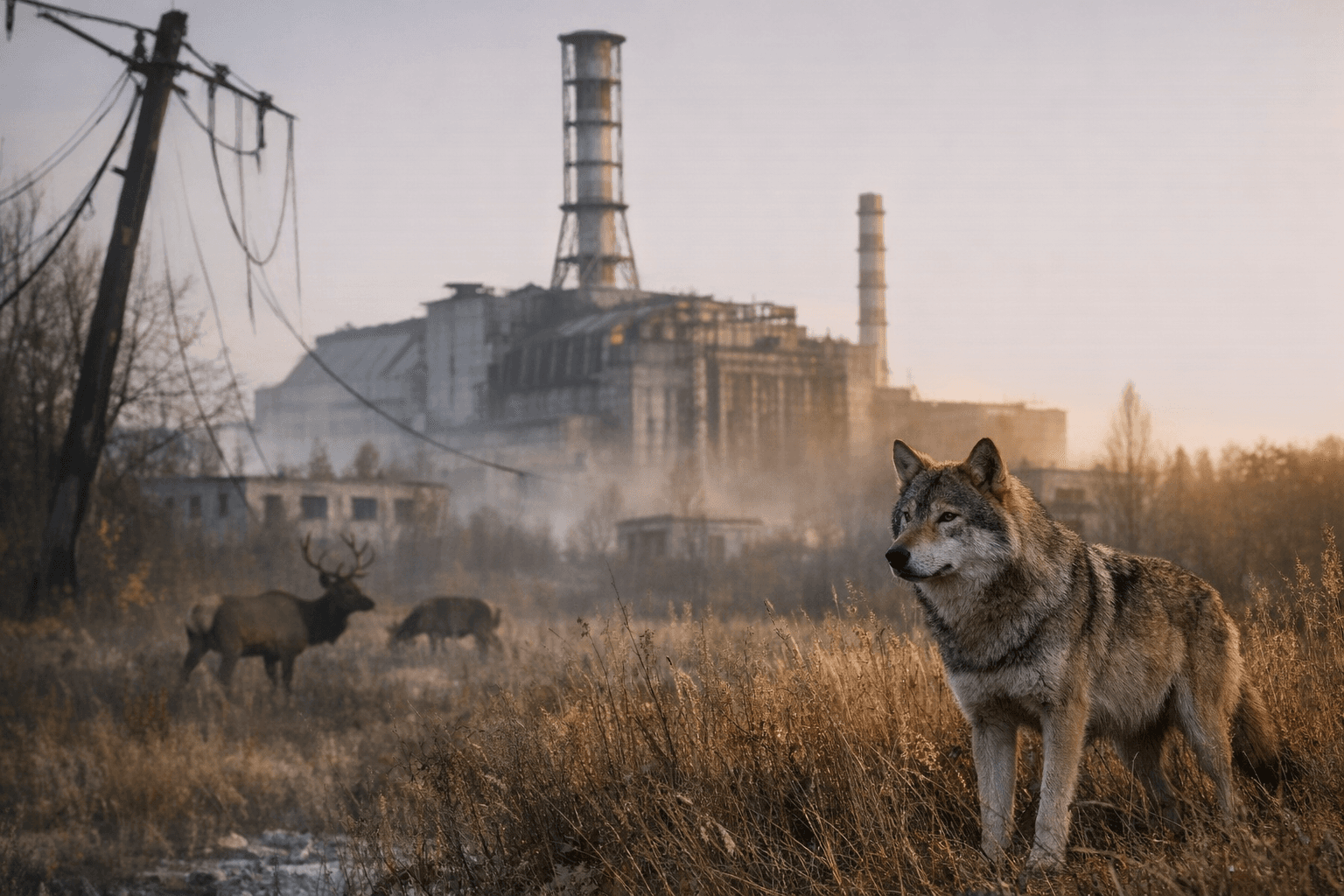
Wolves, horses, bears, and thousands of other animals now move through a landscape that was once emptied by nuclear disaster. The sight is striking, even hopeful, but it carries a hard truth: abundance in the Chernobyl Exclusion Zone does not mean the land is safe, clean, or repaired.
The zone remains the legacy of the April 26, 1986 accident at the Number Four reactor of the Chernobyl Nuclear Power Plant, when an unsafe low-power test ended in an explosion and fire that released large amounts of radiation into the atmosphere. The International Atomic Energy Agency identifies Chernobyl as the most serious nuclear accident in history, and the fallout contaminated large areas of Europe, especially Belarus, the Russian Federation, and Ukraine.
A landscape emptied by disaster, then reclaimed by nature
The exclusion zone is commonly described as a roughly 30-kilometre-radius evacuated area around the reactor. That human withdrawal created the conditions for an unintended ecological experiment: roads faded under forest growth, trees pushed through abandoned buildings, and Soviet-era signs now stand beside overgrown cemeteries. The visual effect is eerie, but the ecological consequence is unmistakable. In the absence of people, many species found room to return.
That recovery has made the zone a unique natural laboratory for scientists studying how ecosystems respond after large-scale human displacement. The Chornobyl Radiation and Ecological Biosphere Reserve has become a place where researchers can watch succession, adaptation, and movement unfold across a contaminated landscape. Scientists including Denys Vyshnevskyi, Germán Orizaola Pereda, Timothy Mousseau, Sergey Gashchak, and Nicholas A. Beresford have helped frame Chernobyl not as a story of untouched wilderness, but as an ongoing test of what nature can do when human pressure suddenly drops away.
Przewalski’s horses and the limits of recovery
Few animals symbolize that shift more clearly than Przewalski’s horses. Native to Mongolia and once close to disappearing altogether, they were introduced into the exclusion zone in 1998 as an experiment to restore biodiversity. Ukrainian sources say the first release involved 31 horses, and the effort was launched by Askania Nova as part of a broader conservation program.
Today, hidden cameras show the horses adapting in ways that reveal both resilience and constraint. They use crumbling barns and deserted houses as shelter from harsh weather and insects, and sometimes even bed down inside abandoned structures. That behavior underscores the central paradox of the zone: wildlife can flourish in places people cannot safely inhabit, but the environment itself remains damaged and dangerous.
Denys Vyshnevskyi, the reserve’s lead nature scientist, views the return of a free-ranging horse population as a sign of extraordinary ecological recovery. His perspective reflects why Chernobyl matters far beyond Ukraine. The horses are not proof that the radiation problem has vanished. They are proof that, in a landscape stripped of routine human disturbance, a species can establish itself and persist in surprising ways.
What the animals can tell scientists, and what they cannot
Chernobyl’s wildlife story is larger than the horses. Populations of lynx, moose, red deer, and free-roaming dogs have also rebounded across the zone. A Science Advances study examined 302 free-roaming dogs living within the site and nearby areas, and found that dogs from the power plant and Chernobyl City are genetically distinct populations. That matters because it shows how quickly isolated animal groups can diverge when they are shaped by a fractured human landscape.
The dog data also illustrate a broader scientific caution. The presence of thriving animals does not mean the environment is ecologically healed in any complete sense. It means life has reorganized under abnormal conditions. Species can adapt to abandonment, and some may even benefit from the removal of human activity, but that is not the same as restoring a normal ecosystem or erasing contamination.
Brown bears offer another example of that tension. A public dataset on brown bears in the Chornobyl Exclusion Zone includes 59 records collected between 2003 and 2025, supporting the view that bears have returned after being absent for more than a century. Their return is ecologically significant, but it should be read alongside the site’s continuing hazards. The same landscape that supports large mammals is still defined by radioactive contamination and the history of evacuation, loss, and long-term exclusion.
Why Chernobyl became a biosphere test case
Chernobyl is often discussed alongside UNESCO’s Man and the Biosphere Programme, which is designed to combine nature protection with human livelihoods. The exclusion zone stands out because it represents something different: recovery without people. That makes it an unusually stark case study, not because it is a model to imitate, but because it strips away a central variable in conservation planning and forces scientists to ask what happens when humans leave abruptly.
The answer is not simple restoration. It is ecological reorganization under extreme conditions. Wolves range across the Ukraine-Belarus borderland. Horses graze in open clearings and take refuge in abandoned buildings. Bears have reappeared. Dogs have formed distinct groups around the plant and in Chernobyl City. These are signs of biological activity, not evidence that the land has returned to normal.
A lesson that resists easy optimism
Chernobyl’s wildlife rebound is one of the most compelling examples of nature reclaiming space after disaster, but it should not be mistaken for healing in the full sense. The 1986 accident remains a historical wound, and the exclusion zone still exists because the land is too dangerous for ordinary human life. The growth of forests and the spread of animals are real, yet they coexist with radiation, trauma, and a permanent reminder of technological failure.
That tension is the story’s lasting value. It challenges the comforting idea that resilience automatically means recovery. In Chernobyl, nature has returned with force and speed, but the comeback is taking place inside a contaminated world, not beyond it.
This article was produced by Prism’s automated news system from verified source data, official records, and press releases, then run through automated quality and moderation checks before publishing. The system is built and supervised by the people who set the standards it runs under. Read our full AI policy.
Did this article answer your question?


