Wolf Supermoon Illuminates Skies, Pairs with Quadrantid Meteor Shower
The first supermoon of 2026 reached peak illumination on January 3, drawing skywatchers worldwide with a larger, brighter full Moon coinciding with the annual Quadrantid meteor shower. The celestial pairing offered dramatic photographs, from orange moonrises in India to a widely shared image over Glastonbury Tor, and marked the opening of a year that will feature three supermoons and an unusual 13 full Moons.

On the pre-dawn of January 3, 2026, the Moon reached perigee and presented the year's first supermoon, commonly called the Wolf Moon, illuminating skies across multiple continents. Peak full illumination was recorded at 5:03 a.m. Eastern Time. Observers reported that the lunar disk appeared noticeably larger and brighter than a typical full Moon, with widely cited measurements of about 14 percent larger apparent diameter and roughly 30 percent greater brightness than average.
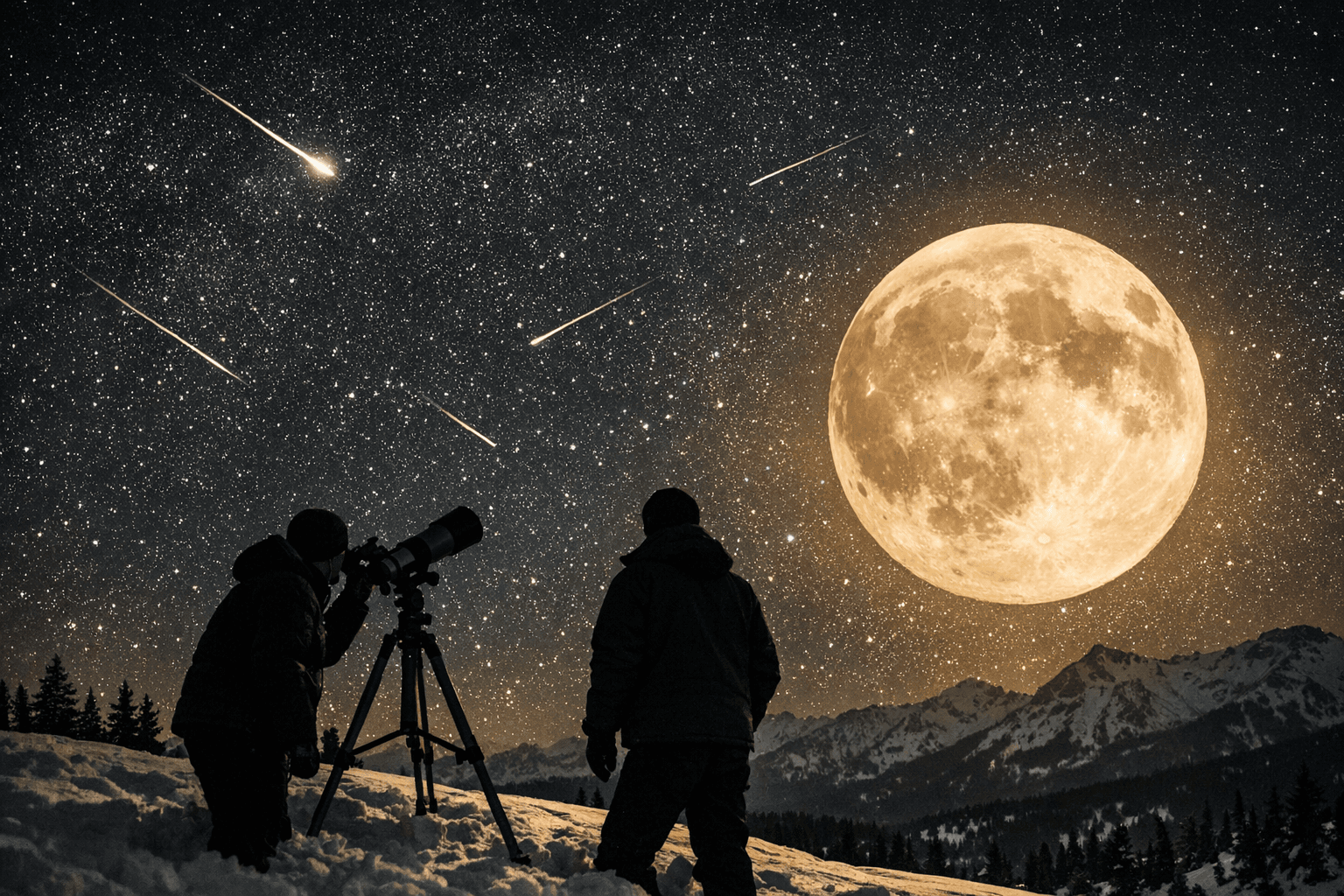
The supermoon's timing coincided with the annual Quadrantid meteor shower, producing a dual attraction for amateur astronomers and casual observers. The Quadrantids peak in early January and added transient streaks of light against the lunar backdrop for those who braved late nights and early mornings. Photographers and citizen scientists captured the scene from urban plazas to rural hilltops; social media circulated striking images, including one notable photograph framing the Moon above Glastonbury Tor in the United Kingdom.
Skywatchers in parts of India reported particularly vivid moonrises, with the disk taking on a deep orange hue as it climbed above the horizon. The coloration and perceived enlargement were enhanced by the classic moon illusion, in which the brain judges the low Moon as larger when seen near terrestrial landmarks. Photographers were urged to exploit this effect by composing the low Moon with foreground elements such as buildings, trees, or hills to convey scale and drama.
The astronomical cause was straightforward: the Moon's slightly elliptical orbit brings it closer to Earth at perigee, increasing its apparent size and reflected light. This perigee-full Moon combination produced the supermoon effect on January 3. The phenomenon requires no specialized equipment to enjoy; even observers in light-polluted cities reported clear views, although darker sites improved visibility of the accompanying meteors.
January's display also sets the stage for an eventful lunar calendar in 2026. This Wolf Supermoon was the first of three supermoons expected this year, with the largest and closest supermoon slated for December 24. Astronomers note that 2026 will be atypical in having 13 full Moons, a consequence of calendar timing that produces two full Moons in May; the second full Moon in that month will be designated a Blue Moon.
Beyond the immediate spectacle, the event underscores the public appetite for low-cost, accessible astronomy. Museums, planetariums, and local astronomy clubs reported elevated engagement around the supermoon, with many organizations using the occasion to promote skywatching and basic observational techniques. For photographers and casual viewers alike, the practical takeaways were consistent: watch near moonrise for color and scale, include foreground objects for context, and look skyward in the early hours to catch meteors against the lunar glow.
As the year proceeds, skywatchers can look forward to two more supermoons and a rich schedule of lunar phases that will keep astronomy clubs and social feeds busy through December.
This article was produced by Prism’s automated news system from verified source data, official records, and press releases, then run through automated quality and moderation checks before publishing. The system is built and supervised by the people who set the standards it runs under. Read our full AI policy.
Did this article answer your question?


