World's most powerful laser helps unlock stars, fusion energy
A 10-story laser in Livermore fired 192 beams at a target the size of a pencil eraser and crossed a fusion milestone that could shape energy and nuclear policy.
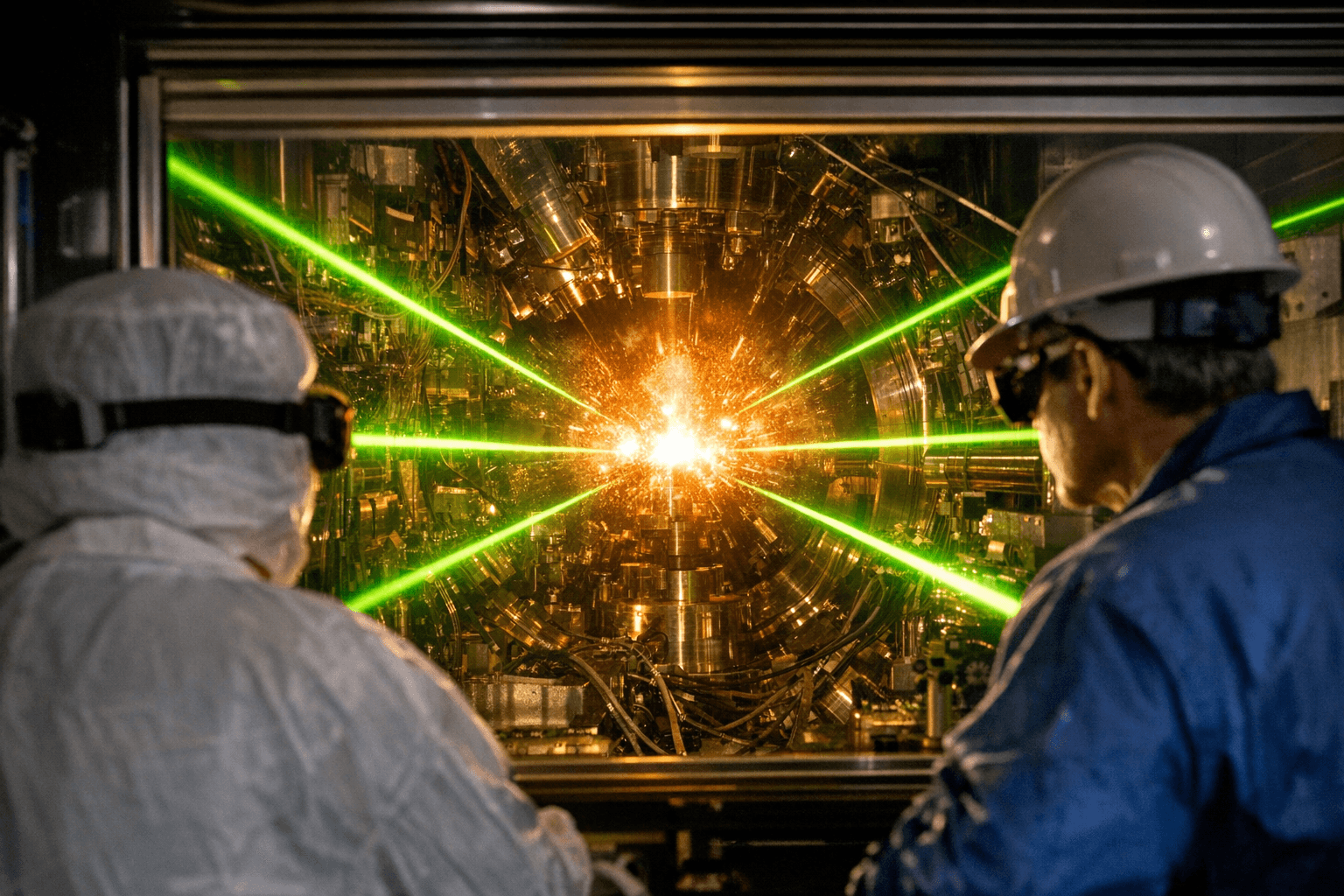
Inside a 10-story building the size of three football fields in Livermore, California, the National Ignition Facility turns a target no larger than a pencil eraser into a stand-in for a star. Its 192 laser beams can deliver more than 2 million joules of ultraviolet energy in billionth-of-a-second pulses into a 10-meter-diameter chamber, recreating conditions found in the Sun, giant planets and nuclear weapons.
That scale is why taxpayers and policymakers should care. The National Ignition Facility, or NIF, is not only the world’s largest and highest-energy laser system; it is also a critical tool for the U.S. National Nuclear Security Administration’s Stockpile Stewardship Program. The federal government uses it to study how nuclear materials behave without resorting to full-scale nuclear testing, making the machine a central part of stewardship, deterrence and arms control in the post-testing era.
The same apparatus that serves national security also pushes against one of energy policy’s most stubborn frontiers. By compressing fuel to extreme temperatures and pressures, NIF gives scientists a way to study high-energy-density physics, astrophysics and fusion. The long-term promise is inertial fusion energy, a concept that still sits far from commercial power plants but now has a firmer physics basis because repeated ignition can be demonstrated, measured and refined.
The clearest proof came on Dec. 5, 2022, when 192 laser beams delivered more than 2 million joules of ultraviolet energy to a tiny fuel pellet and produced 3.15 megajoules of fusion energy from 2.05 megajoules of laser energy. That first laboratory ignition shot capped more than 60 years of laser-driven inertial confinement fusion research at Lawrence Livermore National Laboratory. It happened in the middle of the night after a delay for optics installation and maintenance, with only a handful of researchers and technicians in the control room. Even then, pre-shot simulations gave it only a slightly better than 50-50 chance of reaching or exceeding break-even.
The result carried political as well as scientific weight. Jennifer M. Granholm, then the U.S. energy secretary, compared the milestone to the Wright brothers’ first flight and called it one of the most impressive scientific feats of the 21st century. A Sept. 19, 2022 shot had already produced about 1.2 million joules of fusion yield, underscoring how quickly the program was moving toward ignition.
NIF became operational in March 2009, but its public value is still being written. It is a rare federal instrument that links basic research, nuclear stewardship and energy ambition in one place, with the payoff measured not in headlines alone but in the long timeline between discovery and public benefit.
This article was produced by Prism’s automated news system from verified source data, official records, and press releases, then run through automated quality and moderation checks before publishing. The system is built and supervised by the people who set the standards it runs under. Read our full AI policy.
Did this article answer your question?