CrossFit hopper model explains why the Games test true fitness
The Hopper Model shows why CrossFit crowns adaptable athletes, not specialists. Every workout announcement becomes a clue to who can survive the field.
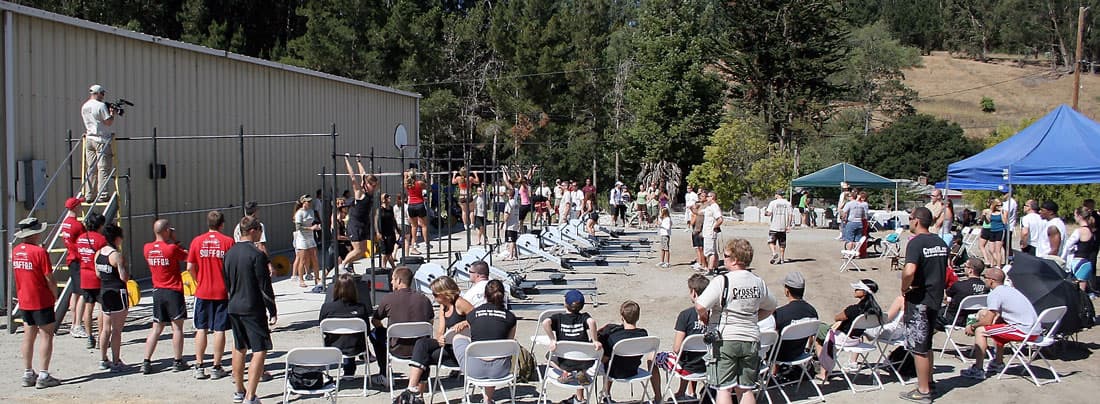
At the first CrossFit Games in 2007, an event was chosen randomly from a hopper at The Ranch in Aromas, California. Greg Glassman’s 2002 fitness definition framed CrossFit as training for the broadest possible adaptational response across broad time and modal domains, and the hopper idea turns that philosophy into a competition model: unknown tasks are pulled at random, and the athlete who performs best across the widest set of demands is the one who rises.
What the hopper model actually tests
At its core, CrossFit treats fitness as competence across an infinite range of tests. The model assumes no athlete gets to specialize for a single predictable event, because the next draw could be a barbell lift, a run, gymnastics, rowing, or odd-object work.
The Games are not asking who can dominate one domain for one day. They are asking who can repeatedly handle whatever appears next. The more varied the test, the more the leaderboard rewards broad capacity instead of narrow excellence.
The 10 skills behind the score
CrossFit’s own framework for judging fitness rests on 10 general physical skills: cardiovascular and respiratory endurance, stamina, strength, flexibility, power, speed, coordination, agility, balance, and accuracy. A person is fit to the extent that they are competent in all 10, not just elite in one or two.
That framework gives fans a practical lens for every workout announcement. A heavy barbell plus short rest will stress strength and power; long efforts with running or rowing put cardiovascular and respiratory endurance, stamina, and speed under pressure; gymnastics, footwork, and precision movements probe coordination, balance, agility, and accuracy. The best athletes are the ones who can keep all 10 skills from collapsing when fatigue arrives.

CrossFit also draws a line between training qualities and practice qualities. Endurance, stamina, strength, and flexibility are built through training, while coordination, agility, balance, and accuracy are honed through practice. Power and speed sit between those groups, drawing on both.
Why the Games were built this way
The first CrossFit Games, held in 2007 at The Ranch in Aromas, California, were shaped by the same idea. CrossFit’s history of the 2007 Games puts the field at about 70 athletes. The original hopper and handwritten leaderboard still sit at The Ranch.
That first edition was also open to all comers, with scaling options available for some movements. But once an athlete had to scale, that athlete was out of contention.
Dave Castro has also tied the history of the Games back to The Ranch, where the event lived from its inception in 2007 until 2009, before it outgrew the family property.
What to watch when workouts are announced
The Hopper Model turns workout release day into a scouting exercise. The question is not simply who will lift the most or run the fastest. The real question is which athletes will be forced to operate outside their comfort zone when the event design mixes capacities together.

A useful way to read an announcement is to look for the hidden weak points:
- Long mixed-modality tests reveal who can hold together across time, not just under a single burst.
- Gymnastics under fatigue expose whether coordination and accuracy still hold when breathing breaks down.
- Odd-object work often separates durable, well-rounded athletes from specialists who rely on familiar implements.
- Heavy barbell work after running or rowing tests whether strength survives a compromised engine.
- Fast transitions and changing movement patterns can punish athletes who are powerful but not agile.
A specialist can look unbeatable when the event plays to one strength, but the moment the hopper spits out a different demand, the margin disappears.
Why this explains comeback and upset narratives
The model also explains why CrossFit produces so many comeback stories and leaderboard shocks. Because the test changes so often, no one is safe on talent alone. An athlete who loses ground in one event can recover when the next workout tilts toward a different mix of skills, and an athlete who looked ordinary in one format can suddenly jump into contention when the hopper favors their better attributes.
Over time, the Games have evolved into a more comprehensive test, and the field has become dramatically deeper. CrossFit says the average Semifinals athlete in 2023 would be dramatically more capable than the world’s best in 2007.
This article was produced by Prism’s automated news system from verified source data, official records, and press releases, then run through automated quality and moderation checks before publishing. The system is built and supervised by the people who set the standards it runs under. Read our full AI policy.
Did this article answer your question?