Why the United States Women’s Disc Golf Championships stands apart
USWDGC is the sport’s only women-only Major, and that changes everything from qualification pressure to the shared experience on the course. Its field now spans ages, divisions, states, and countries, with Salt Lake City next on the schedule.

The loudest swings in women’s disc golf often happen on a weekend that belongs entirely to women. The United States Women’s Disc Golf Championships stands apart because it is the only PDGA Major reserved for women, and because its amateur side is not narrowed by age in the way many championships are. That mix of elite Open play and age-spanning amateur divisions makes the title mean more than a trophy: it creates a single national stage where champions, up-and-comers, and players from every age group share the same spotlight.
What makes USWDGC different
USWDGC is built on a structure no other Major matches. The event is women-only, but it is not a one-note championship, because the amateur divisions are not limited to FA1 or a single age band. Instead, players compete across divisions that include FA2, FA3, and FA4, which gives the tournament a broader national footprint and a wider definition of who gets to belong at Major level.
That matters on the ground. A title race in a women-only Major carries different emotional weight because it is not just about who can beat the field. It is about creating a championship setting where women and girls see themselves represented at every rung of the event, from junior and amateur divisions to the elite professional card. The result is a tournament that functions as both a competitive proving ground and a public showcase for the sport’s growth.
From 21 players to a national gathering
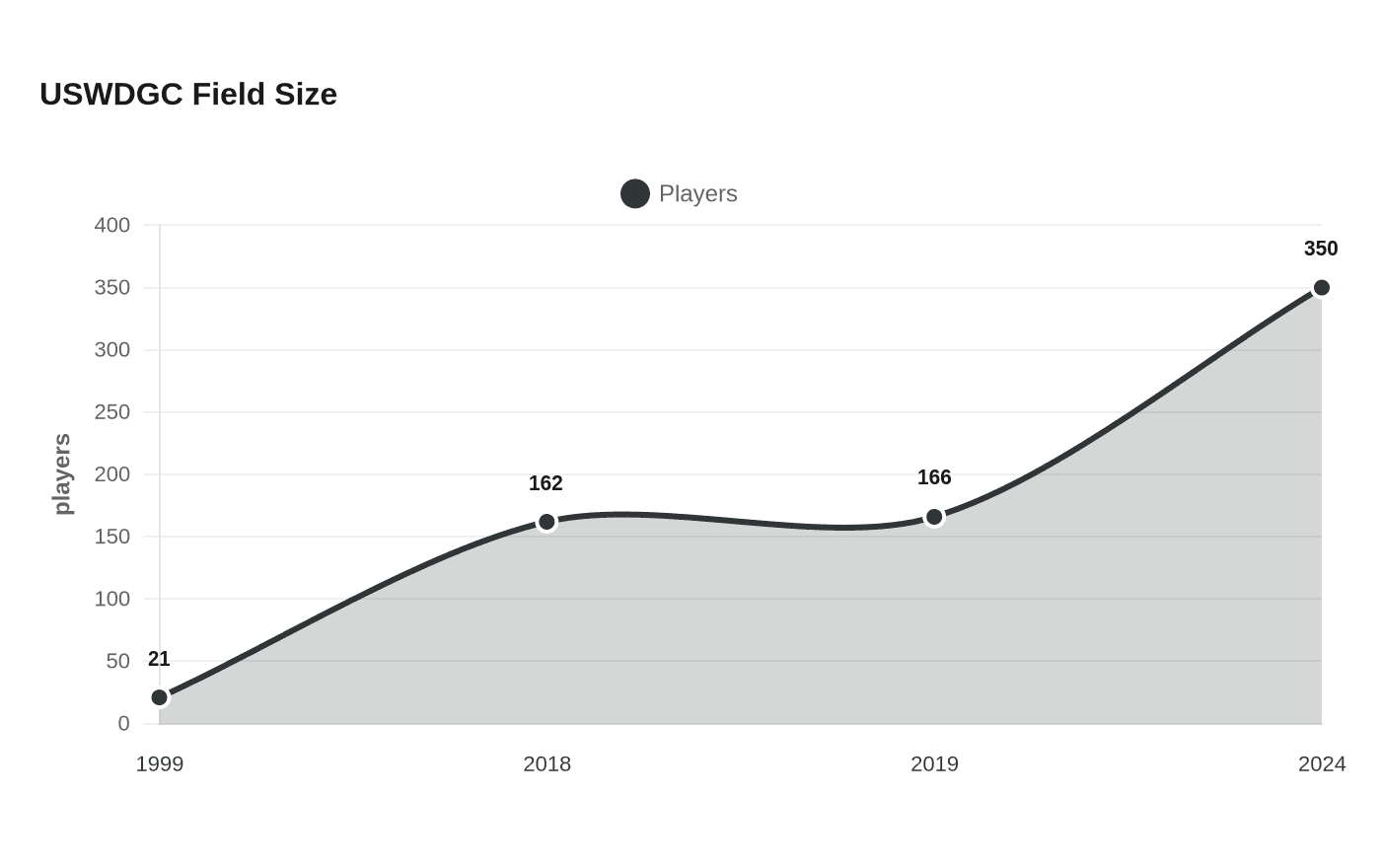
The event’s first roots go back to 1999 in Charlotte, North Carolina, when Harold Duvall ran what PDGA described as the first Women’s National Championships. That field included 21 women competing in two divisions, a modest start that still established the basic idea behind the championship: one event dedicated to women’s disc golf, with room for both serious competition and community.
The growth since then has been steady and measurable. PDGA described the 2018 championship in Lansing, Michigan, as hosting 162 women from 26 states and five countries. The following year, the event was described as the single largest women’s event in PDGA history at that point, with 166 women and 16 divisions. Those numbers show more than expansion. They show that the event had become a destination, not just a tournament stop.
By 2024, the scale had climbed again. PDGA said the field reached 350 players representing eight countries and 39 states, across 21 divisions. That made it the 25th running of the event and the first PDGA Major of the year, and it came with a record purse of $126,000. The size of that purse and the breadth of that field underline how USWDGC has become one of the sport’s marquee gatherings, not only for the players in contention but for the entire competitive ecosystem around them.
Why the title carries extra pressure
A women-only Major does something that a coed national event cannot quite replicate: it concentrates attention. Every card is part of the same celebration, and every division sits under the same championship umbrella, so the pressure is not only to win but to represent well in a field that carries unusual visibility. That makes the title feel singular, because there is no second women-only Major to compare it against.
The amateur divisions sharpen that effect. Players who might never cross paths in a normal weekend, whether because of age, division, or travel range, end up in the same championship environment. That shared setting makes the event feel like a cross-section of the women’s game rather than a narrow cut of it, and it gives the weekend a sense of scale that reaches beyond the lead card.
The practical consequence is simple: players are not just chasing scores. They are stepping into a championship that doubles as a visibility event for the whole women’s side of the sport. That changes the meaning of every round, especially for younger players watching the top pros and for amateurs competing on the same stage.
How the event keeps growing on and off the course
The 2025 championship in Manitowoc, Wisconsin, kept that momentum going. PDGA described it as the 26th running of the tournament, with more than 330 players competing across 19 divisions. Even with a slightly smaller field than 2024, the event still drew a national and international mix large enough to keep its identity as a traveling celebration of women’s disc golf.
That travel piece matters. USWDGC is not just a local major that fills a calendar slot. It pulls players, families, and clubs into a temporary national hub, and it often inspires fundraising far from the host city. Louisville Ladies Disc Golf Club and Northwest Arkansas Ladies League raised money to help women get to the 2025 championship, including entry fees and, in one case, shared lodging. That kind of support shows how the tournament stimulates organizing at the club level, not just at the event site.
It also shows how the championship functions as a destination event. When clubs are raising money for travel, the tournament is doing more than handing out invites. It is shaping who gets to attend, who gets to compete, and who gets to see themselves in a Major field.
What to watch in Salt Lake City
The next championship is set for July 16 to 19, 2026, in Salt Lake City, Utah, with rounds spread across Brighton, Creekside, Dragonfly, and Roots. Brighton sits at 9,000 feet, while the valley courses play between 4,200 and 4,500 feet, a layout mix that creates a different physical and shot-making test from site to site. Altitude, course variety, and travel all add a layer of complexity that fits the tournament’s reputation for demanding more than raw distance.
That course rotation is part of why USWDGC remains such a meaningful title. Players are not walking into a single uniform test. They are navigating a multi-course championship that asks for control, adjustment, and endurance, while carrying the distinction of playing in the sport’s only women-only Major. That combination is exactly what makes the event stand apart: it is both a championship and a statement about where women’s disc golf stands now.
This article was produced by Prism’s automated news system from verified source data, official records, and press releases, then run through automated quality and moderation checks before publishing. The system is built and supervised by the people who set the standards it runs under. Read our full AI policy.
Did this article answer your question?