Aerix Systems' New Propulsion Tech Lets Racing Drones Move Without Tilting
Aerix Systems' AERIX T-16 delivers 3.5 G and 200 km/h without tilting the airframe, but racing's real test is whether thrust vectoring cuts lap times or just adds mechanical complexity.
Every tenth of a second lost coming off a gate is a position surrendered. That is the axis on which Aerix Systems' omnidirectional propulsion technology lives or dies as a racing proposition.
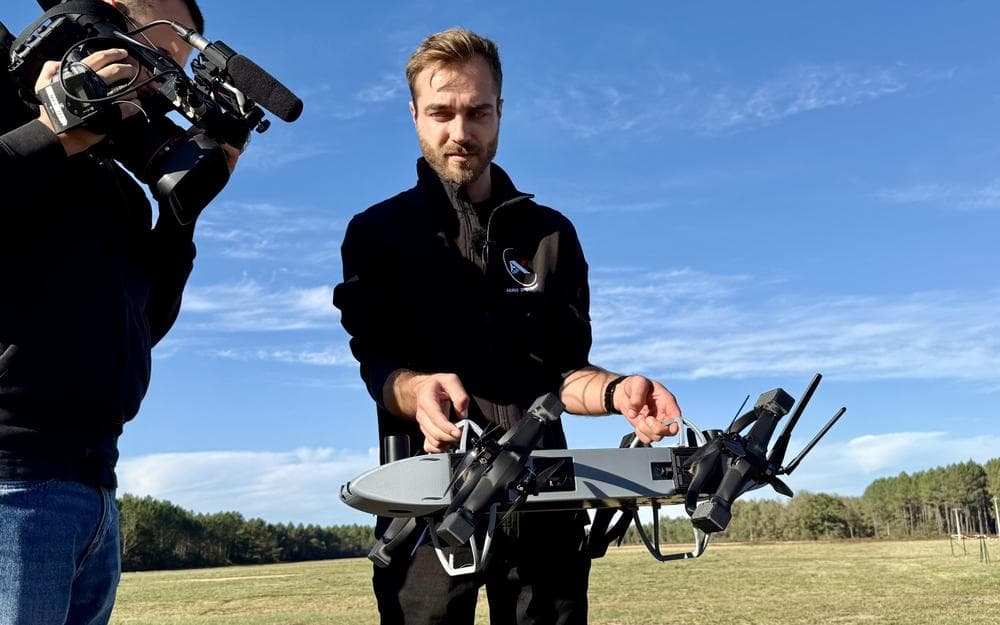
The Bordeaux-based French startup, founded in 2020 by engineering graduates Clément Picaud and Hugo Mayounove, has built its AERIX T-16 propulsion unit around a core mechanical argument: conventional fixed rotors force a drone to tilt its entire body to redirect thrust, and that tilt is both a time cost and a precision liability. The T-16 breaks that dependency. Each rotor pivots on a ball-and-socket joint with no angular limits, redirecting thrust vectors in real time without rotating the airframe. The drone's body stays level while it accelerates sideways, holds position while rotating a full 360 degrees in yaw, or sprints forward while actively correcting for crosswind, rated up to 100 km/h.
The performance figures Aerix cites are racing-relevant, at least on paper. The T-16 delivers 3.2 kg of thrust per unit with acceleration rated at 3.5 G, and the AXS-µ1, the compact platform built around multiple T-16 units in a 40 cm by 40 cm frame, reaches 200 km/h in under three seconds. The system provides sub-degree angular control across all three axes simultaneously, full roll, pitch, and yaw, with centimeter-level positional precision. "Inspired by a gyroscope, we're developing a new type of drone propulsion that delivers significantly improved flight capabilities," Picaud said. "Able to travel at high speeds with great mobility, it will be ideal for complex environments and missions."
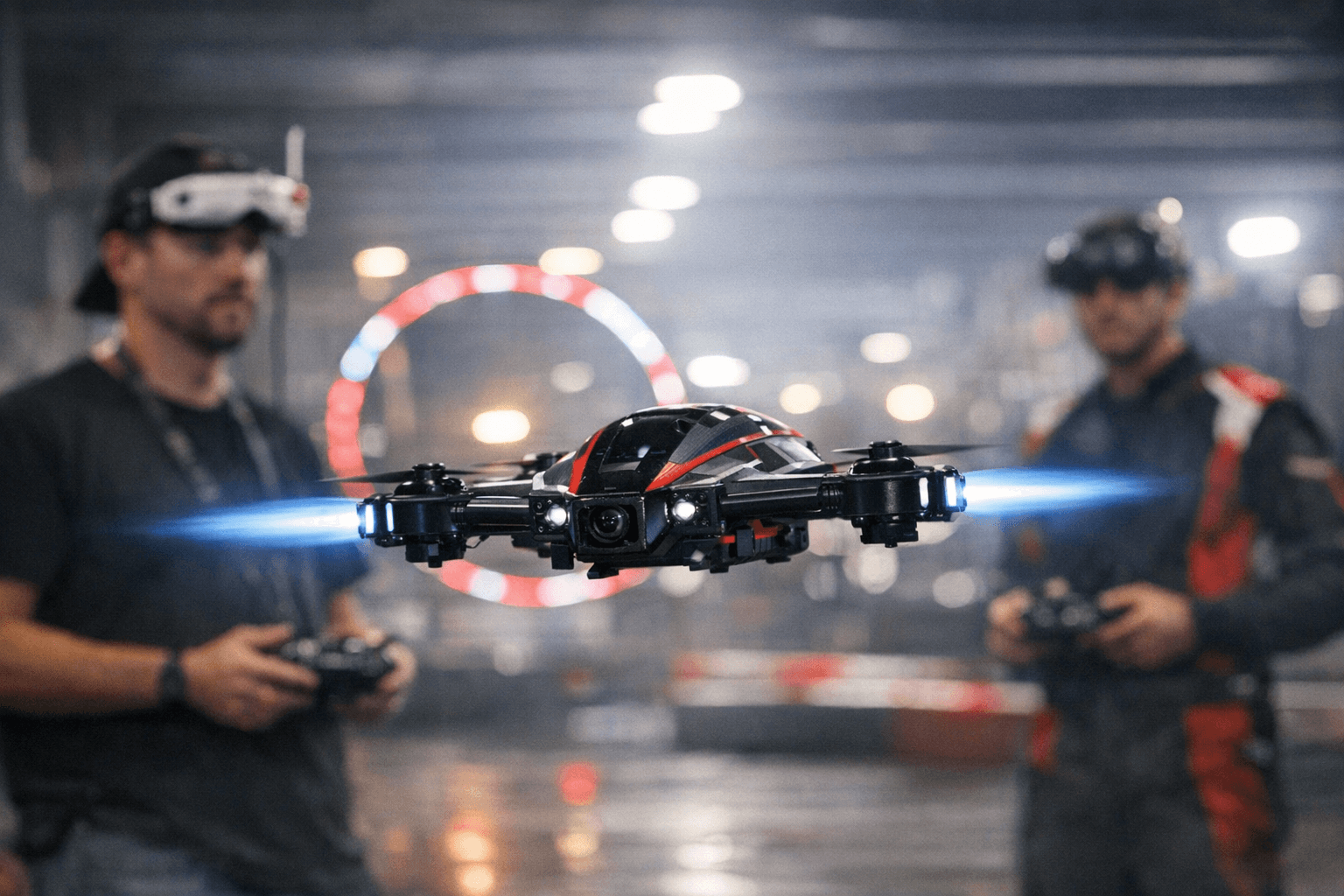
The racing question is sharper than the military applications Aerix primarily targets. Competitive 5-inch FPV race quads, running 2306-series motors on 6S lithium polymer packs, routinely generate thrust-to-weight ratios north of 8:1 and sustain directional corrections that exceed 10 G in controlled conditions. Aerix's 3.5 G figure suggests the T-16 architecture currently trades peak acceleration headroom for directional freedom. That tradeoff may be acceptable, or even advantageous, in course sections where no-tilt lateral strafing through tight chicanes or side-entry gates eliminates the angular wind-up that conventional quads must execute before each direction change. Where today's course designers cannot place a horizontal slide gate because no existing quad can navigate it level, Aerix's system opens a design dimension that has never existed in competition.
The survivability picture is more complex. The ball-and-socket mechanical vectoring adds moving parts at the propulsion layer, components that must absorb gate-brush and debris contact during a race. Standard 5-inch race frames rely on a fixed-rotor architecture with established crash-and-replace economics; a pilot can swap a snapped arm in minutes. How the T-16's pivot mechanism holds up after a hard gate strike has no public test record. Thermal performance under the sustained maximum-thrust intervals of a three-minute race heat is similarly uncharacterized in available data.
Aerix secured €5 million in fresh funding in early March 2026, led by Odyssée Venture, to move from prototype to industrial production, and the AXS-µ1 platform claimed the Prix de l'Innovation Air et Espace de l'Aéro-Club de France in 2024. The technology's primary commercial case remains counter-drone and defense applications, where the 20-kilometer range, 15-minute powered endurance, and inverted-flight capability represent clear operational advantages over any race course metric.
But the racing DNA cannot be dismissed. The AXS-µ1 already supports FPV piloting mode, and the T-16 architecture's decoupling of heading from thrust direction is the kind of mechanical premise that eventually forces a rulebook conversation. Whether Aerix brings that conversation to a race director before it brings it to a procurement officer may be the only scheduling question that separates a footnote from a category reset.
This article was produced by Prism’s automated news system from verified source data, official records, and press releases, then run through automated quality and moderation checks before publishing. The system is built and supervised by the people who set the standards it runs under. Read our full AI policy.
Did this article answer your question?