AI Drones Beat Human Champions, Reshaping FPV Racing Landscape
TU Delft’s MAVLab autonomous racer beat three former DCL world champions, hit 95.8 km/h and lapped a 170m course twice in 17 seconds, forcing leagues to rethink formats and hardware.
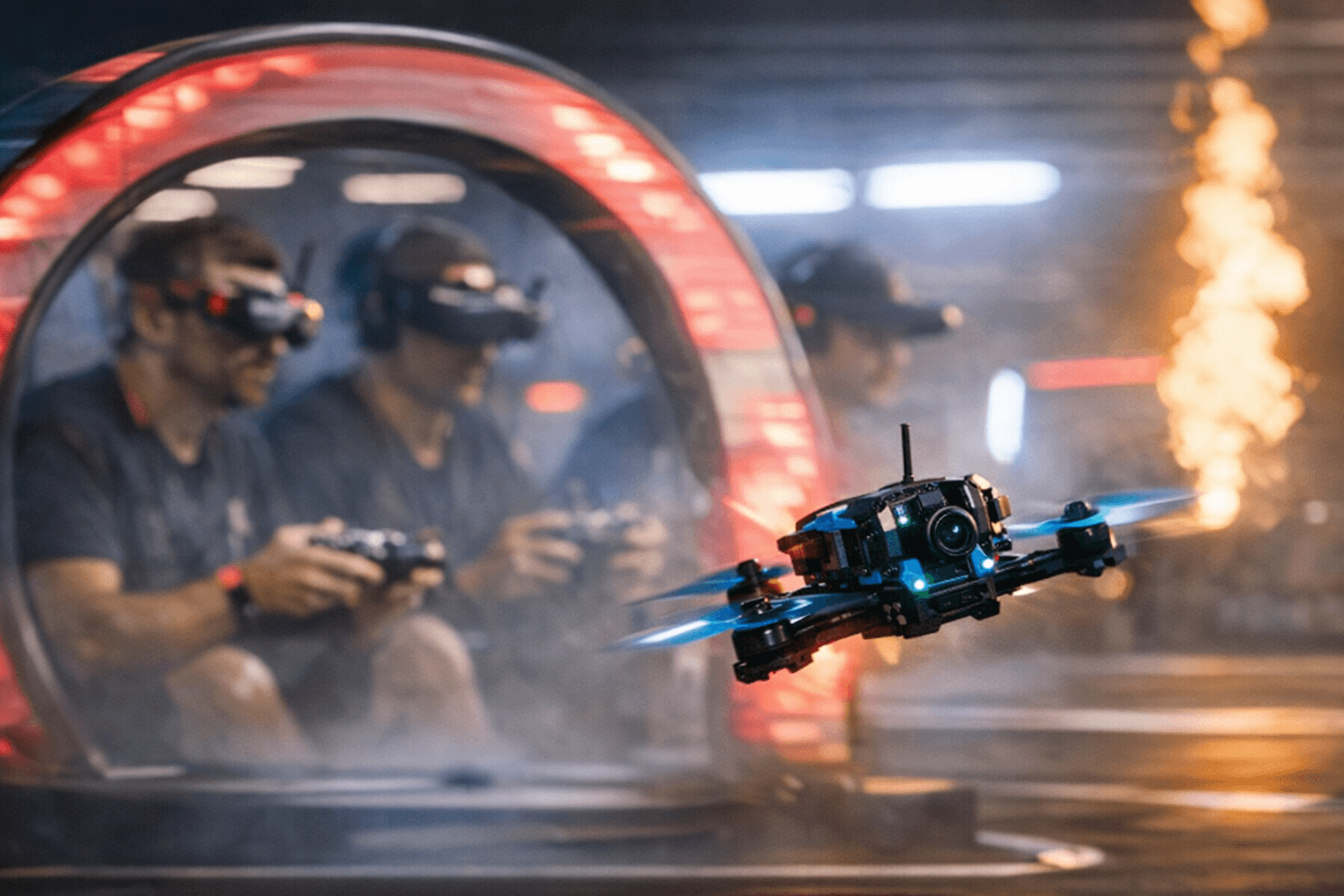
TU Delft’s MAVLab did what scouts and skeptics said wouldn’t happen in a proper arena: it beat three former Drone Champions League world champions in an AI-vs-human knockout and clocked a peak speed of 95.8 km/h during the April 14, 2025 finale sequence, after winning the AI Grand Challenge time trial. MAVLab’s run included a headline performance on the 170-meter course, completing two laps and 22 gates in 17 seconds, a raw performance marker that exposed how quickly autonomy has closed the gap on elite FPV reflexes.
The event architecture made the comparison meaningful. The A2RL x DCL Autonomous Drone Championship ran April 11–12, 2025 at ADNEC Marina Hall in Abu Dhabi with a US$1 million prize pool and 14 finalist teams, and featured a structured slate: an AI Grand Challenge time trial on a 170-meter track, an AI vs Human knockout, a multi-drone race, and a drag race. Organizers required that each finalist fly a standardized drone built around an NVIDIA Jetson Orin NX module with a single forward-facing camera and an IMU, and explicitly barred external control. The Abu Dhabi Media Office called the AI-vs-human duel "the most complex ever staged," and event officials repeatedly cited harsh track conditions including irregular lighting, minimal visual markers, and rolling-shutter camera challenges.
That hardware constraint was the point. Teams raced the same chassis and compute stack so competitive edges came from perception, control and model generalization rather than bespoke airframes. Yaw.news and event materials highlighted the single forward-looking camera plus IMU rule as intentional, mirroring an FPV pilot’s forward view and forcing autonomy to prioritize robust vision stacks. The championship recap showed autonomy’s potential at scale: event notes recorded autonomous runs exceeding 150 km/h in some formats, MAVLab taking the AI Grand Challenge and AI Drag Race, and TII Racing winning the Multi-Drone Race under the same standardized regime.
The championship also left fingerprints on the sport beyond lap times. Hundreds of teams filtered through qualifiers for 14 final slots, showing a competitive pipeline; DCL paired the finals with a STEM outreach program supervised by the Advanced Technology Research Council and UNICEF that involved 100+ Emirati students and resulted in more than 60 percent earning a Trusted Operator certification. Faisal Al Bannai framed the series as proving innovation "in the real world," a line organizers used to justify pushing autonomy into spectator-facing formats.
For pilots, engineers and league directors the implications are concrete: expect separate AI and human classes, hybrid mixed-reality matches that pair pilots with co-pilots, sim-based qualification pipelines, and a market push for efficient motor controllers, higher-throughput video links, and lightweight lidar or stereo stacks. The Abu Dhabi finals supplied the playbook and the proof points: uniform hardware, a US$1 million prize pool, and a knockout in which software outpaced elite human reaction and race craft.
This article was produced by Prism’s automated news system from verified source data, official records, and press releases, then run through automated quality and moderation checks before publishing. The system is built and supervised by the people who set the standards it runs under. Read our full AI policy.
Did this article answer your question?