U.S. Navy MQ-4C Triton vanishes over Gulf after emergency descent from 52,000 feet
An MQ-4C Triton, callsign VVPE804 (registration 169804), squawked 7400 then 7700 during a patrol and vanished from public trackers after a 52,000-to-~9,500-foot descent on April 9, 2026.
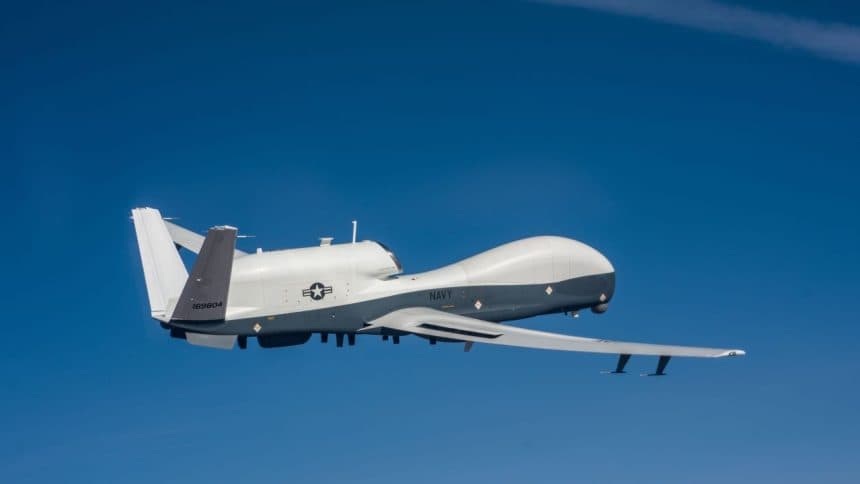
An MQ-4C Triton operating as callsign VVPE804, registration 169804, squawked a lost-link transponder code and then a general-emergency code before disappearing from commercial flight trackers during a patrol over the Strait of Hormuz. Public ADS-B and Flightradar24 replay snapshots show the Triton departing Naval Air Station Sigonella in Sicily for a roughly three-hour sortie, beginning a rapid descent from cruise altitude near 52,000 feet to roughly 9,500–12,750 feet in about 15 minutes on April 9, 2026, after which public telemetry ended.
OSINT track replays and ADS-B exchange packet snapshots plotted the aircraft turning toward Iranian territorial approaches in the final plotted phase of descent; no confirming statement assigning cause or declaring a loss was issued by U.S. Navy, U.S. Central Command, or U.S. 5th Fleet during the immediate reporting window. The transponder sequence seen in public logs moved from code 7400, reported in unmanned-system OSINT logs as a lost-link indicator, to 7700, the international general-emergency squawk used under ICAO and FAA procedures, before the signal vanished.
The incident echoes the most relevant precedent in the region: the June 20, 2019 shootdown of an RQ-4 BAMS-D Global Hawk derivative over the Strait of Hormuz. That 2019 event, driven to a near-confrontation and formally discussed by CENTCOM leadership, remains the benchmark for how contested maritime airspace can produce sudden losses of high-altitude ISR assets. Analysts have listed a range of plausible technical causes for the April 9 disappearance, including mechanical failure, sustained comms disruption or RF/electronic attack, and kinetic engagement; public telemetry in this case showed a sustained loss-of-function episode rather than a momentary blip.
For the drone-racing community the operational lesson is practical and measurable: contested RF and degraded-link environments can cascade into uncontrolled flight profiles even on HALE platforms worth headline valuations. Public reporting commonly cites an approximate per-airframe figure near $200 million and Navy procurement planning of roughly 27 Tritons with about 20 delivered by early 2024, underscoring the strategic and fiscal stakes that can drive regulatory reaction after a loss over busy sea lanes.
Translate this to FPV event design and product engineering: enforce multi-path telemetry, hard-tested failsafes, and explicit lost-link envelopes. Small-system mitigations that have clear technical precedent include GPS return-to-home logic, controlled descent or ballistic recovery, parachute systems, conservative cut-throttle failsafes, and redundant control/video links such as ExpressLRS, Crossfire, or adaptive OcuSync-type systems; frequency planning, antenna and ground-station placement, and NOTAM coordination remain immediate operational controls under FAA Remote ID rules (14 CFR Part 89) and Academy of Model Aeronautics guidance.
Follow-ups that will materially change the public picture include any official Navy or CENTCOM release, imagery or debris confirmation in the Persian Gulf/Strait of Hormuz region, and technical comment from NAVAIR or Northrop Grumman on lost-link autonomy for Triton-class systems. The hard take-away for race pilots and organizers is specific: build for link failure modes, document failsafe outcomes, and coordinate airspace and NOTAMs so a lost telemetry envelope becomes an engineering problem, not a public-safety one.
This article was produced by Prism’s automated news system from verified source data, official records, and press releases, then run through automated quality and moderation checks before publishing. The system is built and supervised by the people who set the standards it runs under. Read our full AI policy.
Did this article answer your question?