RoboMaster 2026 kicks off, university robotics teams compete across China
USTC's RoboWalker won the Hefei 3v3 title on March 22, beating 26 rivals in a 27-team field as RoboMaster 2026 regional stops train computer-vision and low-latency control talent.
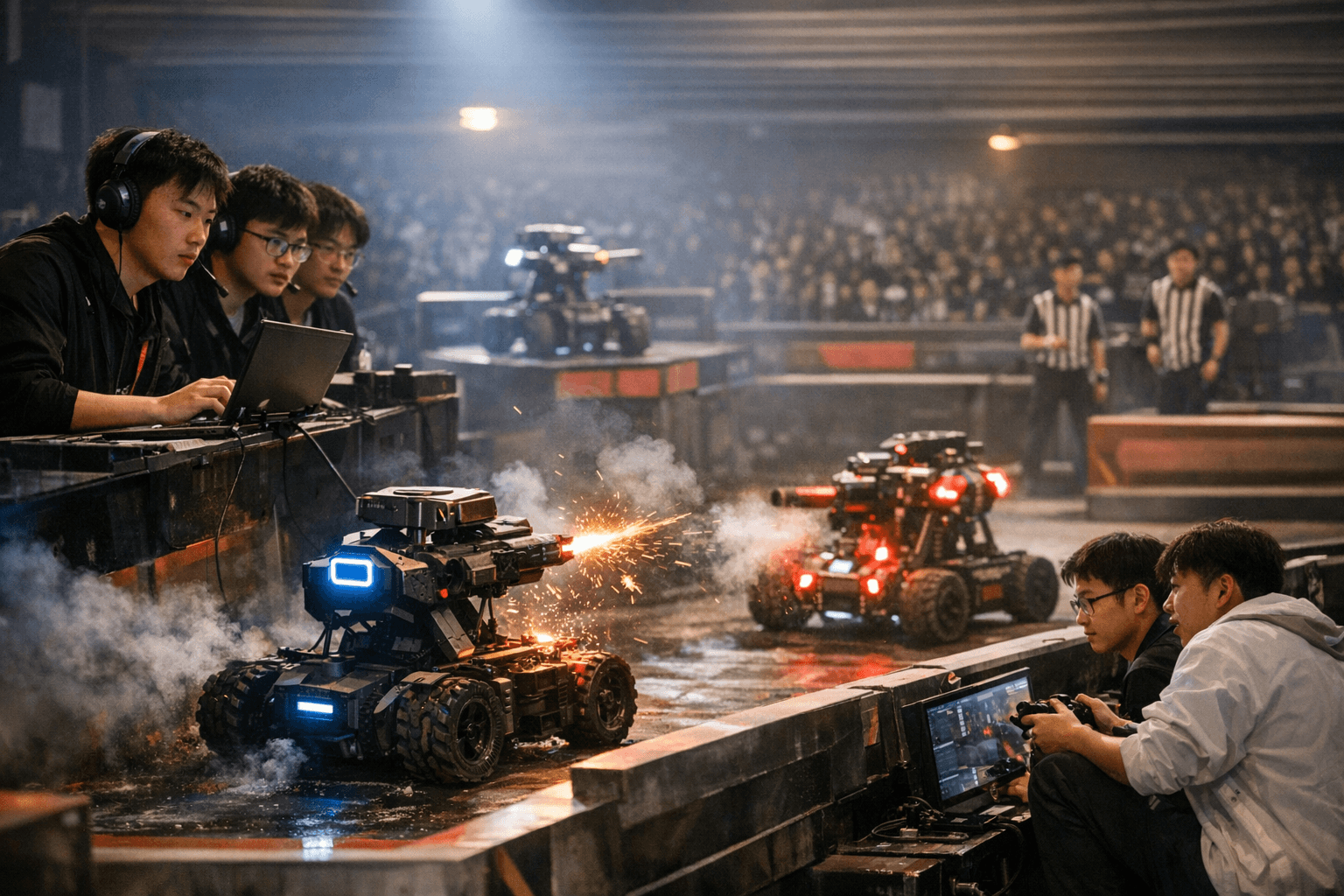
USTC's RoboWalker claimed the 3v3 crown at the Hefei RMUL stop on March 22, 2026, emerging from a 27-team field that drew roughly 500 participants and immediately spotlighting the practical engineering intensity RoboMaster is staging this season. The regional series, which opened registration from 18:00 October 29 to 18:00 November 13, 2025, is running across mainland China in March–April 2026 and was planned to include eight mainland sites as the primary development pipeline for university teams.
The Jiangsu station in Jiangyin ran March 27–29, 2026 and brought 31 universities and 685 faculty and students to the floor, with the opening ceremony attended by RoboMaster Organizing Committee chair Fu Mengyin and DJI RoboMaster R&D director Li Zhuoquan. The Shanghai Songjiang stop opened April 3, 2026 at the Shanghai University of Engineering Science Songjiang campus and assembled 37 university teams for a three-day slate of 3v3, infantry 1v1, and engineering challenge events. Student captains, including Shanghai Jiao Tong University captain Wang Zhongfu and East China University of Science and Technology captain Zhou Nanjian, were cited in local coverage describing the matches as a "real-world" engineering crucible that exposed stability and targeting issues to be fixed.
RoboMaster's three core RMUL events at regional stops — the 3v3 confrontation, the Infantry 1v1, and the Engineering Challenge — require teams to field multiple robot classes, from infantry or "hero" chassis to sentry and engineer robots, and to pass technical assessment checkpoints and referee-system tests before match play. Those checkpoints, plus the competition's referee kits and discounted official components provided to teams, mirror the hardware, timing, and safety regimes race organizers in drone sports must manage on event day.
The technical curriculum on display maps directly to drone-racing needs: computer vision and real-time control work practiced in RoboMaster matches translate to target tracking and low-latency flight-controller loops; embedded systems and autonomy modules used in robot coordination parallel the development of autonomous assists, collision-avoidance overlays, and race-timing telemetry; and the Intelligent UAV events and UAV mission modules historically present in RoboMaster seasons show an explicit aerial competency that can migrate into FPV and mission-planning tooling. Official RMUL guidance also frames the economic investment: per-robot build costs are estimated at about 10,000–20,000 CNY, and teams budget for travel across regional sites.
The RMUL regional series feeds into the RoboMaster University Championship national circuit: the 2025 RMUC national finals ended in Shenzhen on August 3, 2025 with Shanghai Jiao Tong University's Jiaolong team winning the title, underscoring the pathway from regional lab work to national competition. With DJI's founding role and ongoing R&D participation, RoboMaster 2026 is functioning less like a classroom showcase and more like a high-throughput talent pipeline for computer-vision engineers, embedded-systems developers, and low-latency control specialists who will shape the next wave of drone-racing hardware, autonomous assists, and race-day operations.
This article was produced by Prism’s automated news system from verified source data, official records, and press releases, then run through automated quality and moderation checks before publishing. The system is built and supervised by the people who set the standards it runs under. Read our full AI policy.
Did this article answer your question?