APX-ATAKAN Leads 2026 Belgian Championship Heat 1 With Blazing 38-Second Lap
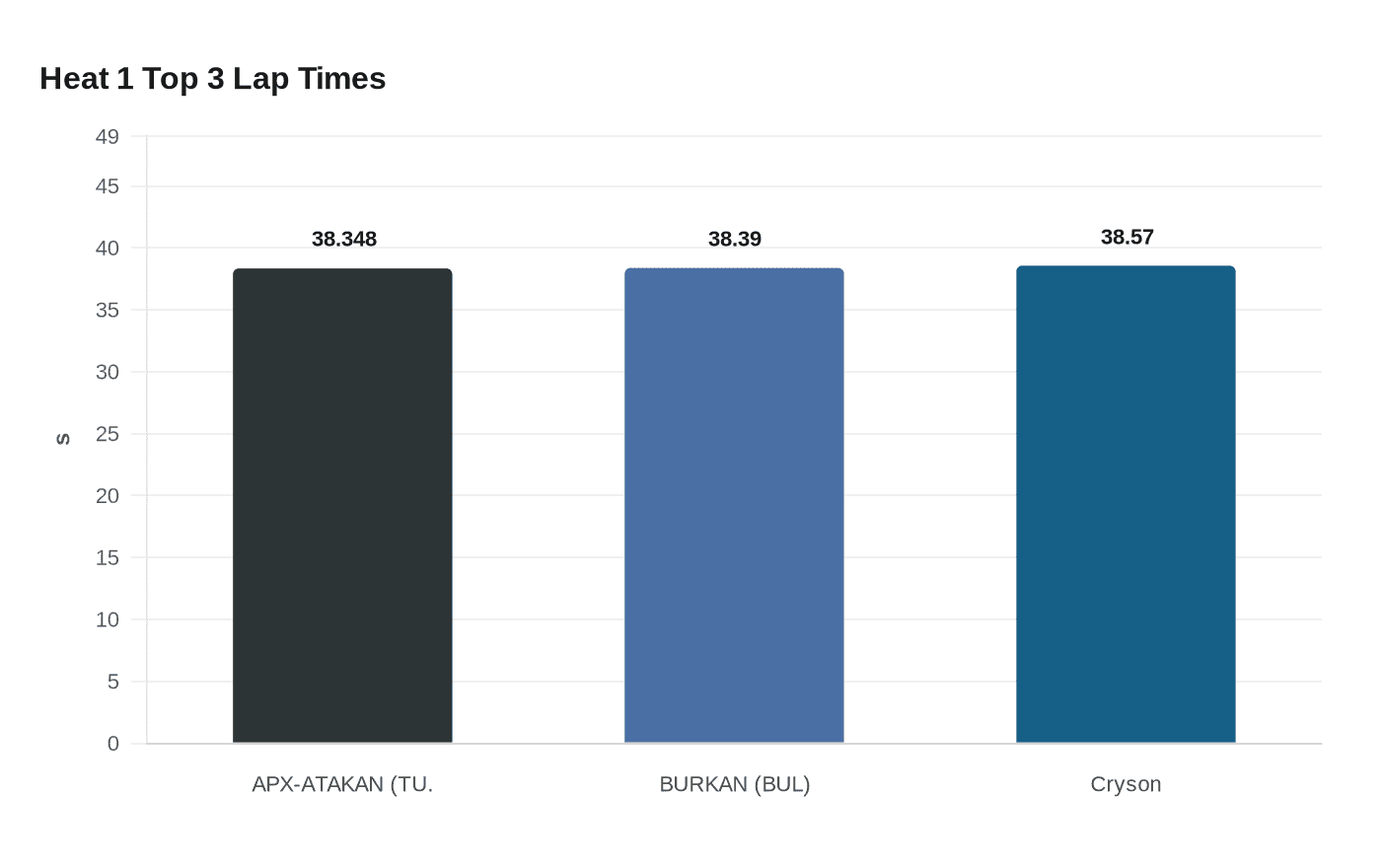
APX-ATAKAN's 38.348-second lap tops 2026 Belgian Championship Heat 1, edging Bulgaria's BURKAN by just 42 milliseconds on the VelociDrone leaderboard.
Forty-two milliseconds. That razor-thin margin separates APX-ATAKAN of Turkey from Bulgaria's BURKAN on the VelociDrone leaderboard for the 2026 Open Belgian Championship Heat 1, and in sim racing, 42 milliseconds is not a rounding error. It is a complete philosophy of flight.
APX-ATAKAN posted the heat's fastest lap at 38.348 seconds on March 29, 2026, establishing the benchmark every pilot in this field is now chasing. BURKAN responded the same day with a 38.390, a time that would lead nearly any other heat in sim competition this season. Cryson, posting a 38.570 on March 25, had already signaled this track would reward precision over raw speed. The 222-millisecond gap between first and third place tells you the margins are compressing at the top, and compressing fast.
The sub-39-second barrier has become the dividing line between contenders and the rest of the Heat 1 field. The entries clustering between March 29 and 31 confirm this was no single-day hot streak. The fastest pilots returned repeatedly to the same track and shaved fractions of seconds through iteration rather than luck. That repetition matters to anyone evaluating sim performance as a predictor of live racing: a pilot who posts sub-39 across multiple sessions has internalized the track's rhythm, not stumbled onto a clean lap.
Craft model choice is doing real work in these results. The Bahamut and Five33 Switchback appear prominently among the fastest runs, alongside entries on the Fox Crooked and TBS Spec. Each carries different handling characteristics in VelociDrone's physics engine. The Switchback rewards aggressive cornering lines, while more stable platforms like the Bahamut allow pilots to carry speed through technical gate sequences without the yaw corrections that bleed tenths. APX-ATAKAN's 38.348 suggests a setup optimized for gate-to-gate efficiency rather than peak straightaway velocity; the flat 38.3 puts the emphasis on carrying momentum through the entire lap rather than banking on a single fast sector.
The geographic spread of the top entries tells a broader story about where sim racing talent is concentrating. Turkey, Bulgaria, France, Belgium, China, the United States, and Mexico all appear on the leaderboard, making this as international a time-trial field as any physical event the Belgian circuit has produced. APX-ATAKAN's lead represents a strong showing for Turkish sim specialists, who have been increasingly visible in European virtual qualification events. The Belgian entrants, racing on home-country terrain by name if not by physics, face the uncomfortable reality that the fastest laps are coming from across the continent.
For pilots currently sitting in the 39.2 to 39.8 range and targeting sub-39, the leaderboard offers a clear diagnostic. The gap from Cryson's 38.570 to APX-ATAKAN's 38.348 spans just over two-tenths of a second, which on a Heat 1 circuit typically lives in one or two gate pairings rather than distributed across the whole lap. Identifying the specific segment where throttle application softens or a line through a tight sequence forces a correction, and then drilling that segment in isolation, is what separates a 38.3 from a 39.4. Cryson's time, posted four days before the March 29 cluster, suggests the top pilots were still refining approach angles in the final days before the heat deadline.
VelociDrone's public leaderboard is now functioning as both a scouting tool and a seeding mechanism for hybrid virtual-physical events. The same model DCL has been developing, using sim times to seed live heats, makes APX-ATAKAN's 38.348 more than an online entry. It is a credential.
This article was produced by Prism’s automated news system from verified source data, official records, and press releases, then run through automated quality and moderation checks before publishing. The system is built and supervised by the people who set the standards it runs under. Read our full AI policy.
Did this article answer your question?