FPV Drone Captures Ankara's 1920 Run Around Atatürk's Iconic Tomb
An FPV quad shadowing 1,188 runners around Atatürk's mausoleum in Ankara doubles as a technical blueprint for cinematic urban drone work.
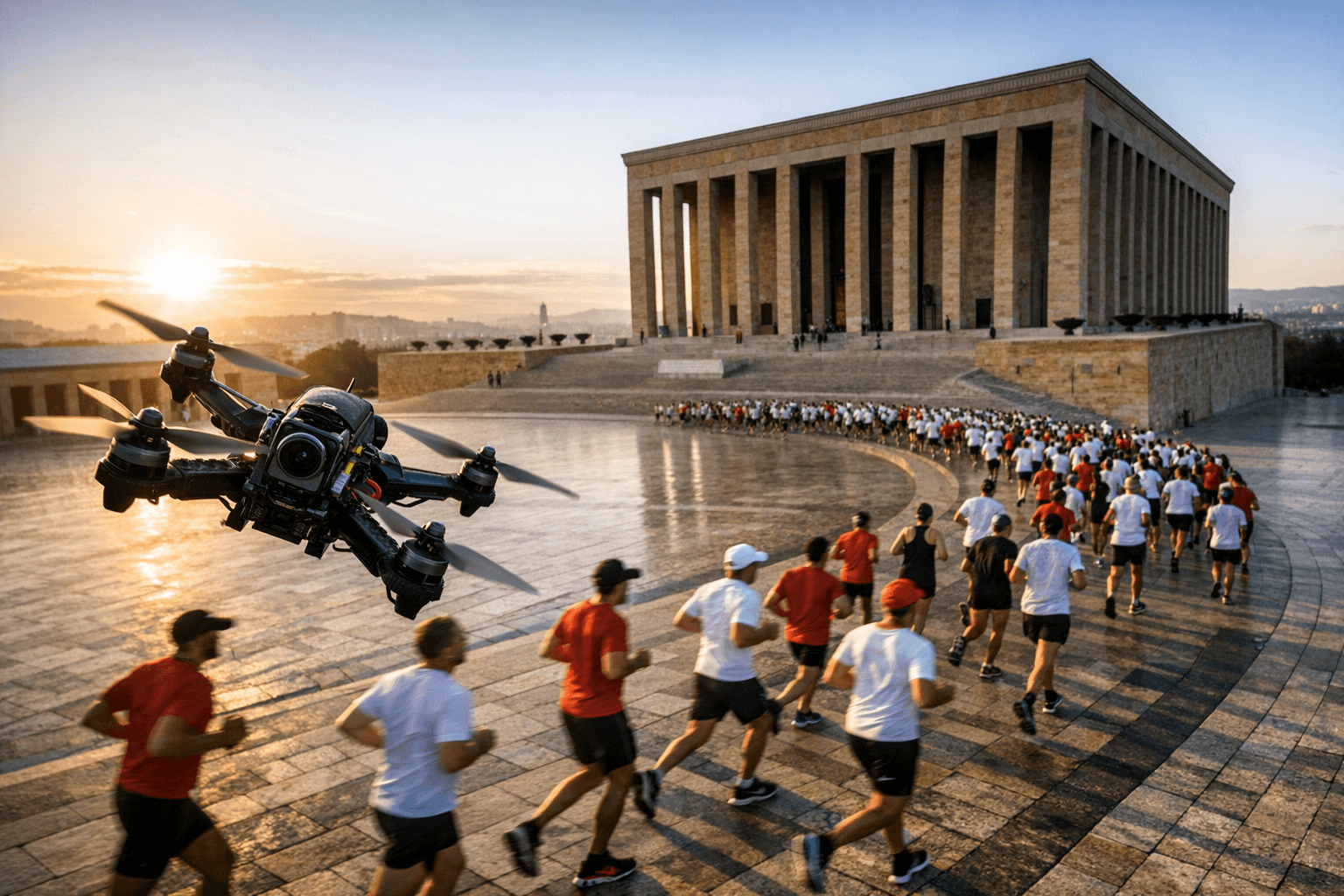
Flying low enough to show individual race bibs and then pulling back to frame Anıtkabir's entire stone perimeter in a single arc, the FPV operator behind Anadolu Agency's 1920 Run coverage on April 5 produced footage that functions as both a commemorative document and a technical brief for any pilot serious about cinematic work in dense public environments.
The race, marking Anadolu Agency's 106th anniversary, drew 1,188 domestic and international athletes to a 10-kilometer loop starting at the agency's Cankaya headquarters, encircling the mausoleum of Mustafa Kemal Ataturk, and finishing where it began. Ankara Governor Vasip Sahin and Anadolu CEO Serdar Karagoz fired the starting gun at 10 am local time, with coverage running live on TRT Spor Yildiz. Derya Kunur claimed the women's category in 34 minutes and 54 seconds; both category winners took home 100,000 Turkish liras, approximately $2,255. The footage was placed for editorial licensing through Newsflare.
For FPV pilots, the clip is worth dissecting frame by frame. The course layout around Anıtkabir functions as a proxy race circuit: consistent apex points anchored by the monument's perimeter walls, Ankara's hilly urban terrain producing natural elevation changes, and pack density through the early kilometers that forces the operator to manage separation the same way a chase pilot manages proximity in a multi-drone shoot. The difference is consequence. A contact incident here carries stakes a race pack crash does not, and that calculus shows in every altitude and input choice the footage reveals.
The operator held roughly two to five meters throughout the low monument passes, which is the cinematic FPV sweet spot for events of this kind. It is close enough to generate real parallax and perceived speed against the runners; it is high enough to recover from a gust or a stall before a bystander becomes an obstacle. The cornering cadence around the mausoleum perimeter shows deliberate input smoothing. No sharp roll snaps, the kind race pilots default to for gate entries, because abrupt attitude changes read as jitter on a non-stabilized camera and compress the safety margin when crowds line the flight path.
Several specific setup choices likely produced the look. A wide field of view in the 120-to-130-degree range matches the exaggerated foreground-to-background compression visible in the group passes and gives the operator a larger visual buffer during proximity work. On a bright April morning in Ankara, a neutral density filter around ND16 would have been necessary to hold the 180-degree shutter rule at 60 frames per second, keeping motion blur natural rather than strobed. Rates and expo would be dialed well below race-day settings: lower expo softens the breakout from center stick and prevents the micro-corrections that show as wobble in longer focal pulls. A flat or log color profile captures the contrast between Anıtkabir's white marble and the shadowed city streets without clipping the sky, giving editors latitude in post.
The tradeoff against pure speed racing is direct. Everything that makes this footage smooth, the wide field of view, the conservative rates, the ND-forced longer shutter, slows the operator's response to an unexpected obstacle. A race pilot executing a split-S recovery through gates runs high rates and no ND precisely because the inputs need to be instantaneous. The Ankara operator accepted the inverse tradeoff for the cinematic result the job required.
Anadolu Agency's decision to commission FPV coverage for a 1,188-person public race and distribute it under an editorial license is the commercial signal worth noting. The agency was founded on April 6, 1920 as a wartime communications instrument; 106 years later it is using a racing-derived camera platform to document its own anniversary. For pilots who can document a clean safety record and a repeatable urban workflow, that market is already paying.
This article was produced by Prism’s automated news system from verified source data, official records, and press releases, then run through automated quality and moderation checks before publishing. The system is built and supervised by the people who set the standards it runs under. Read our full AI policy.
Did this article answer your question?