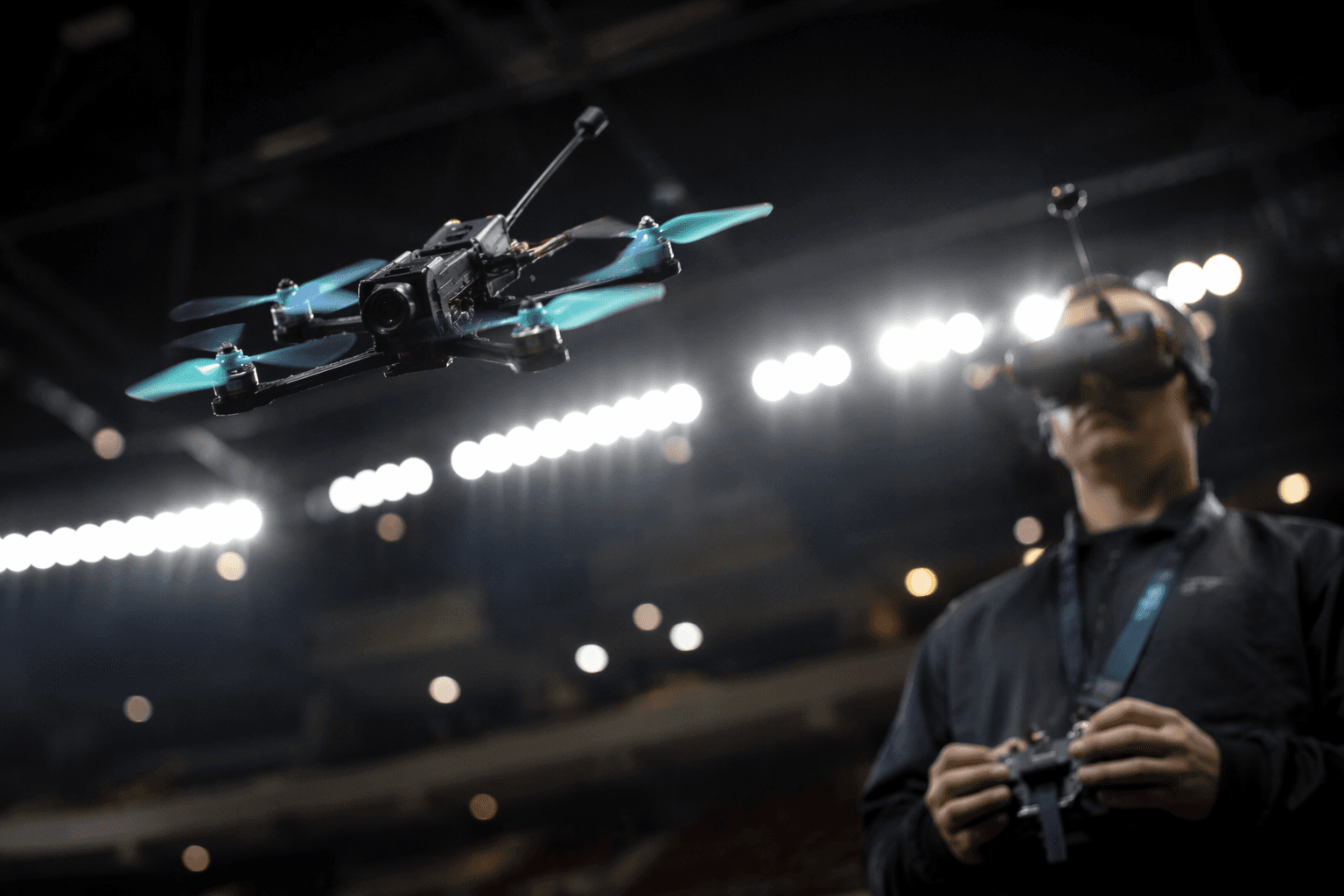
Drone Racing League was built to make speed easy to watch
Drone Racing League turned raw FPV speed into a broadcast sport by redesigning the course, the format, and the places fans watch from.

Nicholas Horbaczewski’s spark came in 2015 at an amateur race behind a Long Island Home Depot, where the sport’s appeal was obvious but the viewing challenge was even bigger: the action was too fast, too high, and too far away unless it was built around the audience from the start.
How drone racing made speed legible
The Drone Racing League answered that challenge with first-person-view goggles for pilots, tightly engineered gates and checkpoints, and courses designed as a sequence of visual decisions instead of a blur of motion. Drone racing is not just about raw speed, it is about making a pilot’s line through the course understandable in real time. The league’s format turns flight into something viewers can follow: drones collect points in heats, then advance toward a championship final.
That shift separates drone racing from older air-racing models. In traditional aircraft races, the vehicles can disappear into the sky and the drama becomes hard to read; in DRL’s version, the pilot’s eye line becomes the show. The sport is built so the fan sees the same tension the pilot feels, whether the drone is threading a gate or trying to keep pace through a technical section without losing control.

From parking-lot spectacle to branded arenas
The league’s first event took place on July 11, 2015, at an abandoned power station on the Hudson River nicknamed “The Gates of Hell.” Early DRL events moved through abandoned power plants, malls, laboratories, paper mills, and auto plants, including the Hawthorne Mall in Los Angeles, a laboratory in New York, a paper mill in Hamilton, Ohio, and an auto plant in Detroit. They staged speed inside architecture that looked industrial, futuristic, and television-ready.
That venue logic carried into the league’s first season, which launched in January 2016, and later into more polished, arena-style production. DRL eventually expanded into iconic sports arenas, international landmarks, and even palaces in London, a progression that helped the sport shed the look of a backyard gadget demo. At a test event at an abandoned New York power plant, pilot Ummagawd flew inside the kind of raw space that gave the league its visual edge.
Why the race format matters as much as the speed
The race itself is what makes the broadcast product work. In 2016, DRL drones were 800-gram quadcopters, six at a time, running a 300-foot straightaway and reaching about 80 mph, but the real challenge was not top speed. Pilots had to manage battery life and slow down in the technical sections just to finish cleanly, which means the race rewards control, rhythm, and line choice as much as aggression.
Because the drones must navigate obstacles, survive the course, and earn advancement through heats, the competition gives viewers a clear story arc: who survived the opening burst, who made the cleaner line, and who earned a place in the final.
The business case behind the spectacle
In 2015, Miami Dolphins owner Stephen Ross invested $1 million in the Drone Racing League through RSE Ventures, and Matt Higgins framed the idea as “Twitch meets Formula One.” That phrase still captures the league’s commercial logic: it blends reflex-driven competition with the kind of viewer experience that can travel beyond a niche hobby and into a repeatable entertainment product.

DRL had $12 million in venture capital in 2016, a figure that suggests the sport was already being priced as an emerging media property rather than a one-off novelty. DRL calls itself the world’s premier, professional drone racing property.
From underground experiment to global audience
By 2022, DRL had reached 75 million global fans and was airing in 250 million households in more than 140 countries.
This article was produced by Prism’s automated news system from verified source data, official records, and press releases, then run through automated quality and moderation checks before publishing. The system is built and supervised by the people who set the standards it runs under. Read our full AI policy.
Did this article answer your question?