DWIM Quarterly Q1 2026: Tactical FPV Attacks and the Operational Lessons for Counter‑Drone Forces
An Iranian-backed militia's FPV strike on a U.S. Black Hawk shows how battlefield drone innovations are now setting the agenda for competitive racing's rules, gear, and safety planning.
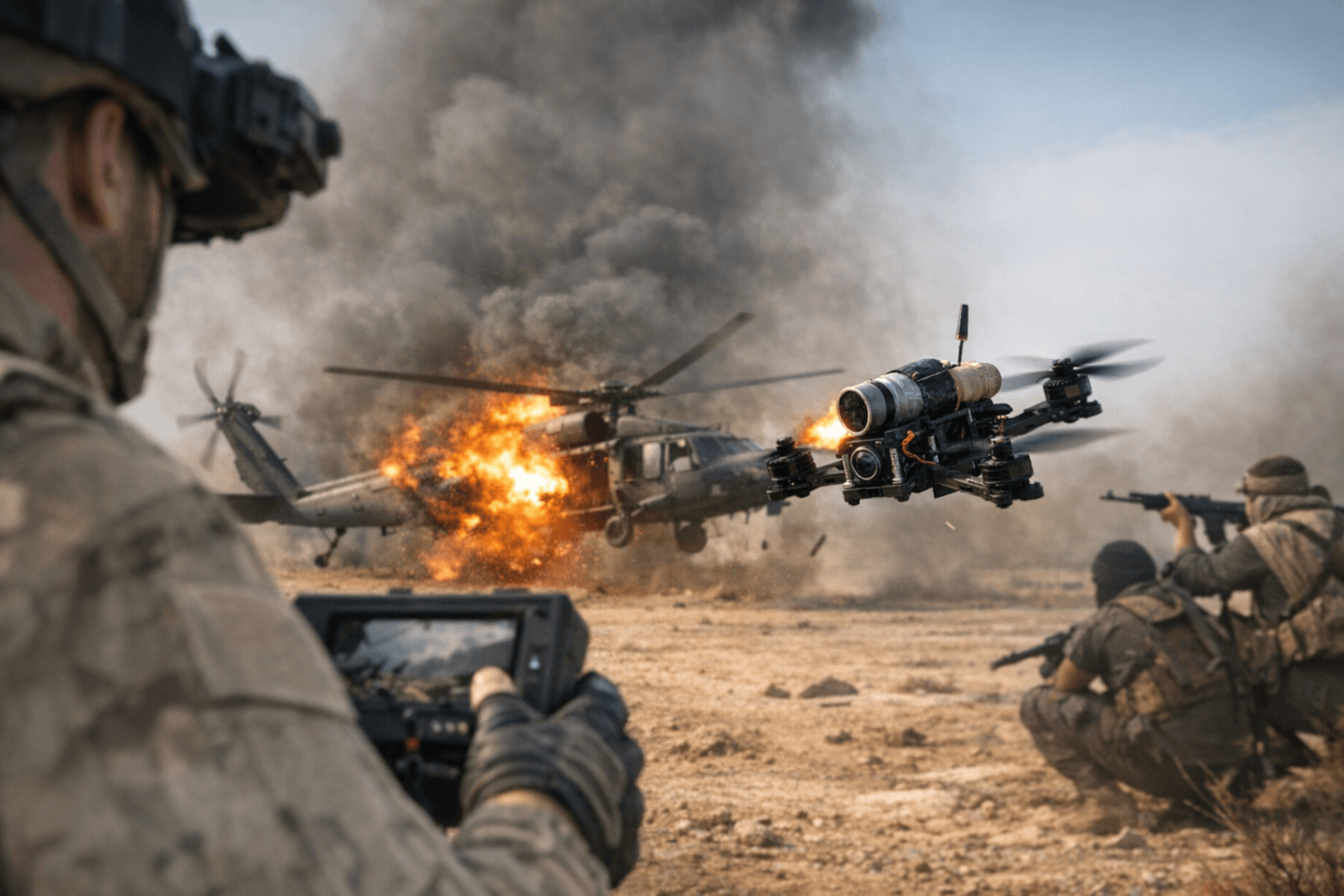
A single FPV drone, guided through a live first-person video feed, crossed the perimeter of one of the most defended American installations in Iraq and struck a parked HH-60M medevac helicopter at the Victory Base Complex near Baghdad on March 24, 2026. The same attack also damaged an AN/MPQ-64 Sentinel air-defense radar sitting nearby, the sensor explicitly tasked with detecting incoming aerial threats. It was not a lucky shot. It was a coordinated double-tap that stripped both rescue capability and situational awareness in a single sortie, and the DWIM Q1 2026 quarterly assessment, published April 3, labeled it a strategic inflection point in the maturation of low-cost strike UAS. For pilots and engineers who build, race, and regulate FPV systems, that label is not a distant headline. It is a direct line back to the technology stack sitting in every race pit.
The DWIM report synthesizes three months of OSINT incident data and industrial tracking through the end of March 2026. Its core argument: the tactical effectiveness of FPV and loitering systems is now underwritten by the same open-source avionics, low-cost airframes, and high-performance imaging that powers competitive FPV. Understanding where the battlefield has diverged from the sport, and where it is still running on shared hardware, is the clearest competitive and regulatory edge available heading into the rest of 2026.
Fiber-Optic Control Links: What Jam-Proof Actually Means
The most consequential technical shift documented in the Q1 report is the battlefield adoption of fiber-optic control and video systems. Rather than transmitting control signals over radio frequencies, fiber-optic drones unspool a thin optical cable during flight, routing both command-and-control and HD downlink video as pulses of light. The signal cannot be jammed, spoofed, or geolocated because it never enters the electromagnetic spectrum.
Ukrainian firm General Chereshnya demonstrated the operational maturity of this approach on March 20, 2026, when a fiber-optic FPV drone destroyed a Russian Ka-52 attack helicopter near Nadiivka. On January 27, U.S. Marine Expeditionary Force and the Defense Innovation Unit had already run an over-water test of fiber-optic FPV systems at Camp Pendleton, specifically to evaluate performance in GPS-denied and communications-denied environments.
On a race course, fiber-optic tethers are a non-starter: no cable dispenser is compatible with competitive lap times. But the operational logic behind them exposes a genuine gap in how racing thinks about RF resilience. Multi-pilot events running dozens of video transmitters in a confined airspace already produce enough frequency congestion to degrade video and spike latency. The battlefield's response, eliminating RF entirely, is a design signal that competition safety plans and venue frequency coordination must account for when evaluating failsafe protocols and pilot protection standards.
Low-Latency HD Video and Event Cameras: Racing's Edge Meets the Battlefield
DWIM identifies improved imaging and targeting integration as a core driver of battlefield effectiveness, specifically low-latency HD video and event cameras optimized for autonomous terminal guidance. Event cameras detect changes in pixel luminance at microsecond resolution rather than capturing full frames, generating targeting data far faster than conventional sensors with a fraction of the bandwidth overhead.
Competitive FPV racing has already made latency the central hardware arms race of the last three seasons. The progression from analog to digital systems, and the subsequent battles between competing digital link standards over millisecond differences in glass-to-glass delay, reflects the same understanding that fractional latency changes determine gate position. What the battlefield layer adds is the event-camera architecture feeding directly into autonomous obstacle avoidance and terminal guidance rather than a human pilot. For race operations, this is not immediate race-kit technology. It is, however, the technical trajectory that autonomous racing formats and equipment rules written today need to account for before the next two to three seasons render current rulebooks obsolete.
Open-Source Avionics and Attritable Airframes: The Shared Supply Chain Problem
One of DWIM's central industrial arguments is that battlefield FPV effectiveness is underwritten by accessibility. Inexpensive airframes built on open-source flight controller firmware, the same Betaflight and ArduPilot ecosystems powering competitive builds, have made attritable strike drones reproducible at scale. The unit economics that allow state and non-state actors to absorb losses and maintain sortie rates are the same economics that allow club racers to rebuild a competitive 5-inch quad for under $150.
That shared supply chain is precisely why DWIM urges the civil FPV community, event organizers, and component manufacturers to monitor export-control and regulatory changes closely. Governments responding to the VBC attack and the broader industrialization of Shahed-type loitering munitions will not draw clean distinctions between a purpose-built kamikaze drone and a competition-grade 5-inch. Regulatory turbulence in component sourcing, particularly for flight controllers and imaging sensors, is a near-term operational risk for league procurement teams and kit sponsors that demands contingency planning now rather than after policy moves.
Anti-Sensor Targeting Workflows: The Doctrine Behind the Double-Tap
The deliberate pairing of the HH-60M strike with damage to the AN/MPQ-64 Sentinel radar reflects a targeting doctrine the DWIM report treats as increasingly systematic: use low-cost FPV assets to degrade or destroy the sensors enabling counter-drone defense before or alongside a primary strike. Taking out radar and detection infrastructure extends the operational window for follow-on systems and degrades the defender's ability to classify subsequent threats.
For race event safety planning, the translation is direct. Venues relying on a single RF monitoring system or a single spectrum-analyzer operator carry the same single-point-of-failure vulnerability that the VBC attack exploited. Redundant detection architecture, combining spectrum monitoring, optical detection, and coordinated human spotters, is the race-ops equivalent of not parking your only radar in the same blast radius as your highest-value aircraft.
Saturation and the Shahed Model: When Volume Is the Weapon
Wide-scale Shahed-type kamikaze drone use against logistical hubs throughout Q1 2026 demonstrates the operational logic of mass: send enough low-cost one-way platforms and an acceptable fraction will breach any realistic intercept rate. DWIM frames this as a reproducible, production-oriented strike doctrine rather than improvised asymmetric tactics.
Competitive racing does not face kinetic saturation, but the electronic equivalent is present at every large multi-pilot event. A crowded 5.8 GHz or 2.4 GHz environment is the RF analog of flooding the zone. Race directors who treat channel assignment as a pre-flight courtesy rather than a tactical coordination problem are operating without a doctrine adequate to the electromagnetic environment they are managing.
What's Truly New Versus What Racing Already Has
The honest comparative verdict: low-latency HD video is already a solved problem in competitive FPV. The battlefield is catching up to standards the racing community normalized years ago. Open-source avionics are entirely shared ground. The genuinely new elements are fiber-optic jam-proof links, event-camera-driven autonomous guidance, and deliberate anti-sensor targeting doctrine. None of those are in any race pit today. They represent a capability tier above current competitive hardware and a strategic logic with no direct sporting parallel.
Actionable Implications for Rules, Safety, and Gear
Three conclusions for anyone making decisions about events, equipment lists, or safety protocols before the 2026 season deepens:
- Frequency coordination at multi-pilot events must be treated as a formal risk-management exercise. RF saturation lessons from active conflict zones apply directly to dense race environments, and frequency plans written for 20-pilot fields are not adequate for 60-pilot championship formats.
- Equipment rules governing autonomous flight-control features should be written now, before event-camera and AI-guidance hardware reaches commercial availability. The regulatory lag documented at the national airspace level will be mirrored at the league level if organizers wait for the hardware to arrive before drafting the rules.
- Component sourcing contingency plans for flight controllers and video systems are no longer theoretical. Export controls responding to battlefield use of hobbyist-origin technology move faster than product roadmaps, and leagues without alternative supplier relationships will feel that policy cycle most acutely.
The DWIM Q1 2026 report is built from OSINT feeds tracking active conflicts, not podium finishes. But the technology it is analyzing runs on the same hardware that lines the starting gate. Pilots and organizers who understand that connection hold a clearer view of where the sport is heading, and what rules will be written around it, than those who treat battlefield reporting as someone else's problem.
This article was produced by Prism’s automated news system from verified source data, official records, and press releases, then run through automated quality and moderation checks before publishing. The system is built and supervised by the people who set the standards it runs under. Read our full AI policy.
Did this article answer your question?