Ukrainian Attack Drone With Live Warhead Crashes Inside Finnish Territory
A Ukrainian AN-196 Liutyi landed in Finland with its warhead intact after Russian jamming knocked it off course, triggering a controlled detonation and a diplomatic crisis.
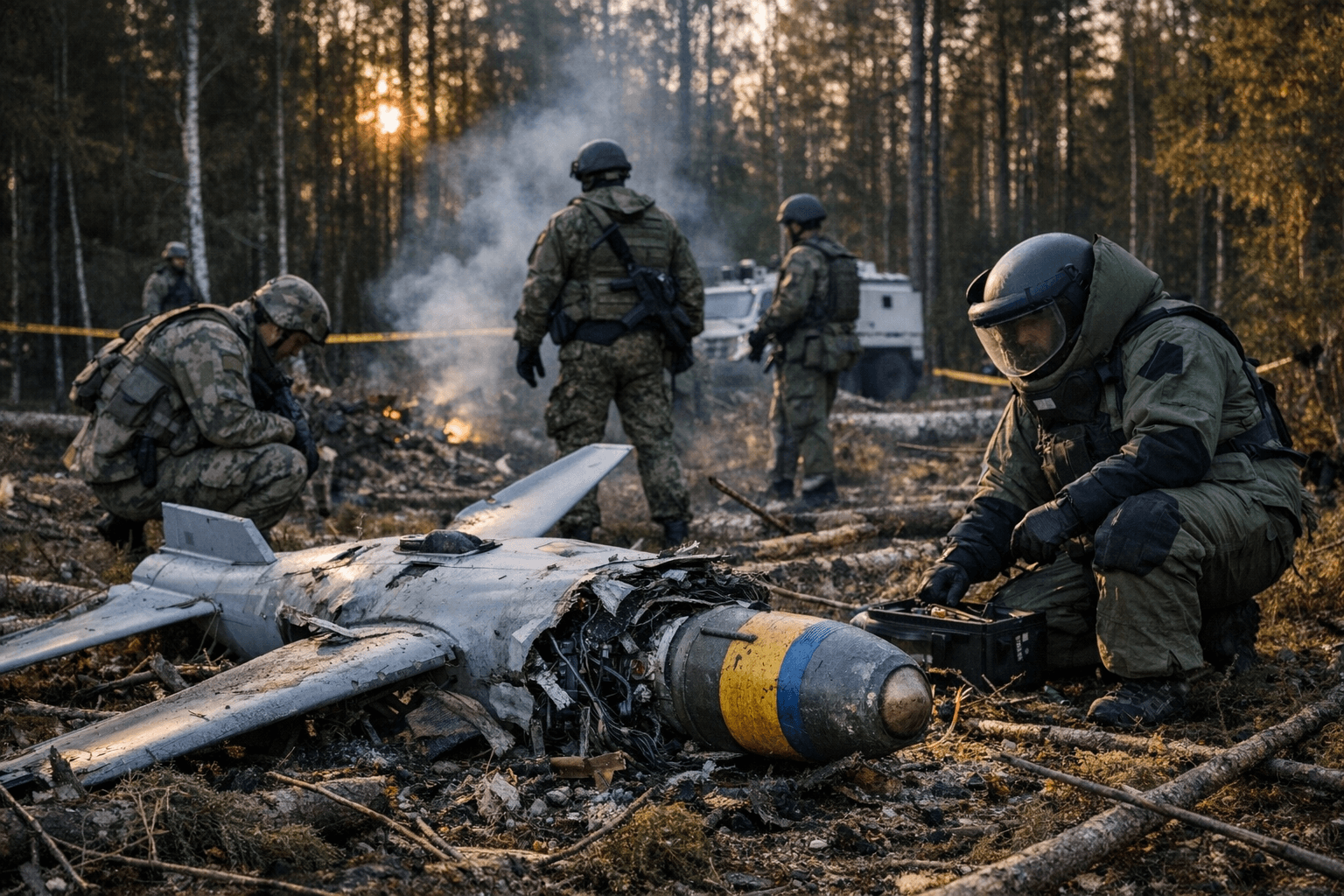
When a Ukrainian long-range attack drone touched down in a field north of Kouvola on the morning of March 29, warhead still attached, the immediate crisis belonged to Finnish Air Force F/A-18 Hornets and police officers cordoning off two crash sites. The downstream crisis belongs to every FPV racing club trying to hold onto its event permit calendar.
The aircraft was an AN-196 Liutyi, developed by Ukraine in late 2022 specifically to answer Russia's Iranian-made Shahed-136 fleet. At 22 feet across the wingspan, it is built from fiberglass reinforced with epoxy resin, metal mesh, and plywood, a construction chosen for radar evasion and fuel efficiency. A rear-mounted gasoline engine drives a three-blade propeller. The nose houses a warhead of up to 75 kilograms. Its guidance system combines inertial navigation with satellite correction and allows the drone to fly more than 1,000 kilometers autonomously toward targets like the Ust-Luga oil terminal in Russia's Leningrad Region, which Ukrainian forces struck for the third time in a week on the same morning the Liutyi came down on Finnish soil. Kouvola sits roughly 130 kilometers northeast of Helsinki and 70 kilometers from the Russian border. A second crash site was identified east of the city, and a third debris field was later found in the municipality of Luumäki.
The connection between that hardware and FPV racing is not metaphorical. The miniaturized cameras, small-form-factor propulsion systems, low-latency video links, and rapid-prototyping culture that built the Liutyi's tactical siblings trace directly back to the hobbyist and racing FPV community. What the sport optimized for lap times, the defense industry scaled for kinetic range. That lineage runs in one direction now: when a militarized derivative lands in a NATO member state with a live warhead, regulators do not ask which community originally developed the underlying technology. They ask what needs to be locked down.
Finnish President Alexander Stubb called the crash a serious violation of Finland's sovereignty and convened an emergency government meeting. Defense Minister Antti Hakkanen was unambiguous: "Drones have strayed into Finnish territory. We take this very seriously." Prime Minister Petteri Orpo called it a very serious matter of territorial integrity. Kyiv apologized within 24 hours. Ukrainian Foreign Ministry spokesman Georgiy Tykhy told reporters: "Under no circumstances were any Ukrainian drones directed toward Finland. The most likely cause is interference from Russian electronic warfare systems. We have already apologized to the Finnish side for this incident." President Zelenskyy said he had spoken directly with Stubb and that both sides are "sharing all necessary information." Finnish Foreign Minister Elina Valtonen acknowledged Finland had no desire to see Ukraine stop striking Russian oil infrastructure, a diplomatic tightrope that illustrates precisely how politically charged any drone incident near an active conflict zone has become.
The tactical cause, inertial drift after satellite correction was jammed or spoofed by Russian electronic warfare, is also why civilian aviation authorities now treat every newly approved drone use case as a potential future liability. This was not an isolated incident. Between March 23 and March 25, Ukrainian strike drones hit all three Baltic states within roughly 48 hours. A drone entered Lithuania near Varena, a second detonated in Latvia's Krāslava region at 2:30 a.m., and a third struck the chimney of Estonia's Auvere power station at 3:43 a.m. on March 25, less than 50 kilometers from the Russian port those drones had been targeting. Each incident produced an emergency government statement. Each one added data points to the file that aviation regulators in multiple NATO countries are now building on low-altitude airspace management.
That file will shape the next round of event permit reviews. Clubs that treat compliance as paperwork rather than positioning will feel the difference. Proactive documentation is the operational edge here: submitting updated site maps that define physical operating boundaries, designating a named law enforcement liaison before race day, and maintaining written records of which Remote ID protocols are active for every aircraft at a given event. When Finnish security agencies were coordinating police, military, and diplomatic inquiries simultaneously across three debris fields on March 29, the operating template they were working from was an emergency response plan. Clubs that have already written their own version of that plan, and shared it with local authorities in advance, present a categorically different risk profile than those that have not.
Remote ID enforcement tightens fastest after incidents like Kouvola because it is the most visible compliance layer. The FAA maintains roughly 1,900 FAA-Recognized Identification Area sites tied almost exclusively to established model aircraft clubs, and operating within a designated FRIA is the most defensible position in the airspace when a government agency begins reviewing what is flying in its jurisdiction after a high-profile drone story breaks globally. Clubs outside FRIA boundaries face a higher probability of ad hoc airspace closures triggered by security reviews that have nothing to do with racing but affect it anyway. Getting FRIA status is not bureaucratic overhead; it is the same kind of track position advantage that dictates race outcomes off the first gate.
Insurance requirements are the quietest pressure point and the one most likely to catch clubs unprepared. Underwriters read the same headlines regulators do. A high-profile weaponized-drone incident in a NATO member state raises the risk signal across the entire low-altitude aviation category, which compresses appetite and pushes premiums upward. The clubs that demonstrate documented airspace authorization, active Remote ID broadcasting, and written coordination agreements with local authorities will widen their separation from those that cannot show that documentation, and that gap in premium cost will compound across renewals.
The communications plan is the piece most clubs skip. After the Kouvola crash, Finnish authorities were fielding simultaneous inquiries from police, air force, and diplomatic offices. Clubs that have already established a working relationship with their local aviation authority contact, filed advance event notifications, and can produce a clean compliance record on demand, are the ones that receive cooperation rather than restriction orders when the next drone story floods the news cycle and nervous officials audit what is operating in their backyard.
The Kouvola incident was caused by a 22-foot military weapon deflected by electronic warfare during a combat mission that had nothing to do with sport. The regulatory scrutiny it generates will distribute across every low-altitude operator regardless. Clubs that treat compliance infrastructure as a competitive asset, the difference between a permit that processes in three days and one that sits in review for three months, hold the position when the rules tighten. The ones that do not are the ones watching their race calendar evaporate while the paperwork catches up to the news cycle.
This article was produced by Prism’s automated news system from verified source data, official records, and press releases, then run through automated quality and moderation checks before publishing. The system is built and supervised by the people who set the standards it runs under. Read our full AI policy.
Did this article answer your question?