FPV Drone Strike Hits Parked Car in Yurivka, Two Wounded
Two men, 44 and 67, were rushed to hospital after an FPV drone hit a parked car beside a private home in Yurivka, Zaporizhzhia.
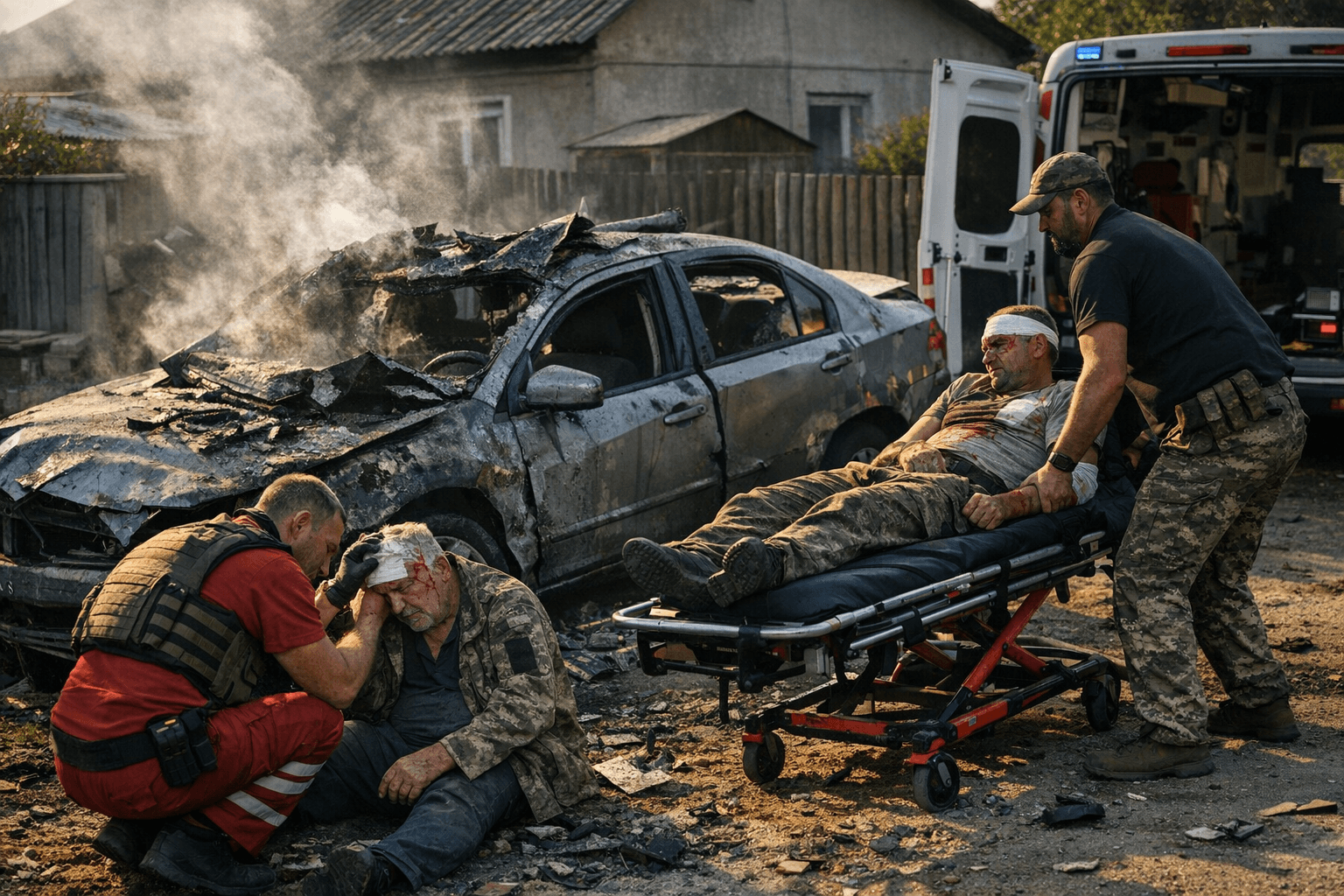
The FPV format that recently crowned Danoob over RedSheep and BATO in Drone Champions League seeding finals showed up in a far darker lane in southern Ukraine: an FPV drone strike hit a parked civilian car in the village of Yurivka, wounding two men and damaging the vehicle.
Regional authorities in Zaporizhzhia said the attack took place near a private home and sent both victims, aged 44 and 67, to the hospital. Ivan Fedorov, head of the Zaporizhzhia Oblast Military Administration, described the strike as a direct hit on the car, writing: “The Russians attacked a car with an FPV drone near a private home in Yurkivka... Two men, aged 44 and 67, were wounded.”
The Yurivka incident, reported April 9, fit a pattern that has sharpened in recent weeks across frontline regions: FPV and other short-range drones being used against small targets of opportunity, including civilian vehicles and infrastructure, not just military positions. That same day, strikes elsewhere across Dnipropetrovsk and Zaporizhzhia oblasts left additional casualties and damage, including at least one reported fatality outside Yurivka.
What makes FPV racing so unforgiving is exactly what makes FPV strikes so hard to stop. The operator’s real-time video feed enables last-second corrections, letting the aircraft thread into low-signature targets that are too small, too mobile, or too “cheap” for higher-end stand-off weapons. In competitive terms, the margins are measured in blinks: at the Abu Dhabi Autonomous Racing League’s January championship, Technology Innovation Institute’s TII Racing posted a 12.032-second benchmark lap in the AI Speed Race, with MAVLAB next at 12.832.
The broader economy around FPV has also shifted from niche to industrial. Ukraine’s defense leadership has said FPV-drone provision levels for its forces rose from about 20,000 per month in early 2024 to about 200,000 per month by 2025, a scale that speaks to mass production, procurement pipelines, and a normalization of FPV as a standard tool of war.
For civilians, the cost is measurable and growing. The UN Human Rights Monitoring Mission in Ukraine reported on June 26, 2025 that attacks with short-range drones killed at least 395 civilians and injured 2,635 from February 2022 through April 2025, including documented cases of drones targeting civilians and civilian objects in frontline areas.
In Zaporizhzhia, local officials moved emergency and hospital services to treat the injured men, and regional leaders continued pressing for expanded protective measures such as hardened safe zones, stronger local air-defense layers, and improved early-warning systems as FPV threats compress the timeline from detection to impact into seconds.
This article was produced by Prism’s automated news system from verified source data, official records, and press releases, then run through automated quality and moderation checks before publishing. The system is built and supervised by the people who set the standards it runs under. Read our full AI policy.
Did this article answer your question?