Russia claims Posokh laser downs FPV drone at 1.5 km
Russia’s Posokh laser claims a 1,500-meter FPV kill shot, a sharp jump from 1 km tests in December that ended with a drone catching fire and crashing.

Russia’s LazerBuzz directed-energy system, known as Project Posokh, is claiming a new range mark that reads like a brutal split time for anyone who lives in the FPV lane: the developer says the laser downed an aircraft-type unmanned aerial vehicle from 1,500 meters, extending the engagement envelope from earlier publicized results.
TASS reported the April 9, 2026 milestone with the developer saying it “shot down an aircraft-type unmanned aerial vehicle” at 1,500 meters and describing the system as using focused ytterbium laser technology. The same reporting thread also tied Posokh’s recent evolution to tighter tracking against maneuvering targets, including integration with radar as part of an automated detect-track-engage chain that seeks physical destruction rather than electronic interference.
That matters because Posokh’s previous headline result was already moving fast. In a separate TASS report dated December 29, 2025, the developer said the system hit an FPV drone at 1 kilometer for the first time, up from a prior effective range of roughly 700 meters, crediting new components and optimized software algorithms. In that December account, the developer said the laser “completely damaged the battery and other components,” causing the drone to catch fire and crash, while also signaling it was seeking funding and potential investors.
The technical picture being presented is a familiar performance story in FPV terms: incremental gains stacked into a new ceiling. Reporting around the April trials described improvements in beam control, thermal management, and software optimization that let the system deliver energy more precisely at longer stand-off distances. The same accounts positioned an 80 kW configuration as the higher-output build aimed at infrastructure protection and short-range air defense, with the April engagements described as producing structural and functional failure on a fixed-wing target under controlled conditions.
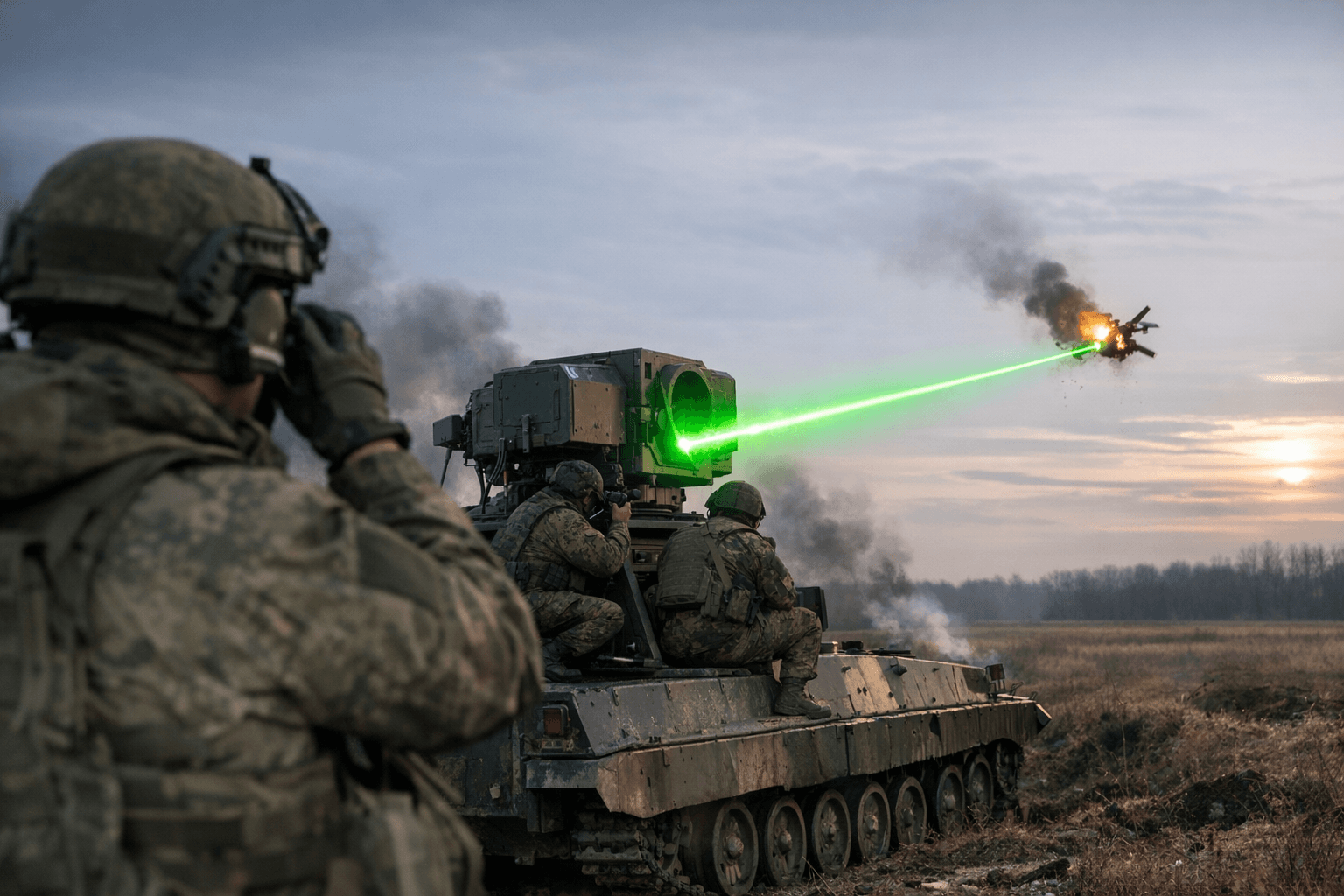
The broader industry trend is not subtle. The U.S. Department of Defense’s Director, Operational Test and Evaluation noted in its FY2024 annual report that the U.S. Army deployed four DE M-SHORAD prototype vehicles overseas in February 2024, built around a 50-kilowatt laser mounted on a Stryker and powered by lithium nickel cobalt aluminum oxides batteries recharged by onboard diesel generators. Israel’s Ministry of Defense announced on December 28, 2025 that it delivered the first operational Iron Beam high-power laser system to the IDF after extensive tests, and subsequent reporting highlighted a core limitation for lasers: degraded performance in low visibility and inclement weather.
For the FPV racing world, the signal is less about battlefield headlines and more about the tightening perimeter around airspace near defended sites. A counter-UAS market shifting from jamming to hard-kill lasers changes the risk calculus for training locations, sponsor activations near critical infrastructure, and the insurance and compliance pressure that follows when “drone” stops meaning nuisance and starts meaning target.
Key operational details around Posokh’s April claim were not released, including the test location, environmental conditions, full target specifications, engagement doctrine, and the power and cooling footprint required to sustain repeated shots. Until those are clearer, the 1.5-kilometer mark stands as a claimed performance milestone that still leaves the real-world matchup, against clutter, weather, and multiple fast inbound tracks, unresolved.
This article was produced by Prism’s automated news system from verified source data, official records, and press releases, then run through automated quality and moderation checks before publishing. The system is built and supervised by the people who set the standards it runs under. Read our full AI policy.
Did this article answer your question?