Ukrainian Students Race 'Combat' FPV Drones in Kyiv — Winner Completes Course in ~36 Seconds; Competition Uses SkyFall’s SHRIKE Platforms
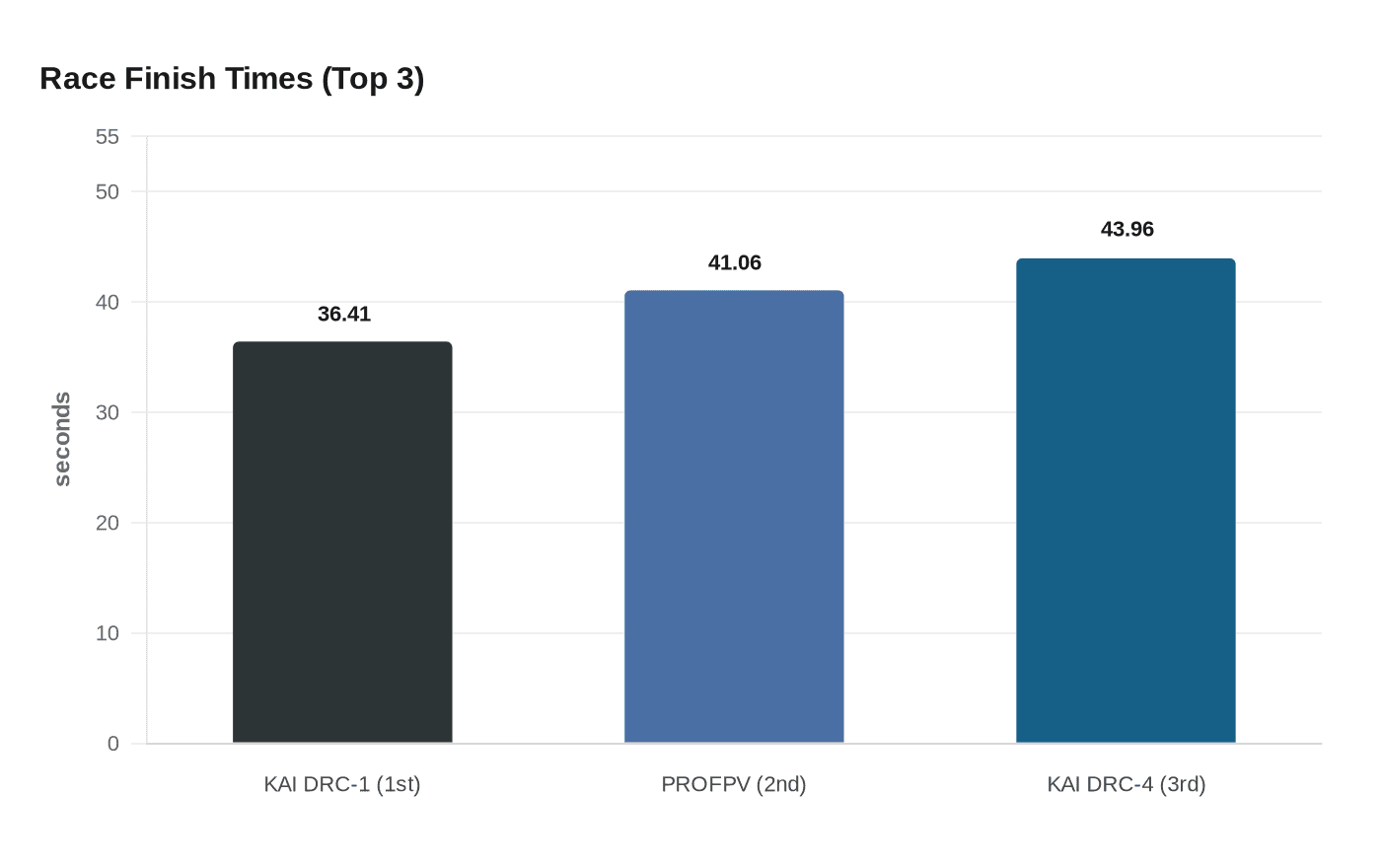
KAI DRC-1 won Kyiv's student FPV race in 36.41 seconds on a SHRIKE platform that scored 99.3/100 at the Pentagon's Drone Dominance Gauntlet weeks earlier.
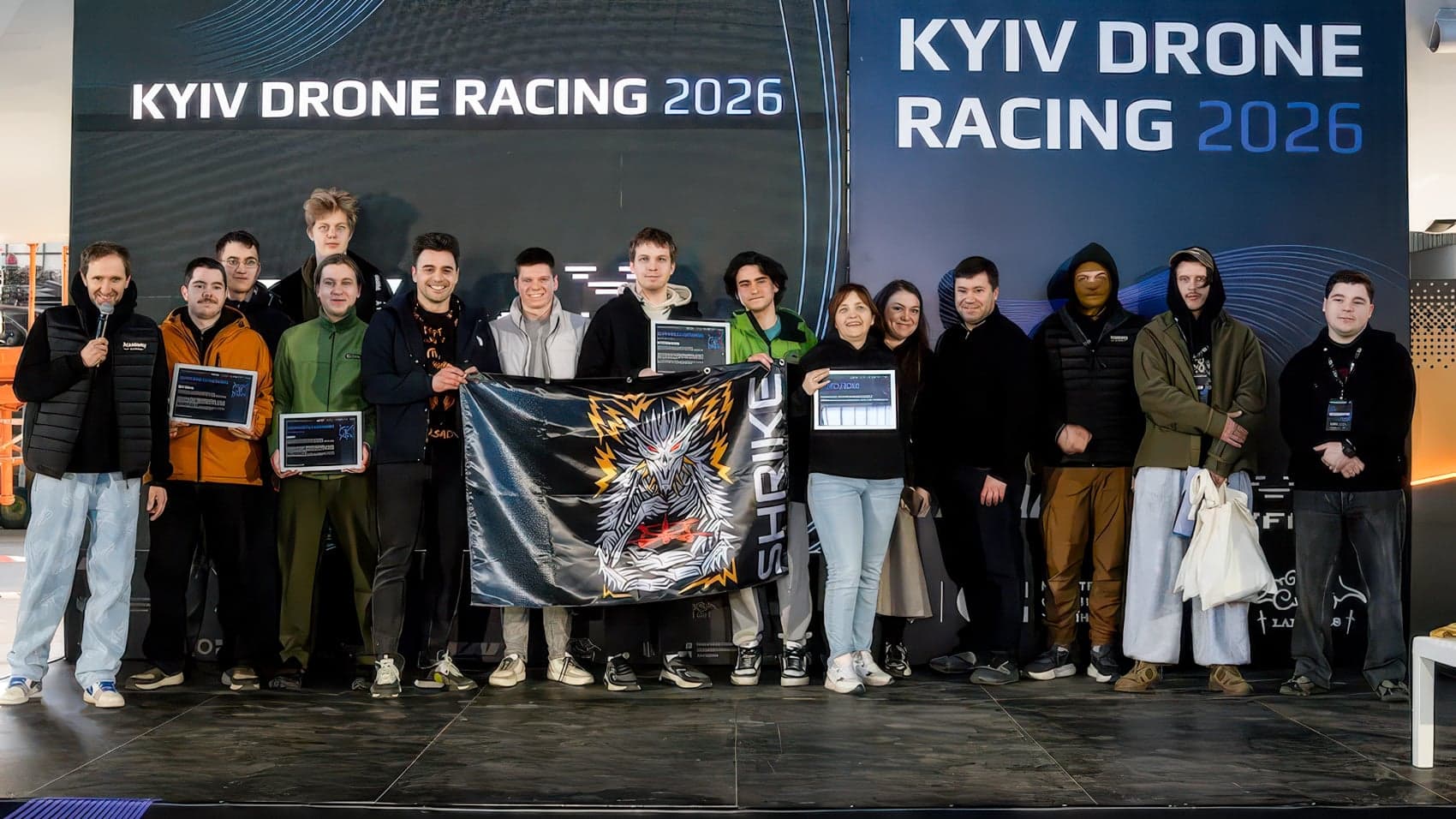
The gap between first and second place was 4.65 seconds. When KAI DRC-1, the host squad from the Kyiv Aviation Institute, crossed the timing line of Kyiv Drone Racing in 36.41 seconds, they turned a student competition into a data point: the same airframe family that won the hangar course that afternoon had, one month earlier, scored 99.3 out of 100 in the Pentagon's Drone Dominance Gauntlet, finishing more than ten points ahead of its nearest competitor.
That number is the lens through which the entire event needs to be read.
More than 30 student teams, roughly 100 pilots in total, flew inside a KAI hangar in Kyiv, weaving through a course of more than ten obstacles that included gates, slaloms, and precision windows threaded between suspended real aircraft and helicopters. Every team flew the same drone: SkyFall's SHRIKE FPV, a Ukrainian-made high-speed strike platform that has been among the most widely deployed combat UAVs of the Russia-Ukraine war. Second place went to PROFPV, from Kyiv Polytechnic Lyceum, at 41.06 seconds. Third went to KAI DRC-4, a second squad from the host institute, at 43.96 seconds.
The competitive spread reveals more than a podium order. A 36.41-second clearance on a ten-plus-obstacle indoor course at student level sits well below the 40-70 second range typical of comparable amateur FPV events, which means KAI DRC-1 was not merely fastest but operating in a different performance tier. The 7.55-second gap between first and third signals meaningful skill variance across the field, the kind of differential that in conventional FPV racing separates club-level pilots from regional competitors.
But the comparison to conventional sport racing only goes so far, and where it diverges is where this event's significance sharpens.
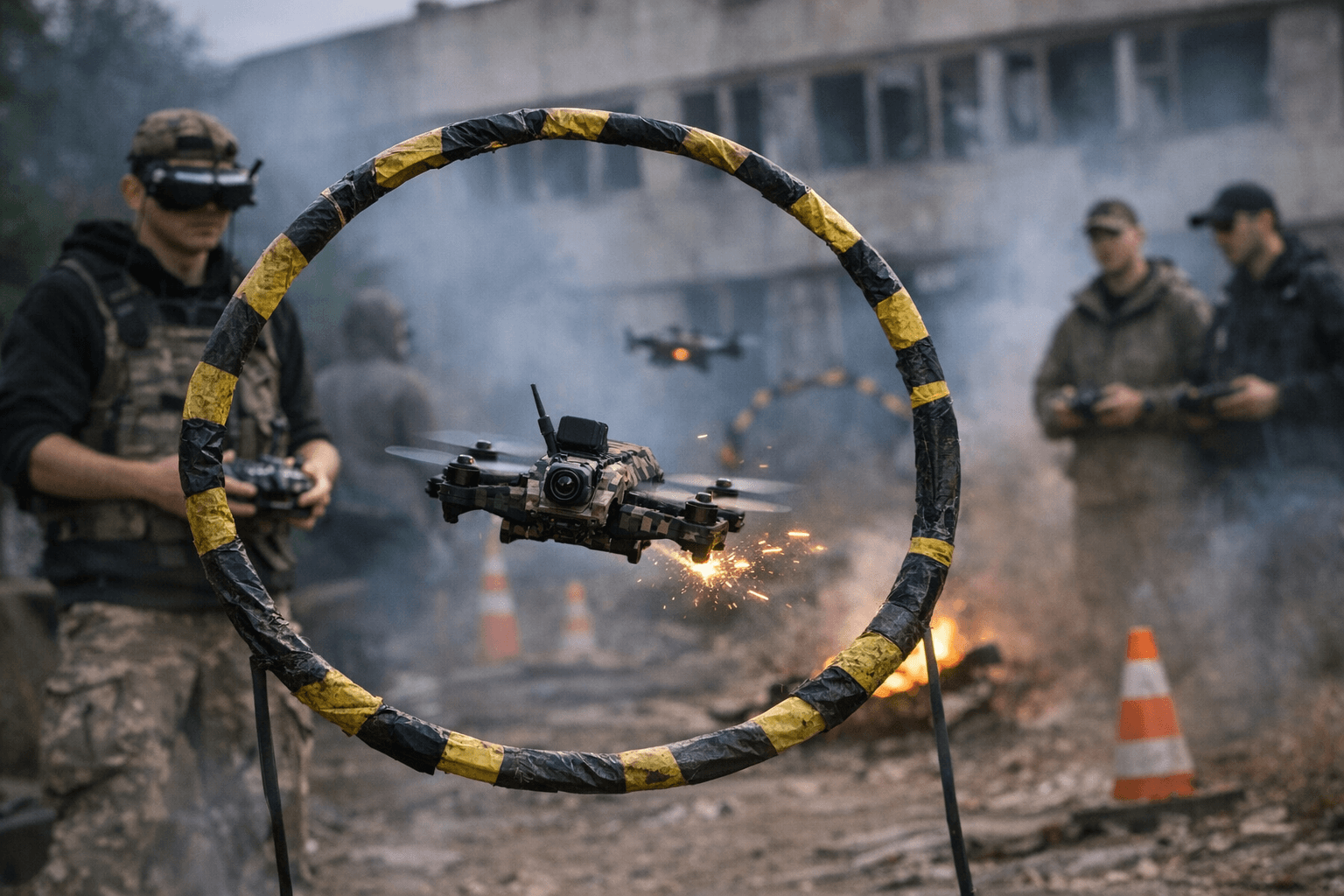
Standard FPV competition borrows from motorsport: engineered gate sequences, crash-and-rebuild permissiveness, and hardware tuned for maximum snap response and gate-to-gate rhythm. The Kyiv Drone Racing format borrowed the fair-hardware principle, identical SHRIKE airframes for every competitor, and tournament-standard timing to hundredths of a second. It diverged from sport racing in nearly every other structural dimension. The course threaded through actual aviation infrastructure rather than foam gates. The judges were not officials from a sport governing body but active personnel from Ukraine's Unmanned Systems Forces. The technical regulations were written by SkyFall Academy instructors, and the prizes awarded to the top three finishers were not trophies: KAI DRC-1, PROFPV, and KAI DRC-4 each received certificates for advanced training on P1-SUN FPV interceptor drones at the SkyFall Academy, plus a SHRIKE airframe for continued institutional use.
Those prizes define the intent. This was not a sport event that happened to use military hardware. It was a talent pipeline that used sport-format competition as its evaluation mechanism.
Understanding what the SHRIKE teaches, and what it does not, matters for anyone tracking FPV pilot development. SkyFall built the SHRIKE as a strike platform, and its flight characteristics reflect that design brief: stability at speed, directional consistency under load, and accommodation of the fiber-optic link management that makes the Shrike 10 Fiber resistant to RF interference in high-density electromagnetic environments. A pilot developing skills on the SHRIKE builds spatial anticipation across obstacle sequences, smooth yaw discipline, and the throttle management that prevents energy loss through unclean line choices. All of those attributes translate directly to competitive FPV performance. The ability to read a course entry angle, carry corner speed without clipping obstacles, and maintain clean video transmission through a complex link are exactly the competencies that separate fast pilots from merely aggressive ones.
What the SHRIKE does not produce is the snap-and-flip kinesthesia of 5-inch open-class or Tiny Whoop-class racing. Those formats reward instant directional reversal, rhythmic pitch-and-roll sequencing through engineered gate pairs, and near-continuous power cycling optimized for gate entry geometry. A pilot trained exclusively on the SHRIKE arrives at a competitive FPV event with excellent foundational skills and a throttle profile shaped more like a precision driver than a sprinter. That is not a deficiency; it is a design outcome. The platform teaches consequence-aware flying, which is the skill set that matters when a missed approach costs more than a gate penalty.
The institutional architecture around the competition is as significant as the hardware. SkyFall Academy, which wrote the technical regulations for the event, is certified by Ukraine's Ministry of Defence and has trained more than 20,000 people to fly and maintain combat drones. The tournament was co-organized by KAI, SkyFall, and defense technology company LAB418, with support from Ukraine's Ministry of Education and Science. KAI rector Kseniia Semenova has described the university's ambition as building a research institution where students engage directly with technology and defense applications, and the competition format operationalizes that goal: aviation students evaluated on combat-grade hardware by military judges with active operational experience.
The SHRIKE's concurrent role as a procurement contender ties this event to global defense acquisition debates. In March 2026, the Shrike 10 Fiber, the fiber-optic guided variant of the platform these students raced in Kyiv, scored 99.3 out of 100 in Phase I of the Pentagon's Drone Dominance Gauntlet inside a program backed by a $1.1 billion procurement budget. That performance benchmark exists alongside a starker operational data point: a $500 variant of the same airframe family has been documented as having destroyed a Russian Mi-8 helicopter worth more than $10 million, a return ratio that has sharpened attention from procurement offices well beyond Ukraine's own defense establishment.
For the global FPV racing community, the Kyiv format poses a structural question with no clean resolution. Blended civil-military ecosystems, where identical hardware, timing infrastructure, and training curricula serve both sport competition and operational application, accelerate pilot development faster than any sport-only program. The feedback loops are tighter: instructors are active operators, hardware is proven under field conditions, and scoring criteria reflect performance standards that extend beyond any leaderboard. The ceiling for pilot development in that environment is genuinely higher than what a conventional racing club can reach.
That efficiency is inseparable from the dual-use reality of the platform, and the Kyiv competition makes no effort to obscure it. The prizes are training certificates for weapons systems. The judges carry military rank. The course runs between real aircraft.
Those 20,000 SkyFall Academy graduates are the longer story. Thirty-plus teams in a KAI hangar are the visible surface of a training ecosystem that has already reached industrial scale, and the next squad to post a sub-37-second lap is already somewhere in that pipeline.
This article was produced by Prism’s automated news system from verified source data, official records, and press releases, then run through automated quality and moderation checks before publishing. The system is built and supervised by the people who set the standards it runs under. Read our full AI policy.
Did this article answer your question?