FCS football remains a proven NFL talent pipeline for overlooked stars
Grey Zabel’s No. 18 selection and 198 FCS draftees since 2013 show the small-school pipeline is built on repeatable proof, not reputation.
Proof, not perception
Grey Zabel going No. 18 overall to the NFL from North Dakota State was the cleanest reminder that the FCS still feeds the league with real draft capital, not just feel-good stories. The 2025 NFL Draft produced eight FCS selections, and the year before delivered 11 more, a steady run that keeps challenging the idea that only the biggest brands create pro-ready talent.
That pattern is not a fluke. From 2013 through 2025, 198 FCS players were drafted, and recent draft history shows a pipeline that keeps turning out NFL names even when the visibility is lower than at the sport’s biggest powers. In 2024, no FCS player was taken in the first or second round for the first time since 2009, yet the class still produced 11 selections overall, proving the lower profile does not mean the well has run dry.
Why FCS players keep getting their shot
The biggest advantage FCS programs offer is opportunity. Players who get passed over by major schools often arrive at FCS campuses and play right away, instead of waiting years behind deeper depth charts. That early action matters because it gives scouts something more valuable than recruiting pedigree: real game film built through full workloads, tough matchups, and repeated snaps in live competition.
That is part of why the league keeps circling back to small-school prospects during the pre-draft process. The NFL invited 13 former FCS players to the 2025 Scouting Combine, which ran in Indianapolis from February 24 through March 3 and included 329 total prospects. The message was straightforward: if a player from the FCS wants to break through, the pathway is open, but it runs through measurable performance and verified athletic testing just like everyone else.
Development is the hidden edge
FCS staffs often have to coach with a sharper edge because the margins are tighter and the resources are thinner. That usually produces a more individualized development model, one in which players are coached to maximize what they do well and expand their roles quickly. The result is often a more complete prospect, because the same player may be asked to handle multiple alignments, multiple responsibilities, and multiple solutions in the same season.
That versatility shows up everywhere. A receiver may be moved around the formation to create matchups. A linebacker may have to blitz, cover, and fit the run. A corner may need to survive both press coverage and zone assignments without the luxury of hiding in a one-dimensional role. NFL evaluators like that kind of exposure because it tells them how a player responds when the game asks more than one thing of him.
Live reps build pro-ready habits
The FCS path also creates a different kind of toughness. Conference races are tight, playoff races are unforgiving, and every snap can matter in a way that changes how a player prepares and competes. That week-to-week pressure helps explain why so many FCS standouts arrive in the NFL with a reputation for durability, attention to detail, and a willingness to fight through every possession.
Those habits matter because scouts are not only projecting body type or raw speed. They are watching how a prospect handles a full workload, how he responds to hostile environments, and whether he can carry responsibility without shrinking from it. In smaller programs, especially at places such as North Dakota State, South Dakota State, Northern Iowa, New Hampshire, Southeast Missouri State, Eastern Kentucky, Houston Christian, and Yale, those demands are not theoretical. They are the weekly assignment.
The draft data tells the real story
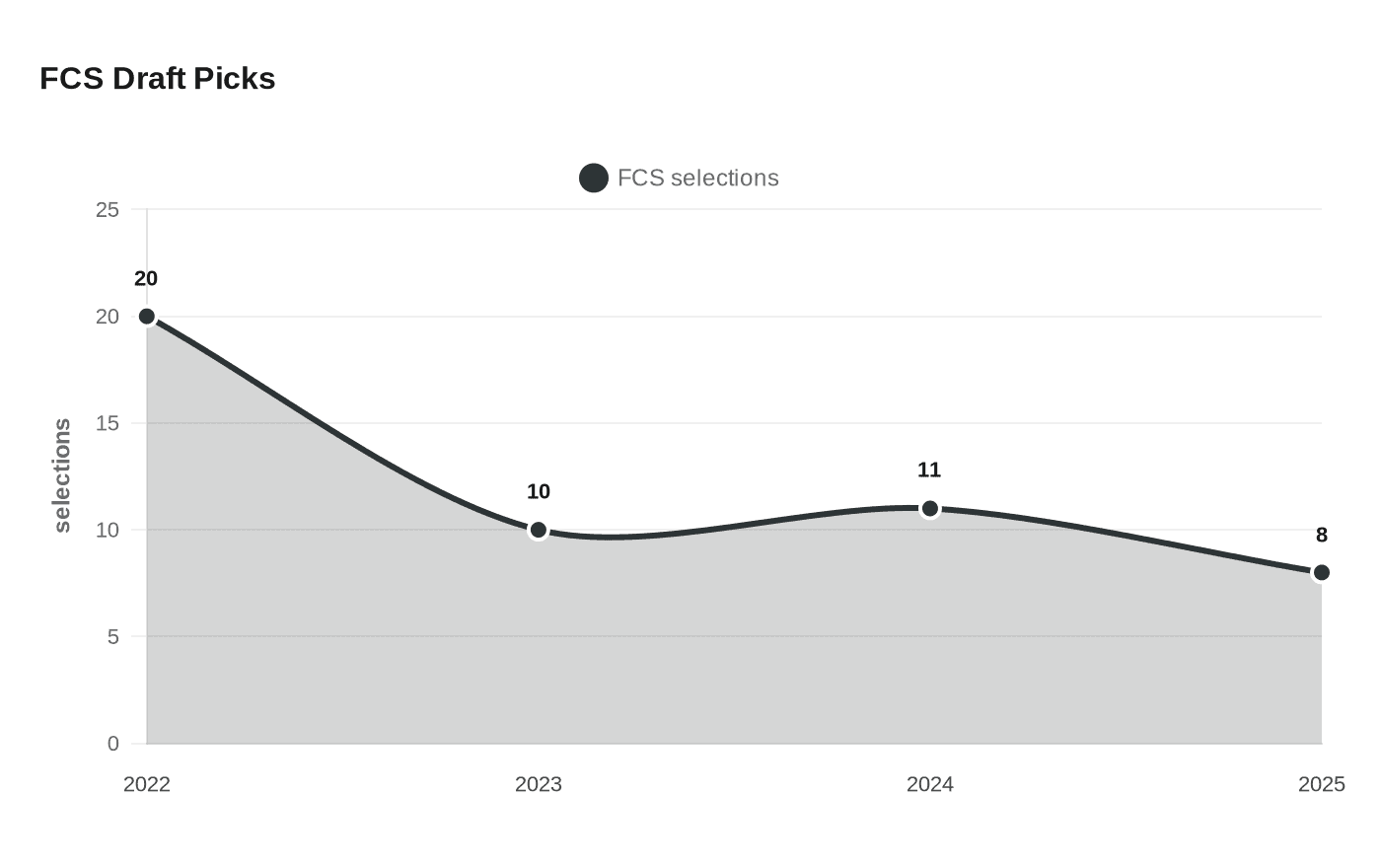
Recent draft classes underline how durable the FCS pipeline remains. The 2022 draft produced 20 FCS selections, followed by 10 in 2023, 11 in 2024, and 8 in 2025. That is not the profile of a one-off hot streak. It is a repeatable talent channel that keeps finding its way into NFL draft boards even as the sport’s attention keeps tilting toward bigger stages.
The high end matters too. Zabel’s rise to No. 18 overall shows that FCS prospects are not limited to late-round flyers or developmental bets. When a small-school player has the tape, athletic profile, and consistency to win in the pre-draft process, the league will pay for it. That is the same logic that keeps those combine invitations coming and keeps the scouting cycle active around the FCS every spring.
Why the pipeline still matters now
The broader evaluation ecosystem keeps expanding, and the FCS remains part of it. NCAA coverage of 2026 draft prospects has continued to spotlight FCS and HBCU players, and the NFL’s 2026 HBCU Showcase and International Player Pathway Pro Day is scheduled to draw clubs scouting draft-eligible players. That kind of attention reinforces a simple truth: the league is still looking well beyond the biggest TV windows for useful football players.
The lesson for the next wave of prospects is clear. The route is harder, but it is established. Produce at the FCS level, prove it in all-star settings, earn the combine invite, and make the transfer from smaller-stage excellence to NFL utility. That is how the pipeline has worked for years, and the numbers keep saying the same thing: FCS football is not a detour to the draft, it is one of the draft’s most reliable routes.
This article was produced by Prism’s automated news system from verified source data, official records, and press releases, then run through automated quality and moderation checks before publishing. The system is built and supervised by the people who set the standards it runs under. Read our full AI policy.
Did this article answer your question?