Duotone Skybrid SLS 2026 blends easy takeoffs with foiling performance
Duotone’s Skybrid SLS 2026 is built to cover wing, prone, parawing and foil assist, but the real test is how much specialization it gives up.

The Skybrid SLS 2026 is Duotone’s loudest argument yet that the mid-length board is no longer a halfway house. It is built to launch wing foilers sooner, carry parawing sessions, handle foil assist, and still make room for prone entries, which is exactly where the category is headed. The catch is the same one that haunts every do-everything board: every ounce of convenience has to be paid for somewhere.
A crossover board with a clear mission
Duotone frames the Skybrid SLS 2026 as an evolution of last season’s mid-length debut, and the mission statement is broad on purpose. The brand says the board is designed for wing foiling, parawing, foil assist, and prone foiling, while also describing it as a platform for “next-level efficiency, stability, and performance across a wide range of foiling disciplines.” That is not niche language. It is a direct shot at riders who are tired of owning one board for light-wind wing days, another for prone sessions, and a third shape for parawing experiments.
The design choices back up that ambition. The 2026 shape moves to a slightly longer and narrower outline to improve glide and takeoff efficiency, while the new diamond tail, refined rail bevels, and recessed deck are all meant to make the board carve more cleanly and clear water more easily in transitions. Duotone also leans on a wider deck to give riders a stable stance and a more reassuring connection during the hardest part of any session: the moment before the foil loads up and flies.
That is where the Skybrid SLS makes its case as more than a compromise board. It is trying to be manageable on the water, direct in the air, and less punishing across different disciplines than a hard-specialized shape. The practical payoff is obvious for experienced riders who do not want to rebuild their quiver around every new foil trend.
What the shape tells you about the tradeoff
This board is built around efficiency, but it is not pretending to be the sharpest tool in every box. A longer, narrower outline helps glide and takeoff, yet that same move also signals a shift away from the super-short, ultra-reactive feel of a pure compact wing board. The recessed deck and wide stance make the platform feel secure underfoot, but they are there to support control and access first, not to create the twitchy, locked-in personality of a specialist board.
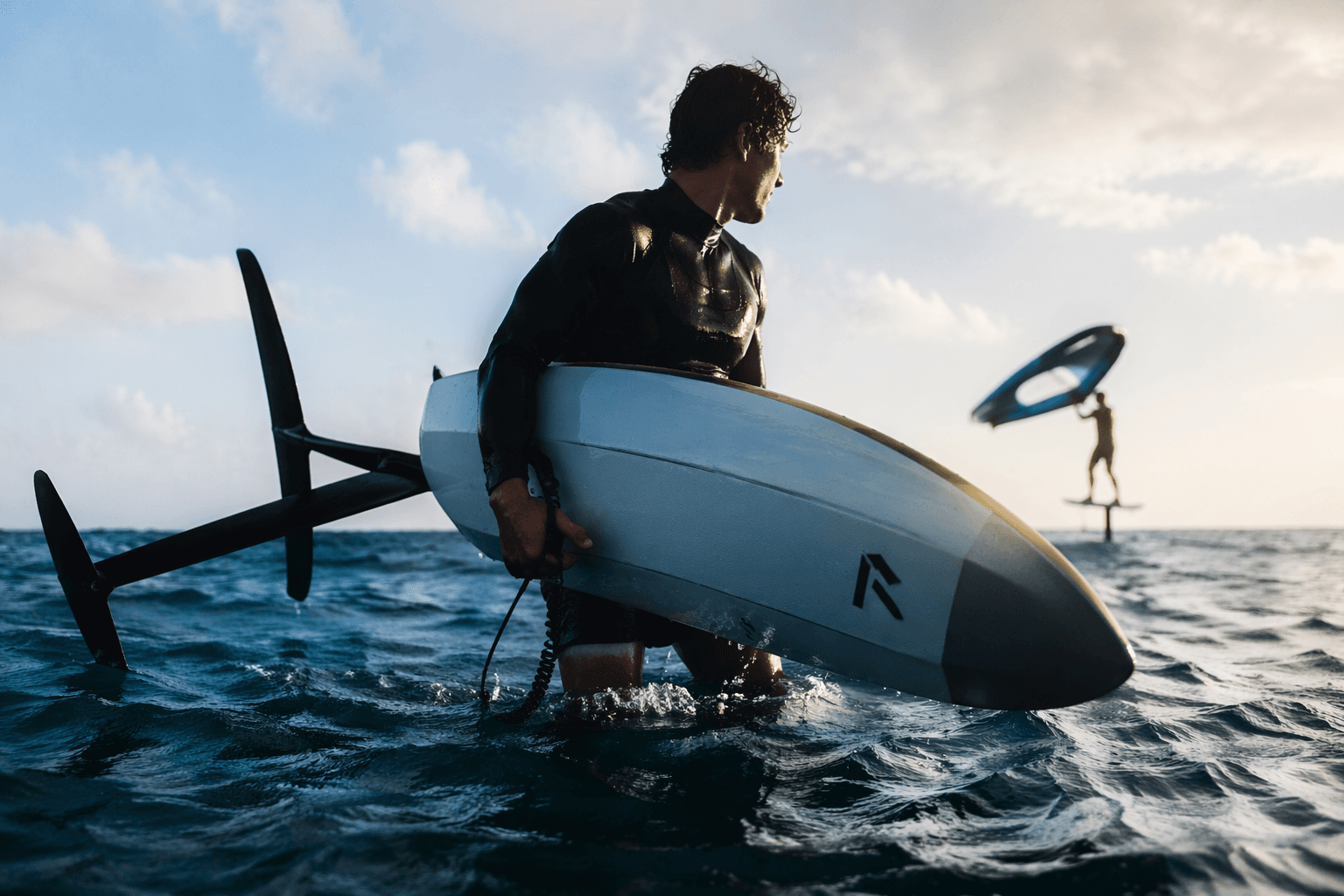
That is the hidden bargain in the do-everything mid-length trend. You gain smoother starts, easier transitions, and a board that can serve more than one foiling style, but you give up some of the single-purpose aggression that dedicated prone or downwind setups deliver. Duotone is making a very specific bet here: most experienced riders would rather have one board that handles a lot well than several boards that each do one thing perfectly.
The Skybrid SLS 2026 is also aimed squarely at intermediate to advanced wing foilers, which matters because that is the rider who feels the compromise most clearly. Beginners usually want forgiveness. Experienced riders want speed, control, and the ability to move across disciplines without feeling like they are dragging the wrong tool into the water.
Construction is part of the performance story
Duotone’s SLS build is not cosmetic. The board uses Biax Carbon PVC Sandwich construction with a light EPS core, and the point of that package is to balance low weight, high strength, and long-term durability. In plain terms, it is meant to stay light enough to feel lively underfoot without becoming fragile or overly soft when the session gets messy.
The hardware matters too. Extended carbon foil tracks and multiple footstrap options let riders fine-tune stance and foil position, which is exactly what a crossover board needs if it is going to work across wing, prone, parawing, and foil assist use. A board like this lives or dies on setup flexibility. If the stance and mast position are off, the whole promise collapses.
Retail descriptions land on the same idea from a different angle, calling the Skybrid SLS durable, feather-light, and versatile. That combination is what makes it relevant in a market where riders increasingly want one board that can move from light-wind wing days to smaller-foil progression sessions without feeling like a dead end.
The size range shows how serious the crossover play is
The Skybrid SLS is not a one-size experiment. The line runs from 5'2" to 6'7", and retail listings show the full spread as 5'2"/45L, 5'5"/60L, 5'7"/70L, 5'9"/80L, 5'11"/90L, 6'1"/100L, 6'4"/114L, and 6'7"/130L. That is a real range, not a token sizing chart, and it tells you Duotone wants this board family to cover compact, everyday, and higher-volume needs without changing the design language.
Independent testing backs up the sense that this is a measured revision rather than a total reset. SURF Magazin noted that the 2026 Skybrid shape is slightly narrower but longer than its predecessor, with the same volume, and that the line is available in eight sizes from 45 to 130 liters. Those are the kinds of changes that usually matter more on the water than in a spec sheet, because they affect how fast the board gets moving and how stable it feels before flight.
How Duotone got here
The Skybrid did not appear out of nowhere. Duotone first entered the mid-length segment with the Skybrid in 2024, introducing it as a high-performance wing and foiling board that bridged the gap between the Downwinder range and traditional Wing Foil boards. In 2025, Duotone expanded the line with a non-SLS version in Vacuum Epoxy Bamboo Sandwich construction, explicitly saying the move followed the overwhelming popularity of the SLS.
That history matters because it shows Duotone is not treating mid-length as a one-season fad. The brand has been building a family around the shape, and the 2026 Skybrid SLS is the most performance-focused version yet. It is also a sign of where foiling is drifting: toward boards that simplify the run without stripping out the glide, control, and speed that experienced riders actually care about.
The verdict is straightforward. The Skybrid SLS 2026 looks like one of the better answers to the all-in-one board question, because it leans into efficiency without giving up the direct feel advanced riders expect. It does not erase the specialization debate, but it does make the case that a single mid-length board can now cover far more water than the old category ever could.
This article was produced by Prism’s automated news system from verified source data, official records, and press releases, then run through automated quality and moderation checks before publishing. The system is built and supervised by the people who set the standards it runs under. Read our full AI policy.
Did this article answer your question?