APD shows HEMA has become a serious academic field
APD gave HEMA a peer-reviewed home, turning manuals, practice, and census data into a shared evidence base for the sport.
Acta Periodica Duellatorum, known as APD, launched in 2013 and has been diamond open access from day one, which means readers pay nothing to read it and authors pay no article processing charge to submit. It is peer reviewed, published twice a year, and built to handle research articles, historiographical studies, editions of short texts, research notes, book reviews, and related formats.
The journal that gave HEMA a scholarly center
The journal is currently published by Bern Open Publishing at the University of Bern, carries ISSN 2064-0404 and eISSN 2813-5970, and offers immediate, unrestricted access under a Creative Commons license. Printed copies are also available through publishing partners Agea Editora and Sacauntos, which extends the journal beyond the screen without changing its open-access model.
Mátyás Miskolczi serves as editorial team manager, Daniel Jaquet is editor in chief, Jacob Deacon and Eric Burkart are editors, Victoria Barlow is assistant editor, Simone Donders is on the team, and Regula Schmid-Keeling serves as assessor. APD’s archive begins with Vol. 1 No. 1.
Why the journal fits HEMA better than a generic academic venue
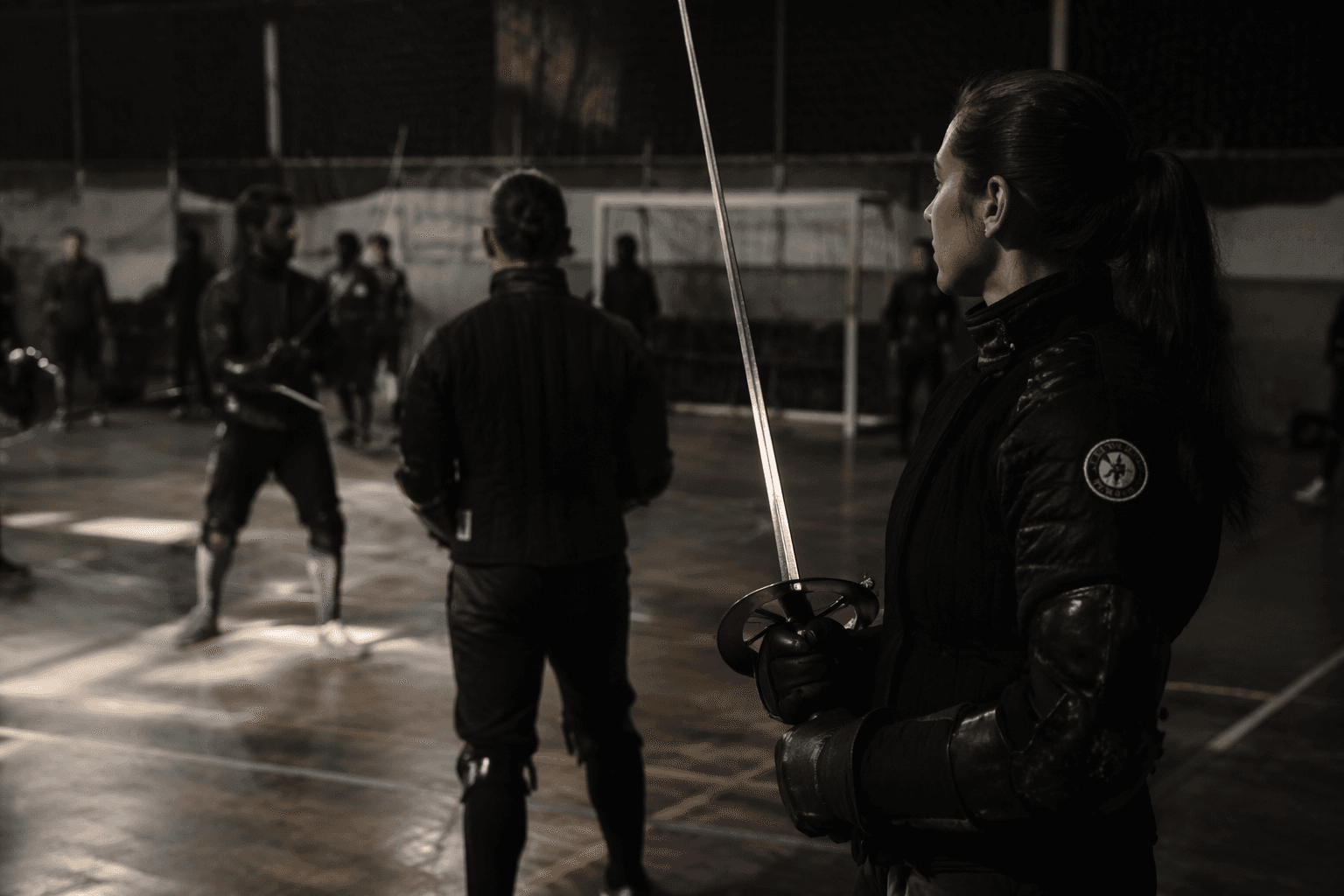
The sport and the scholarship around it are unusually interdisciplinary. APD places European martial arts at the intersection of history, anthropology, historical sciences, art history, the history of science and technology, archaeology, sport sciences, and martial arts studies. HEMA is built on recovery and reconstruction: most living practitioners are not inheriting an unbroken tradition, they are testing interpretations against manuscripts, printed treatises, translations, blades, and bodies.

APD also recognizes practice as research alongside classical academic methods. In HEMA, a reading of a source only gets you so far; a line, a tempo, or a guard has to survive work in the salle, where coaches and fencers can see whether the idea holds under pressure, with timing, distance, and resistance in play. APD gives that loop a formal home, so the field can keep a record of how ideas move from page to drill to sparring set.
How APD changes what happens in the salle
APD provides a shared evidence base. Practitioners use it to compare manuals and translations before building lessons, coaches use it to justify why one interpretation belongs in a drill sequence instead of another, and organizers use it when they need a defensible basis for decisions about reconstruction and safety. That shared record helps keep club instruction from drifting into pure opinion and gives tournament debates a place to land when rules, equipment, and interpretation collide.
Three kinds of APD work show that movement from research into practice especially well.
First, the journal’s focus on editions of short texts and historiographical work gives instructors tools for reading sources closely before they teach from them. A class on longsword or rapier is stronger when its structure is anchored in a published interpretation that can be checked against the original text, rather than in a loose memory of what someone once saw in a seminar.
Second, APD’s embrace of practice as research makes the training hall part of the research process itself. A hypothesis about structure, footwork, or timing can be proposed on the page, tried in free sparring, and then revised with the results folded back into the scholarship.

Third, the journal has carried conference proceedings that connect scholarship to reconstruction debates. APD published proceedings from HEMA Studies at the International Medieval Congress in Leeds in 2016, from Fight books in comparative perspective at the Deutsches Klingenmuseum in 2017, and from Costume and weapon simulator in the reconstruction of ancient martial arts practices in Morges in 2017. They deal with how people read sources, test equipment, and think about the material conditions of combat reconstruction.
The field now has institutions, data, and a paper trail
APD has also helped HEMA argue for itself as a discipline. One article asked whether HEMA could be recognized as an interdisciplinary field and examined where it sits between established academic categories. Another argued that HEMA should be treated as part of Europe’s common cultural heritage, which places the practice inside a broader cultural and historical conversation rather than on the fringe of recreation.
In 2015, IFHEMA described APD as a professional partner and highlighted its double-blind peer review as a way to improve the quality of HEMA-related papers.
A 2021 APD census article counted 3,186 HEMA practitioners in 124 locations in Germany and 801 practitioners in 34 locations in Austria.
This article was produced by Prism’s automated news system from verified source data, official records, and press releases, then run through automated quality and moderation checks before publishing. The system is built and supervised by the people who set the standards it runs under. Read our full AI policy.
Did this article answer your question?