Ciupka leads packed June HEMA singlestick rankings with 516 entries
Ciupka topped June’s singlestick board at 1,902.7, and 516 entries showed a wide field powered by Wisconsin, the Netherlands and other HEMA hubs.

Daniel Bartholomaus Ciupka remained the name to chase in mixed and men’s singlestick, and the June board showed just how broad the pursuit had become. HEMA Ratings listed 516 entries in the category, with 107 tournaments, 1,313 fighters and 7,116 fights feeding the table, a scale that says singlestick is still smaller than the flagship HEMA weapons but firmly alive as a competitive lane.
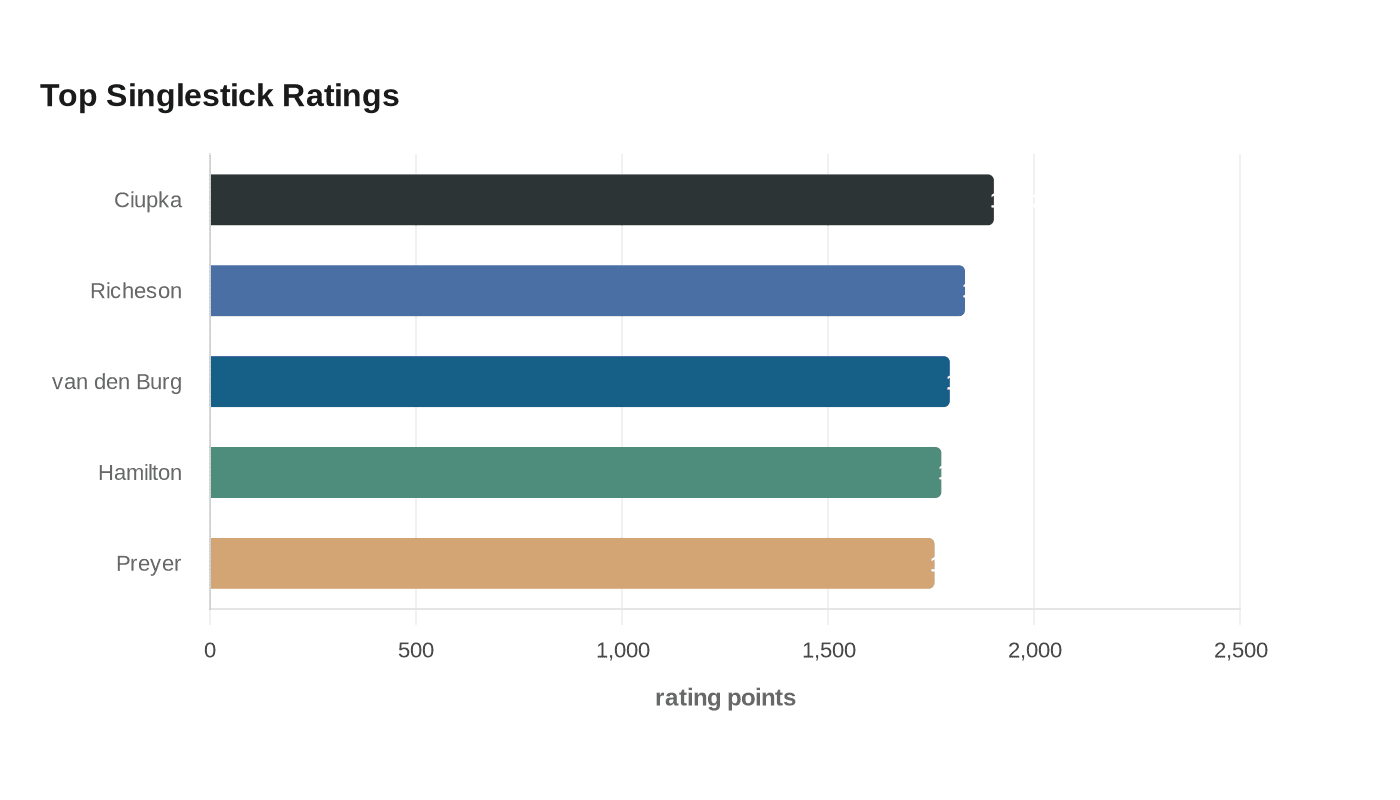
Ciupka of Bellum Nobile led the standings at 1,902.7, with Jack Richeson of Wisconsin Historical Fencing Association next at 1,832.6. Mart van den Burg of Historisch Vrijvechten Nederland sat third at 1,795.7, ahead of Benjamin Hamilton of Saorsa: Scottish Swordsmanship at 1,775.3 and Christopher Preyer of Baerswords School of Western Martial Arts at 1,758.6. That top group already tells the story: no single school owns the category, and the ratings reward fencers who keep showing up across different events and formats.
The middle of the top 10 widened the map further. Michael Roth of Heartland HEMA Historical Fencing Club ranked fifth at 1,749.9, followed by Mykhaylo Skorobogatov of Sharukhan at 1,736.8, Paul Ren of House of Blades at 1,731.6, Gavin Page of Wichita Fencing & HEMA Academy at 1,731.4 and Daniel Rauens, another Wisconsin Historical Fencing Association fencer, at 1,707.7. That kind of spread is a practical sign of depth: singlestick is not being carried by one local scene or one coach’s style, but by multiple clubs that keep producing results.
The rest of the visible top 20 kept the same pattern. Ties Kool, Sam Sobolev, Matthew Biondo, Samuel Ryals, Bart Jongsma, Julia Adballah, Michael Keller, Tony Huang, Oskar ter Mors and Patrick Stahl filled out the board, with Historisch Vrijvechten Nederland and Wisconsin Historical Fencing Association again placing multiple names in the elite tier. When one club can put several fencers near the top and still not monopolize the rankings, that usually means the field is healthy rather than hollow.
The weapon’s lineage explains why the rankings look this way. Britannica traces singlestick to the 16th century as a practice sword that became popular in 18th-century British cities and towns for cudgel play and singlesticking, then says it faded in the late 19th century and was seldom practiced after the start of the 20th. That history leaves modern HEMA singlestick with a split identity: part sport weapon, part training bridge to sabre, backsword and related single-sword systems.
HEMA Ratings uses the Glicko-2 algorithm created by Harvard statistics professor Mark Glickman, and the site says its ratings are meant for seeding tournaments and tracking individual progress. In singlestick, that matters because placement is not just bragging rights. It helps decide who gets the hard path early, and this June board showed a category with enough volume, enough clubs and enough stylistic cross-pollination to keep building, not fading.
This article was produced by Prism’s automated news system from verified source data, official records, and press releases, then run through automated quality and moderation checks before publishing. The system is built and supervised by the people who set the standards it runs under. Read our full AI policy.
Did this article answer your question?