George Silver’s fencing manual reveals Elizabethan English combat culture
Silver reads best as a combatant in a public honor economy, not just a polemicist. His manual captures prize bouts, status contests, and Elizabethan fencing politics.

George Silver married Mary Heydon in London on 24 March 1579/80 and wrote his fencing books from inside a noisy combat culture. He was an English gentleman, likely born in the 1550s or early 1560s, and lived in a world where fencing could be a public performance, a social ladder, and a reputation fight all at once.
Silver in the combat marketplace
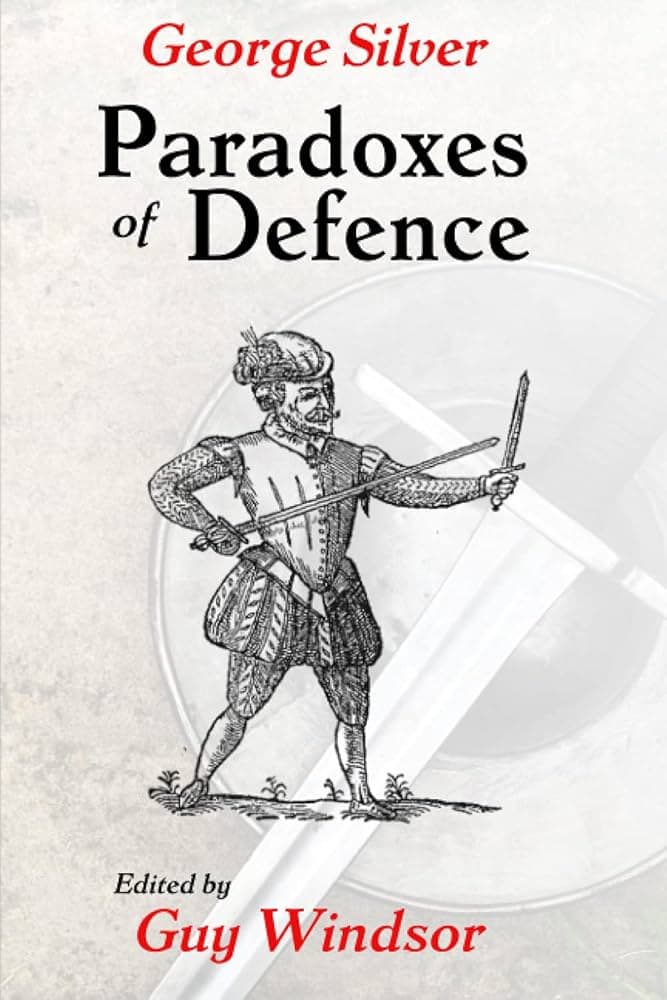
Silver’s best-known work, *Paradoxes of Defence*, was printed in London in 1599 by Edward Blount and dedicated to Robert Devereux, 2nd Earl of Essex. A presentation manuscript was also prepared for Essex and survives as British Library Additional MS 34192. This was a work aimed at status, patronage, and argument in late Tudor London.
Silver was not just describing how to hold a blade. He was trying to win a fight over what counted as sound fighting in the first place. His writing lands in the middle of a city where martial skill could be tested in public, watched by onlookers, and converted into social capital.
What Silver actually argues for
The easy shorthand is that Silver hated Italian rapier culture. That is true, but too small. He defended what he saw as the native English way of fighting and praised the “short ancient weapons,” especially the short sword. He also took seriously dagger work and the staff, which shows his system was broader than a simple rapier-versus-rapier feud.
The surviving structure of *Paradoxes of Defence* moves through acquisition of skill, principles of fighting, weapons and vantages, rapiers and poniards, and conclusions. It reads like a practical attempt to define fighting reality: what works, what fails, and what kind of weapon choice puts the fighter in danger.
Silver’s later *Brief Instructions* pushes the point further. That manuscript covers the short single sword, sword and dagger, sword and buckler, two-handed sword, short staff, forest bill, Morris pike, and single dagger. Silver was building a system, not just denouncing a style. He wanted proper weapons, proper measure, and proper principle, because he thought the wrong habits got men killed.

The public prize world behind the text
Silver’s ideas make the most sense against the backdrop of the London Masters of Defence, the organized fencing world of the day. Their schools taught swords, staffs, wrestling, pugilism, and disarming techniques, and they staged public tests called Playing the Prize. Students advanced through ranks such as Scholar, Free-Scholar, Provost, and Master, sometimes fighting a long sequence of bouts in a single afternoon.
More than 100 fencing prizes were recorded from 1540 to 1598, and these bouts were a regular feature of life in London and its environs.
The Company of Masters of the Noble Science of Defence stood under a royal charter from Henry VIII in 1540, and the monopoly on teaching is also dated to 1545.
Why Silver sounds like a gentleman, not a guild man
Silver’s class position helps explain the tone of his writing. He was not attached to the London Masters of Defence, and he would not have been a fencing master himself because such men were classed as vagrants under the 1529 law.
That perspective also changes how you read his confidence. Silver is not merely saying, “My style is better.” He is saying that the social prestige attached to imported fencing systems is distorting judgment, encouraging vanity, and producing bad outcomes.
The Saviolo challenge and the Italian threat
The most vivid episode in Silver’s public campaign is his challenge to Vincentio Saviolo. Silver and his brother Toby challenged Saviolo to a public fencing match, and the challenge was placarded in London, Southwark, and Westminster. It was also delivered personally to Saviolo, but no formal bout happened.
Silver knew the power of public challenge culture, and he was willing to use it. He aimed his polemic especially at Italian masters working in London, including Rocco Bonetti and Saviolo, because Italian rapier culture had real prestige in the 1590s. Saviolo’s school in Blackfriars sat inside that shift, and his *His Practise*, printed in English in 1595, became the clearest foil to Silver’s 1599 book.
He argued that some fencing books teach offense rather than defence and could lead to unnecessary deaths.
Why HEMA keeps coming back to him
Silver remains one of the most useful late-Elizabethan voices for HEMA because he sits exactly where practitioners want sources to sit: at the junction of theory, technique, and live combat culture. His books are accessible in modern circulation, and that accessibility lets readers compare his arguments with the public prize world around him.
This article was produced by Prism’s automated news system from verified source data, official records, and press releases, then run through automated quality and moderation checks before publishing. The system is built and supervised by the people who set the standards it runs under. Read our full AI policy.
Did this article answer your question?