Hans Talhoffer’s 1467 combat manual reveals medieval fighting culture
Talhoffer’s 1467 manual is not just a sword book. It is a rare, messy snapshot of late-medieval combat culture, from armored fencing to legal duels.

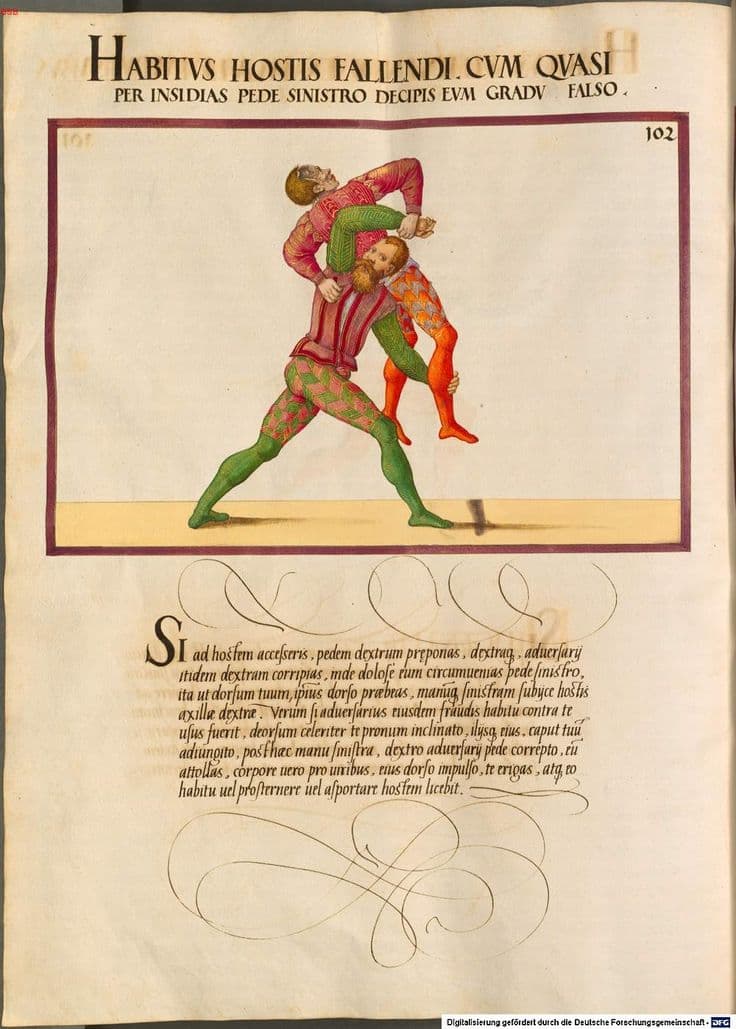
Hans Talhoffer’s 1467 combat manual is the opposite of a tidy sports manual, and that is exactly why it still matters. The manuscript bundles together unarmored fighting, armored fighting, mounted combat, and illustrated instructions for swords, daggers, pikes, and other weapons. It also preserves rules for a trial by combat between a man and a woman, which puts it in a category of its own.
The manuscript that refuses to stay in one lane
The Library of Congress catalogs the work as a 1467 Fechtbuch and identifies Talhoffer as a figure born around 1420 and dying around 1490. In the same record, he is described as an unbeatable swordsman and one of the finest teachers of the German school of fencing, a reputation strong enough that many noblemen sought him out as both advisor and instructor. The Bavarian State Library preserves the manuscript in Munich as Cod.icon. 394a, which gives modern readers a direct path to one of the most unusual combat books to survive from the Middle Ages.
What makes the book so compelling is its refusal to behave like a modern technique manual. The annotated images do not isolate a single weapon or a single class of fighter. They move across scenarios, gear, and status, showing how combat changed when armor came on, when it came off, when the fight stayed on foot, and when it shifted into the saddle. That breadth is the point: Talhoffer captured fighting as a system, not as a stunt catalog.
Talhoffer was a working teacher, not a decorative oddity
Talhoffer was active from 1433 to 1467, according to Wiktenauer, which also says he left at least five surviving manuals and maintained a clear connection to the Liechtenauer tradition. A JSTOR study pushes the count even higher, crediting him with at least six Fechtbücher from 1443 to 1467. That spread matters because it shows the 1467 manual is not an isolated curiosity. It belongs to a long career built around instruction, adaptation, and repetition.
The Metropolitan Museum of Art places Talhoffer squarely in the Liechtenauer tradition, the manuscript culture in which fencing knowledge was preserved in cryptic verse and copied into books. That lineage helps explain why his work looks so practical and so strange at the same time. It is systematic, but it is also deeply shaped by the realities of the courts, duels, and professional teaching culture that defined combat learning in 15th-century Germany.

For HEMA practitioners, that combination is the draw. Talhoffer is not prized because his material is neat. He is prized because he preserves the awkward middle ground that many other manuals leave out: formal instruction for violence as it was actually lived, taught, and regulated.
Why the weapons spread across the page matters
Talhoffer’s manual is valuable because it does not confine itself to the fashionable image of medieval swordplay. The manuscript’s annotated illustrations cover swords, daggers, pikes, and other weapons, which widens the picture of what a fighter had to know. A duel could change shape fast, and the book reflects that by moving between weapon types and fighting conditions instead of pretending there was one universal answer.
That variety also makes the manuscript useful as evidence. A scholar writing on Talhoffer’s unusual weapons notes that legal ordinances and court records help explain the duel scenarios shown in his manuscripts, and that customary law for judicial duels varied significantly across German regions. In other words, the book does not exist in a vacuum. It sits inside a legal and social world where rules differed from place to place, and where combat was shaped by local custom as much as by technique.
The duel culture hidden inside the fighting manual
One of the manuscript’s most unusual features is its trial by combat between a man and a woman. That detail alone keeps Talhoffer in constant circulation among historians and practitioners, because it shows that martial culture in the late Middle Ages was not limited to battlefield formations or gentlemanly duels. It included legal combat, gendered rules, and highly specific procedures that could turn violence into a recognized court process.

Judicial combat was an officially sanctioned legal method in Western Europe from the 10th through the 15th centuries. Talhoffer’s book makes that system visible in a way that a pure weapon manual never could. The fight book reads like a technical text, but it also functions as a record of legal culture, where the question was not only how to strike but when the law allowed the strike to happen at all.
That is why a scholarly chapter places Talhoffer alongside Geoffroi de Charny and Paulus Kal as a key source on medieval fighting practices. He belongs in that company because he shows how closely martial technique, legal process, and social status could overlap. His manual is not just about winning exchanges. It is about the rules that made those exchanges meaningful in the first place.
Why modern HEMA keeps coming back to Talhoffer
HEMA practitioners return to Talhoffer because he offers a complete fighting world in one manuscript. The 1467 book is a rare six-in-one style source before that idea was ever modern: unarmored work, armored work, mounted work, polearms, sidearms, and judicial combat all sit under the same roof. The Library of Congress scan and the Bavarian State Library copy preserve that spread in a form that lets modern readers study not just one system but the connections between systems.
That is the real value of Talhoffer’s manual. It does not give a neat, sanitized version of medieval combat culture. It gives a broad one. It shows why a fighter needed to be ready for different weapons, different armor, different terrain, and different legal conditions, and it does so in a manuscript written by a man whose reputation was strong enough to draw noble clients. For anyone trying to understand what late-medieval combat actually looked like, Talhoffer remains one of the clearest windows we have.
This article was produced by Prism’s automated news system from verified source data, official records, and press releases, then run through automated quality and moderation checks before publishing. The system is built and supervised by the people who set the standards it runs under. Read our full AI policy.
Did this article answer your question?