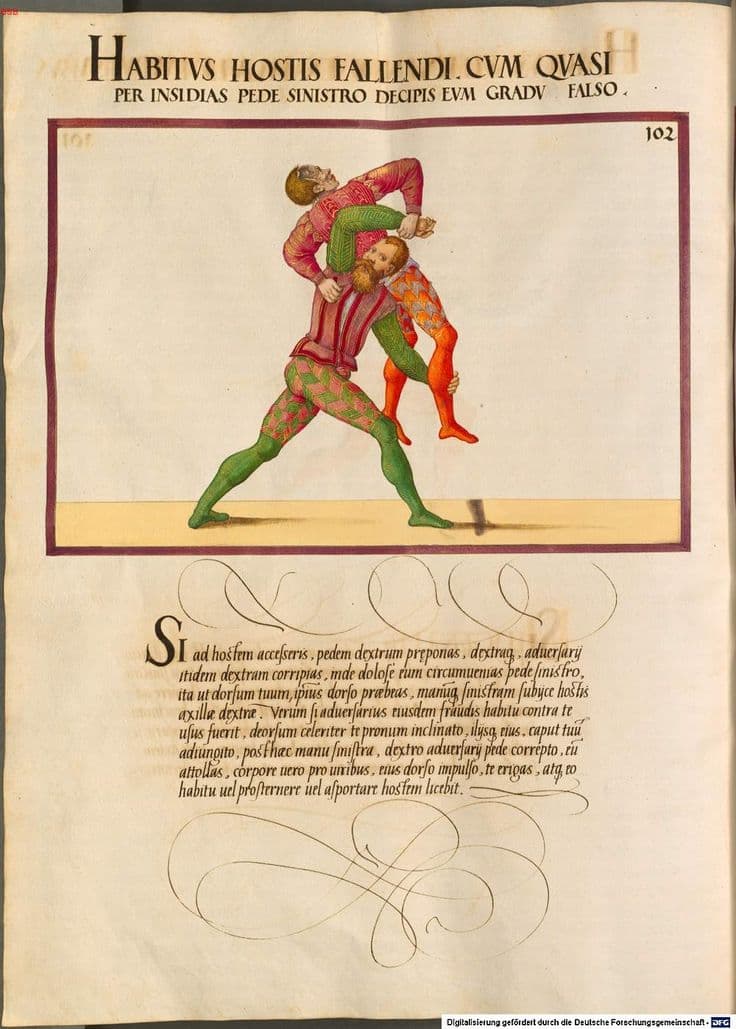
Heinrich von Gunterrodt’s 1579 treatise blends fencing and history
Gunterrodt’s 1579 book did more than teach weapons. It compared fencing sources, named I.33, and helped invent the habit of reading HEMA historically.
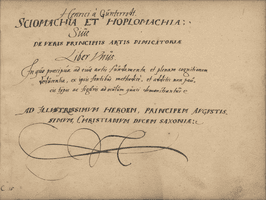
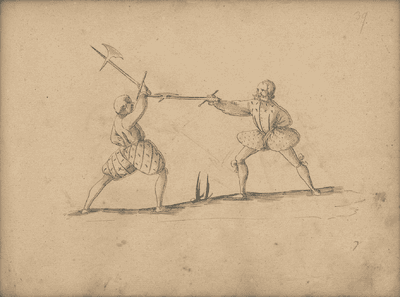
In 1579, 22-year-old Heinrich von Gunterrodt completed *Sciomachia et hoplomachia*, a fencing manual that also argues about where fencing comes from, who inherits it, and which books deserve authority. It shows techniques for grappling, dagger, dussack, poleaxe, side sword, spear, and rapier. It is one of the earliest known attempts to organize martial knowledge as history.
The man behind the text
Gunterrodt was born in Lengefeld at Schloss Rauenstein in 1557 to Hans von Gunterrodt and Elisabeth von der Linda. He studied Greek, Latin, and law, and later studied at the University of Wittenberg.
The book reads less like a narrow fencing pamphlet than a broad, theory-driven survey that treats fighting as an intellectual field with a lineage. Gunterrodt asks who said it first, who copied whom, and how a later reader should sort the claims.
A manuscript that thinks in weapons and categories
The original manuscript, MS Dresd.C.15, is held by the Sächsische Landesbibliothek in Dresden and runs to 76 folia. Its contents are unusually wide for a late-16th-century fencing text. It covers grappling, dagger, dussack, poleaxe, side sword, spear, and rapier, moving across both unarmed and armed systems instead of staying loyal to one tool or one battlefield fantasy.
Elite readers in the late 1500s wanted an overview that could hold up across multiple forms of combat. Gunterrodt’s manuscript fits that appetite neatly. It maps the art itself, not just a collection of favorite plays.
The same year, an abridged printed version appeared in Wittenberg from Matthaeus Welack under the title *De Veris Principiis Artis Dimicatoriae*. That book is 42 pages long, was dedicated to Johann VII of Mecklenburg-Schwerin, and includes poems by Gunterrodt, Johann Maior, and Heinrich Bolschen. The 76-folio manuscript is expansive and exploratory; the 42-page print is a tighter, more publicly legible statement of principle.

Why the I.33 reference changes the story
The most important historical twist is not a technique at all. A 2023 article on Latin fencing manuals identifies *Sciomachia et hoplomachia* as the first known text to explicitly refer to MS I.33, the oldest surviving fencing book. I.33 dates to roughly 1280 to 1320, with its German one-handed sword and buckler material placed around 1290. That means Gunterrodt was reaching back across roughly 250 years of martial writing and treating an older book as a source worth naming.
Practitioners today spend huge amounts of time comparing manuscripts, sorting lineages, and deciding whether a passage is a direct inheritance, a borrowed structure, or a reinvention. Gunterrodt was already doing that kind of work in the 16th century. He was classifying tradition.
The same 2023 article also frames those fight books as evidence for the relationship between Scholasticism and Humanism. Gunterrodt’s work contains scholastic references inside a Renaissance fighting manual. It places fencing at the intersection of older school methods and newer humanist habits of reading, arranging, and citing.
Court politics, fencing patronage, and the Mecklenburg connection
The dedication to Johann VII of Mecklenburg-Schwerin placed the book in a court environment where the ruler was still young and governance was still being shaped by others. Johann VII was born in 1558 and did not rule personally until 1585, after a regency period that followed his father’s death in 1576. The dedication was aimed at a princely household in transition, one that could value martial learning as part of education and status.
Mecklenburg was already a serious fencing patronage environment. Johann Albrecht I of Mecklenburg had hired Joachim Meyer to teach his son, and later Mecklenburg became an important sponsor of the Veiterfechter guild. Gunterrodt’s book sits inside that world. The court was already receptive to technical fencing culture, and his text adds historical consciousness to the mix.
Later scholarship links Gunterrodt to Balthasaro Cramonio Pomerano and to Johannes Herwart of Würzburg, which ties him into the circle associated with the discovery of the Walpurgis Fechtbuch. He was participating in a network that cared about sources, teachers, and the authority of older martial books.
Why practitioners should care now
- Source comparison was not a modern obsession but an old habit of the art itself.
- Gunterrodt gives an early example of a martial author naming an older fencing book, which helps establish how historical authority worked.
- Late-16th-century readers wanted multi-weapon synthesis, not just isolated technique.
- Fencing sat inside humanist and scholastic learning, where Latin, Greek, law, poetry, and combat shared the same intellectual frame.
This article was produced by Prism’s automated news system from verified source data, official records, and press releases, then run through automated quality and moderation checks before publishing. The system is built and supervised by the people who set the standards it runs under. Read our full AI policy.
Did this article answer your question?