Lecküchner’s messer system reveals 15th-century German fencing depth
Lecküchner’s named messer vocabulary makes a 15th-century treatise unusually coachable, with 126 folios, 415 drawings, and a system built for precise bout review.

Johannes Lecküchner’s messer treatise stands out because it does not treat the weapon like a gimmick. It presents a full fencing language, with named actions and positions that modern coaches, judges, and competitors can use with unusual precision. That is why the text still feels competition-ready: it gives structure to drilling, structure to interpretation, and structure to bout review.
A messer system with real vocabulary
Lecküchner’s art is built around named concepts rather than vague advice. The system includes the four hangings, the four stances, and actions such as the Zornhau, Absetzen, Zucken, Durchgehen, Bogen, and Messernehmen. That matters because each term identifies a specific tactical problem, whether the fighter is binding, thrusting, closing distance, or controlling the opponent’s hands and blade.
For a modern HEMA room, that kind of language is gold. A coach can point to a named structure, a judge can identify a phase of action, and a competitor can review whether the line was entered cleanly or whether a bind turned into a failed transition. The treatise is especially useful because it shows messer fencing as a system of timing, edge alignment, winding, and hand control, not just as aggressive cuts.
Lecküchner’s preface also gives the art social weight. He frames the skill as something a fighter should learn to stand properly before princes and lords, which places the messer in the world of status, display, and competence rather than pure street violence. That tone helps explain why the treatise feels so teachable: it is not merely describing how to survive a fight, but how to perform fencing as an intelligible, elite art.

The cleric from the Nuremberg area
Lecküchner was born in the Nuremberg area and studied at the University of Leipzig in 1455. He became a baccalaureus in 1457 and was consecrated as an acolyte in 1459, then later served as a communal priest in Herzogenaurach from 1480 until his death on December 31, 1482.
That biography matters because it pushes back against the easy caricature of messer fencing as a rough civilian afterthought. Lecküchner was a cleric, a trained university man, and a figure embedded in late-medieval institutional life. His 1478 manuscript, Kunst des Messerfechtens, was dedicated to Philip the Upright of Wittelsbach, Elector Palatine of the Rhine, which gives the work clear patronage and courtly context.
The surviving tradition also suggests development rather than one-off improvisation. The Heidelberg manuscript is believed to be the rough draft of the later 1482 version, which means the art was being refined across multiple manuscript stages. That gives the system a compositional depth that modern practitioners can still feel in the way techniques are grouped and explained.
What the manuscripts preserve
The Heidelberg copy, Cod. Pal. germ. 430, is cataloged by the University of Heidelberg as a paper manuscript of 126 folios, written in northern Bavaria, likely Nuremberg, around 1478. The catalogue also states that this copy and Munich BSB Cgm 582 were written by the same scribe, a detail that strengthens the link between the early and later versions.
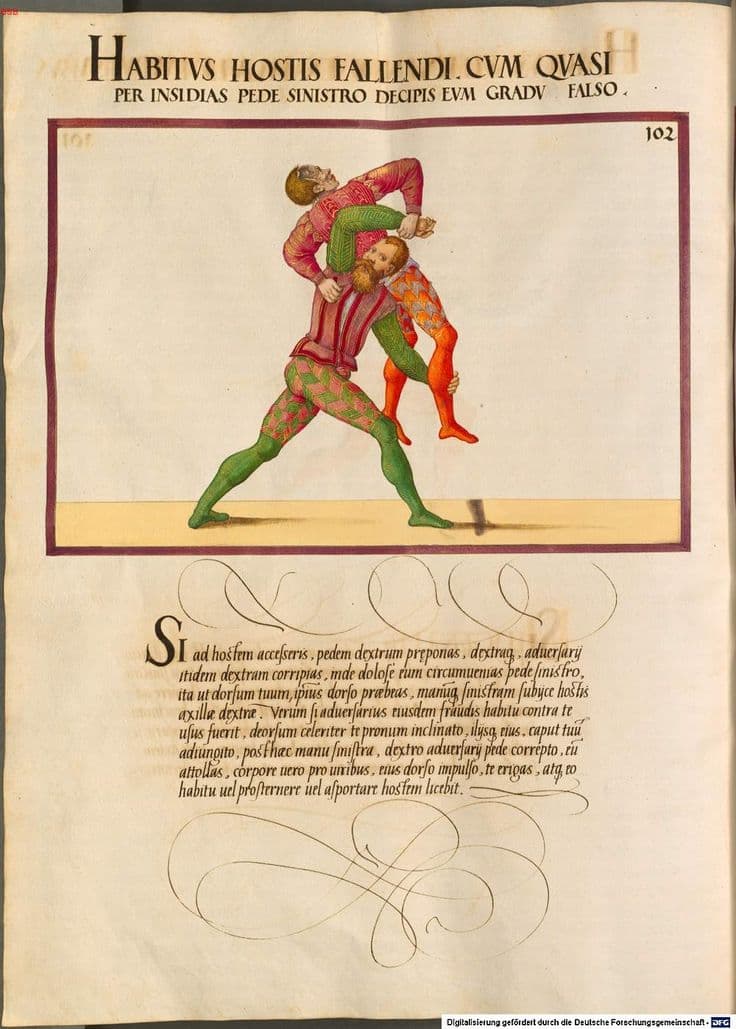
The Munich copy is visually rich, with about 415 drawings of fighters. For readers of fight books, that matters almost as much as the text itself, because the image cycle helps show posture, measure, and body shape in a way words alone cannot. The manuscript description also notes regular catchwords and multiple contemporary ownership traces, which means the work lived a real manuscript life rather than surviving as a clean, isolated author’s draft.
Cambridge University Press describes the 1482 treatise as one of the most important surviving combat texts of the Middle Ages. It also stresses that Lecküchner’s techniques apply beyond the messer itself to single-handed swords and other weapons with similar handling properties. In practical terms, that expands the treatise from a narrow weapon manual into a broader source for cut-and-thrust fencing.
Why the source still teaches well
The value of Lecküchner’s system becomes clearer when you place it beside later scholarship. Wiktenauer notes that some 19th-century scholars wrongly treated Lecküchner’s name as a corruption of Liechtenauer’s, but archival evidence and the manuscript colophon show that Lecküchner was a separate historical author. His system also seems closely related to Johannes Liechtenauer’s long-sword teachings, which helps explain why the messer material feels integrated into the broader German fencing tradition rather than detached from it.
A more recent study of the tradition found that about 59 of 432 pages in Lecküchner’s fight book contain material copied from the Jude Lew fechtbuch, or roughly 13.6 percent. That does not weaken the work’s value. It shows Lecküchner operating inside a living network of Liechtenauer-related material, borrowing, arranging, and reframing ideas into a coherent messer curriculum.
The weapon itself also deserves the serious treatment the text gives it. Metallographic studies of surviving late-medieval messer blades show skilled manufacture and good-quality construction, not crude tooling. That fits the manuscript evidence: this was a serious civilian and military weapon in late medieval Central Europe, one that rewarded clean edge alignment, smart structure, and controlled entry more than brute force.
Lecküchner’s messer system endures because it solves several problems at once. It explains a historical weapon, preserves a named technical vocabulary, and gives modern fencers a source that can still be drilled, judged, and discussed with precision. In a crowded HEMA landscape, that combination is rare, and it is exactly why Lecküchner remains one of the most useful voices in 15th-century German fencing.
This article was produced by Prism’s automated news system from verified source data, official records, and press releases, then run through automated quality and moderation checks before publishing. The system is built and supervised by the people who set the standards it runs under. Read our full AI policy.
Did this article answer your question?