MSS I.33, the oldest known European fencing manual, defined sword and buckler
MSS I.33 is the oldest known European fight book, and its real value is tactical: the sword-and-buckler ideas at its core still shape how HEMA is trained and interpreted today.
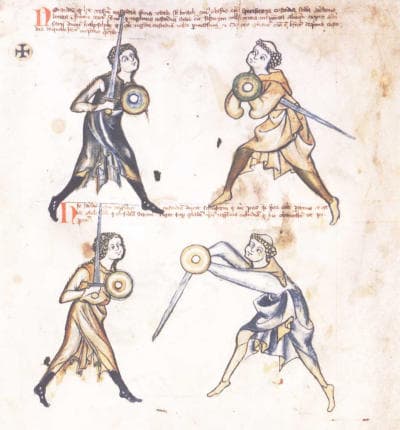
The oldest surviving European fencing manual does not read like a relic. MSS I.33 is a compact 32-leaf codex, 64 parchment pages in all, and it lays out sword-and-buckler instruction with the kind of clarity modern HEMA practitioners still chase in the salle. The Royal Armouries places it in the early 14th century, around 1330 in Germany, which makes it the earliest known example in Europe of a fencing manual, or fechtbuch, that fighters can point to when they talk about formal armed instruction.
What I.33 is, and why that matters
I.33 matters first because it is early, and then because it is structured. The manuscript is written in Latin, with some German technical terms, and its lessons are organized around paired play between figures usually called the Scholar and the Priest, with a later character, Walpurgis, entering the action. That cast gives the book a dramatic shape, but it also signals instruction: this is not just a story about swords, it is a sequence of lessons meant to be studied.
The Royal Armouries says there is no record of the manuscript for roughly its first 250 years, which leaves a long silence between creation and documentation. That gap matters because it forces modern readers to treat the book as both evidence and puzzle. The exact place of production is still unknown, even if Germany remains the working assumption, so every claim about the manuscript has to be built from the object itself, not from a tidy archival trail.
The techniques inside the book
For sword-and-buckler work, I.33 is valuable because it does not stay abstract. ARMA’s discussion of the manuscript notes that it lays out cuts, thrusts, parries, disarms, and attacks to vulnerable targets like the hands, shins, feet, and ankles. That is a real fighting syllabus, not a museum label, and it explains why the manuscript still gets serious attention from people who spar with steel and protect their hands for a reason.
That sequence also tracks with what modern practitioners recognize on the floor. Sword-and-buckler fencing is about managing line, timing, and the opening created by the buckler as much as about raw blade work, and I.33 repeatedly rewards the fighter who can move from one threat to the next without losing structure. The manual’s insistence on hand strikes and lower-line attacks is especially current, because anyone training this weapon set learns fast that small targets and short weapons punish lazy defense.
Why the manuscript still drives modern reconstruction
The biggest modern lesson in I.33 is not a single technique. It is the way reconstruction works. The Royal Armouries identifies the manuscript as a teaching text, but nobody can prove whether it was used in a classroom, copied as a reference, or both, and that uncertainty is exactly where HEMA lives today. Practitioners have to infer method from the images, captions, layout, and the order in which the lessons appear, which means interpretation is not a side issue, it is the engine.
That is also why the manuscript’s authorship and production matter. The Royal Armouries notes that I.33 appears to have been produced by at least two scribes and several artists under a single unknown author. For modern readers, that makes it a case study in medieval workshop production, not the lone genius model people sometimes project onto fight books. The pages were built by hands, revised by hands, and altered by hands, which fits a manuscript that teaches how to fight with a sword in one hand and a buckler in the other.

How the manuscript survived, and how it was read later
The physical object tells its own story. The Royal Armouries points to surviving marks, erasures, layout instructions, later damage, graffiti, annotations, and even a looter’s signature, all of which show that I.33 had a long afterlife after it was made. Those details are not decoration. They show a working artifact that passed through use, neglect, handling, and collecting, which is exactly the kind of biography that makes a manuscript useful to historians and fighters alike.
The book’s later history adds another layer. Secondary summaries note that it was long kept in the Tower of London, which is why it is often called the Tower manuscript, before it entered the Royal Armouries collection in Leeds. That provenance matters because it places the manuscript inside a recognizable chain of custody, one that turned an obscure fechtbuch into a protected museum object with research value and public reach.
The modern breakthrough that changed its audience
I.33 was not always widely known. A secondary source aimed at HEMA readers says the manuscript reached a broader audience in 1997 through Jeffrey L. Forgeng’s article in the Royal Armouries Yearbook, and that timeline helps explain why the book moved from specialist manuscript study into broader martial-arts conversation relatively late. Once that happened, I.33 stopped being just the earliest surviving European fight manual and became a reference point for how modern sword-and-buckler communities build interpretations from incomplete evidence.
That shift still shapes how people train it. I.33 is not a modern rulebook, so it does not hand over a complete competitive format or a finished coaching plan. It gives a sequence of lessons, figures, and tactical priorities, then leaves gaps that modern practitioners have to fill with sparring, comparison, and pressure testing. In practical terms, that means every reconstruction of the Scholar’s play, every reading of Walpurgis’ role, and every decision about distance or tempo carries a layer of interpretation on top of the source.
Why I.33 sits at the start of a longer tradition
I.33 is the first surviving witness, not the whole tradition. HEMA reference lists point to later sword-and-buckler material in German manuscripts connected with figures such as Andres Liegnitzer and later masters, which shows that I.33 sits at the start of a written line rather than alone on an island. That matters because it lets modern students see development over time: I.33 shows the first surviving written form, while the later fechtbücher show how a teaching culture continued and expanded.
The Royal Armouries is the right custodian for that story. As a national museum dedicated to arms and armour, it preserves the manuscript while also supporting research and public interpretation, which keeps I.33 active rather than static. That combination, an early 14th-century codex, a long period of obscurity, a late-20th-century rediscovery, and a living reconstruction culture around it, is why I.33 still defines sword and buckler in HEMA now.
This article was produced by Prism’s automated news system from verified source data, official records, and press releases, then run through automated quality and moderation checks before publishing. The system is built and supervised by the people who set the standards it runs under. Read our full AI policy.
Did this article answer your question?