Why the Fellowship of Liechtenauer matters to HEMA history
The Fellowship of Liechtenauer is HEMA’s earliest clear proof of a connected teaching network, and its 17-name roster still shapes how fighters judge lineage and legitimacy.

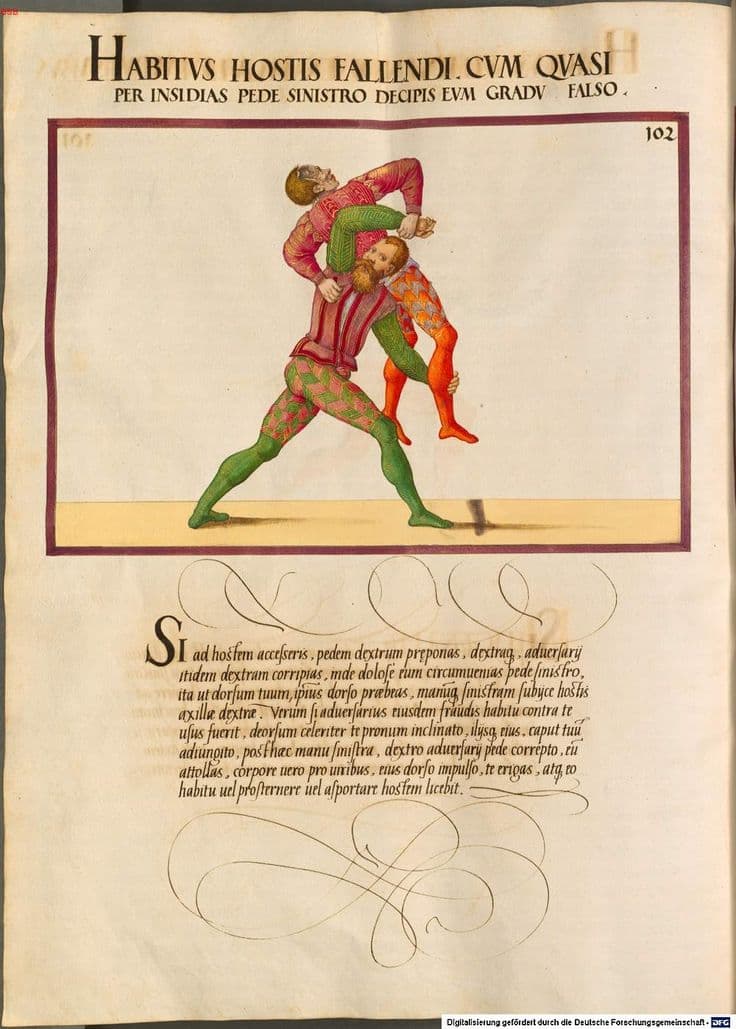
Paulus Kal’s manual, dated to around 1470, preserves a named roster of seventeen masters in the introductions to its three oldest copies. It is the first solid proof that this German fencing tradition moved through real relationships, not isolated texts.
A roster in the Kal tradition
The Fellowship of Liechtenauer, also called the Geselschaft Liechtenauers, is a specific roster embedded in the surviving Kal tradition, with the original Cgm 1507 copy held by the Bayerische Staatsbibliothek in Munich. The list survives inside a manuscript family that can be traced as part of a fencing book produced in the mid-15th century and copied in the decades that followed.
Johannes Liechtenauer gives the tradition its name; Peter von Danzig, Andre Lignitzer, and Ott Jud left their own treatises or shaped the textual tradition that survives today. The roster also names Sigmund ain Ringeck and Hans Stettner von Mörnsheim, while others appear mainly through this one list.
What the Fellowship may have been
What the Fellowship actually was remains uncertain. It may have been a formal organization, a wartime company, or a memorial roll of masters.
One plausible explanation links the Fellowship to the Gesellschaften, the armed companies formed by fighting men in the early 1400s, especially during the Hussite Crusades of the 1420s and 1430s. That connection gives the roster a practical setting: men moved, campaigned, and learned in groups, not in isolation.
The timeline of the tradition
Hans Talhoffer records the Zettel in 1443 and again in 1459, which shows that the core verse tradition was already circulating well before Kal compiled his own manual. By 1452, Liechtenauer, Martin Huntfeltz, Andre Lignitzer, and Ott Jud were dead, while Peter von Danzig was still alive. That makes Kal’s 1470 roster look less like a current club membership list and more like a retrospective honor roll of a tradition that had already changed shape.
Paulus Kal was attached to three different courts and served in at least three campaigns, tying the fencing material to the movement of courtly and military life. His manuscript tradition came out of travel, service, and the practical circulation of martial knowledge across central Europe.
The reach of Liechtenauer fencing
The Fellowship’s list stretches across present-day Austria, the Czech Republic, Germany, and Poland. Liechtenauer fencing was not simply a local Bavarian or Saxon curiosity. The roster points to a broad martial culture in which teachers, students, and manuscript owners could operate across regional lines while still treating the same core tradition as shared.
It provides independent confirmation of some masters’ connection to Liechtenauer’s system, while also showing how much of the tradition survives only through fragments. Modern HEMA is reconstructed from manuscripts, partial lineages, and overlapping terminology. The Fellowship helps explain why different sources sometimes use similar terms, preserve related tactical ideas, or treat the same concepts as inherited rather than invented.
From manuscript roll to fencing guilds
The roster also foreshadows the later institutional life of Liechtenauer fencing. The tradition became central to the Marxbrüder and the Federfechter, the fencing guilds that later gave German martial arts a formal public structure. The Marxbrüder received imperial patent from Frederick III in 1480.
The Federfechter followed a different path. Founded around 1570 in Prague, they were recognized in Frankfurt in 1575.
Modern HEMA and provenance
Wiktenauer, which began in 2009, is an ongoing collaboration among scholars and practitioners building a source library for Western martial arts research. The community’s digital infrastructure is doing something structurally similar to what the Kal tradition did in manuscript form: gathering names, comparing versions, and tracing who connects to whom.
For fighters, instructors, and tournament organizers, that networked view helps answer questions that still define the sport. Which terminology belongs to which branch of the tradition? Which tactical ideas recur across manuscripts because they came from shared teaching, not coincidence? Which masters belong to a living chain of transmission, and which are known only through a single surviving witness? The Fellowship of Liechtenauer gives HEMA its earliest clear map of a tradition moving through people as well as pages.
This article was produced by Prism’s automated news system from verified source data, official records, and press releases, then run through automated quality and moderation checks before publishing. The system is built and supervised by the people who set the standards it runs under. Read our full AI policy.
Did this article answer your question?