Chuck Taylor’s Indiana roots trace basketball’s rise and his iconic legacy
Chuck Taylor’s path from a Brown County gym to a global shoe logo began before Indiana basketball had fully found its footing. His story is the state’s original player-to-brand pipeline, built in school gyms and sold to the world.

Chuck Taylor’s name is stamped on one of the most recognizable shoes in sports, but the Indiana part of his story is what makes it endure. The Indiana Historical Society’s collection materials place his birth in Brown County in 1901 and show him rising fast at Columbus High School, where he became captain of the varsity basketball team as a sophomore. That is the kind of detail Indiana basketball still loves: a local kid, a school gym, and a player good enough to lead older teammates before his high school career was even fully underway.
Taylor also played in an era when the game itself was still taking shape in the state. He logged his first semi-professional game on March 19, 1919, with the Columbus Commercials, which means he was moving through organized basketball just as Indiana was turning the sport from a novelty into a state identity. The line from Brown County to Columbus is not just a biography. It is the setup for how a Hoosier player helped define the look and business of basketball far beyond Indiana.
Indiana basketball was still being built
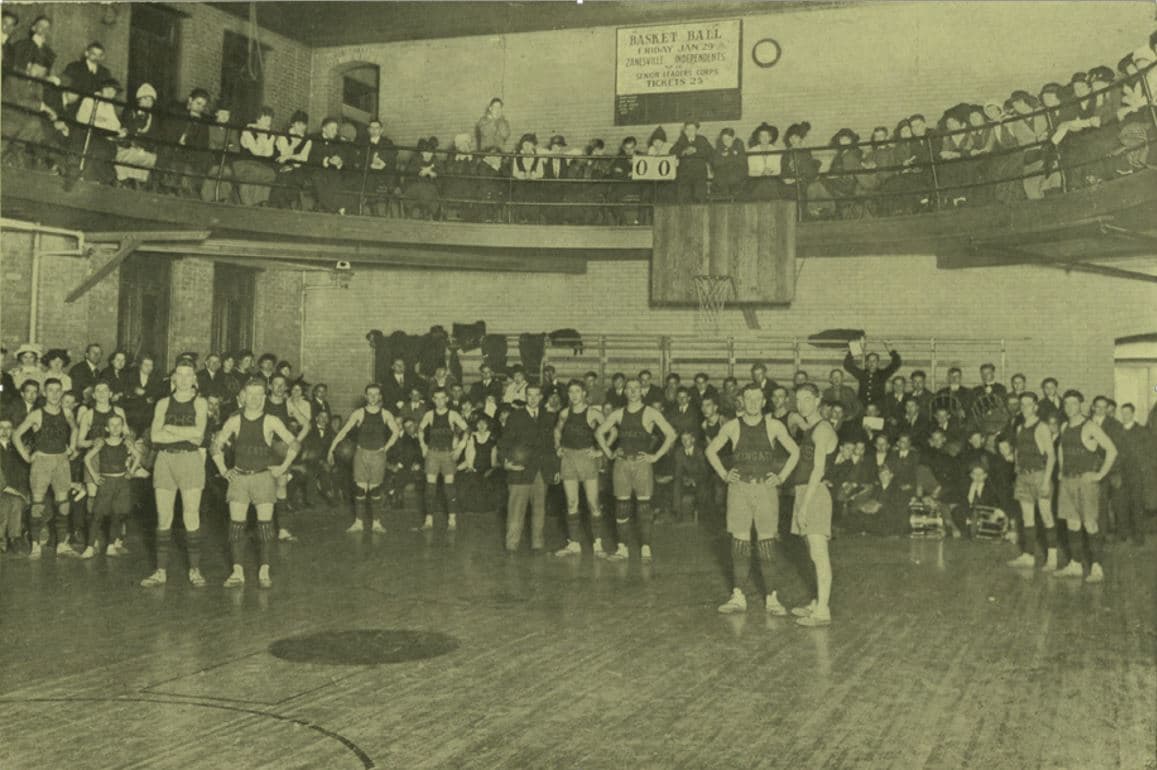
Taylor’s rise overlaps almost perfectly with the state’s early basketball architecture. The Indiana High School Athletic Association traces its origins to a meeting in April 1903, and its first boys basketball state tournament came in 1911. State-history sources also point to one of the earliest organized high school teams in Indiana dating to around 1900, when early opponents were hard to find and the sport was still spreading school to school.
That context matters because Taylor did not enter a mature system with decades of tradition already behind it. He came through during the era when Indiana was inventing its own basketball culture, from scheduling to competition to the idea that a high school gym could become a civic center. Indiana commemorates 1915 as the year of perhaps the earliest surviving photo of an Indiana high school basketball game, a reminder that the visual record of the sport was still young when Taylor was beginning to stand out.
The result is a cleaner and more interesting story than the usual Hall of Fame résumé. Taylor was not merely produced by Indiana basketball. He was part of the generation that helped make Indiana basketball feel inevitable.
A high school star becomes a salesman with a better idea
The on-court credentials were already there. The Naismith Memorial Basketball Hall of Fame identifies Taylor as a two-time All-State selection at Columbus High School, and Smithsonian materials say he made Indiana’s High School All-State Team in 1918. That kind of profile gave him credibility, but his real leap came when the playing career started to bend toward business.
In the summer of 1921, Taylor walked into Converse’s Chicago sales office complaining of sore feet. The Hall of Fame says that conversation helped persuade executives to create a shoe made specifically for basketball, a small complaint that turned into a product line with national reach. Converse hired him in 1922, and Taylor became part salesman, part player-coach for the Converse All Stars, giving clinics and making appearances across the country while helping sell the game as much as the shoe.
That is the player-to-brand pipeline in its purest form. Taylor was not just endorsing a product after the fact. He was one of the people shaping what basketball footwear should solve for: traction, durability and support on hard gym floors. In modern terms, he was both athlete and marketing engine, years before that combination became standard.

The shoe that followed the sport everywhere
Converse added Taylor’s signature to the shoe in 1932, turning a basketball product into a personal brand. Nike’s history page says the Chuck Taylor All Star was worn by basically every top basketball player before 1965, and that Converse outfitted the United States men’s team at the 1936 Olympics with custom white Chucks marked by red and blue stripes. Those details show how quickly Taylor’s influence moved from Indiana gyms to the biggest stages in the sport.
By the late 1960s, the business side had become almost as striking as the playing one. Smithsonian says Converse controlled nearly 90 percent of the basketball-shoe business by that point, which is hard to overstate in an era when one brand could nearly own the sport’s footwear conversation. Taylor’s imprint helped make the shoe not just common, but culturally defining. Every time a player laced up a pair of Chucks, they were stepping into a design that carried Indiana’s early basketball era with it.
That is why the Chuck Taylor story still lands with modern fans who know the game through rankings, shoe deals and recruiting graphics. Before there were social-media edits of prospects choosing schools in custom gear, there was a Hoosier who turned the state’s school-game credibility into a national product identity. Taylor helped prove that a player from an Indiana gym could become a brand recognized anywhere basketball was played.
Why the story still fits Indiana high school basketball now
Indiana high school basketball has always treated its gyms as proving grounds, and Taylor’s career is one of the clearest examples of what happens when that proving ground produces more than points. His path runs from Columbus High School to the Columbus Commercials, from a sore-foot complaint in Chicago to a shoe on the feet of elite players and Olympic teams. The specifics are old, but the model feels familiar: athletic reputation, local credibility and a larger stage that turns both into commerce.
The Hall of Fame lists Taylor’s death as June 23, 1969, one day before his 68th birthday, and his enshrinement in 1969 closed the loop on a career that had already escaped the boundaries of Indiana. But the better way to read his legacy is through the state that formed it. Brown County gave him his start, Columbus High School gave him his platform, and Indiana’s early basketball culture gave him a place where a gifted teenager could become part of the sport’s history.
That is the real significance of Chuck Taylor in Indiana basketball. He was not just an excellent player from the state. He was one of the first to show how a high school star could become a brand that outlived the box score.
This article was produced by Prism’s automated news system from verified source data, official records, and press releases, then run through automated quality and moderation checks before publishing. The system is built and supervised by the people who set the standards it runs under. Read our full AI policy.
Did this article answer your question?