How Indiana girls basketball began its state tournament legacy in 1976
Indiana girls basketball went from permission to permanence in 1976, when Warsaw beat Bloomfield for the first IHSAA title and the sport found its own stage.

Indiana girls basketball did not begin as a side note. It became official, and then it became unavoidable. When the IHSAA opened the door to a state tournament in 1976, the sport already had demand, talent, and communities ready to treat it like a major event, and Warsaw’s 57-52 win over Bloomfield in the first finals gave that new era a starting point no one could miss.
The first championship gave the sport its first landmark
The inaugural girls state finals landed at Hinkle Fieldhouse, a venue already carrying heavy basketball history in Indiana, and the game itself delivered the kind of finish that helps a new tradition take root. Warsaw’s five-point victory over Bloomfield did more than crown a first champion. It gave the state a score, a site, and a name to attach to the beginning of official girls tournament play.
That mattered because an official bracket changes how a sport is seen. Before the tournament, girls basketball in Indiana had players, schools, and local followings; after 1976, it had a statewide endpoint, a champion, and a place in the record book. The IHSAA’s recognition of the 25th year of girls basketball as a tournament sport reflects how fast that shift happened, from an opening act into an established part of the state’s sports calendar.
Hinkle Fieldhouse became the first home of the new tradition
The first four state finals belonged to Hinkle Fieldhouse, which hosted the championship games from 1976 through 1979. That detail is more than a venue note. It shows the IHSAA placing girls basketball on one of the sport’s most iconic stages from the start, rather than isolating it on a smaller or lesser-used court.
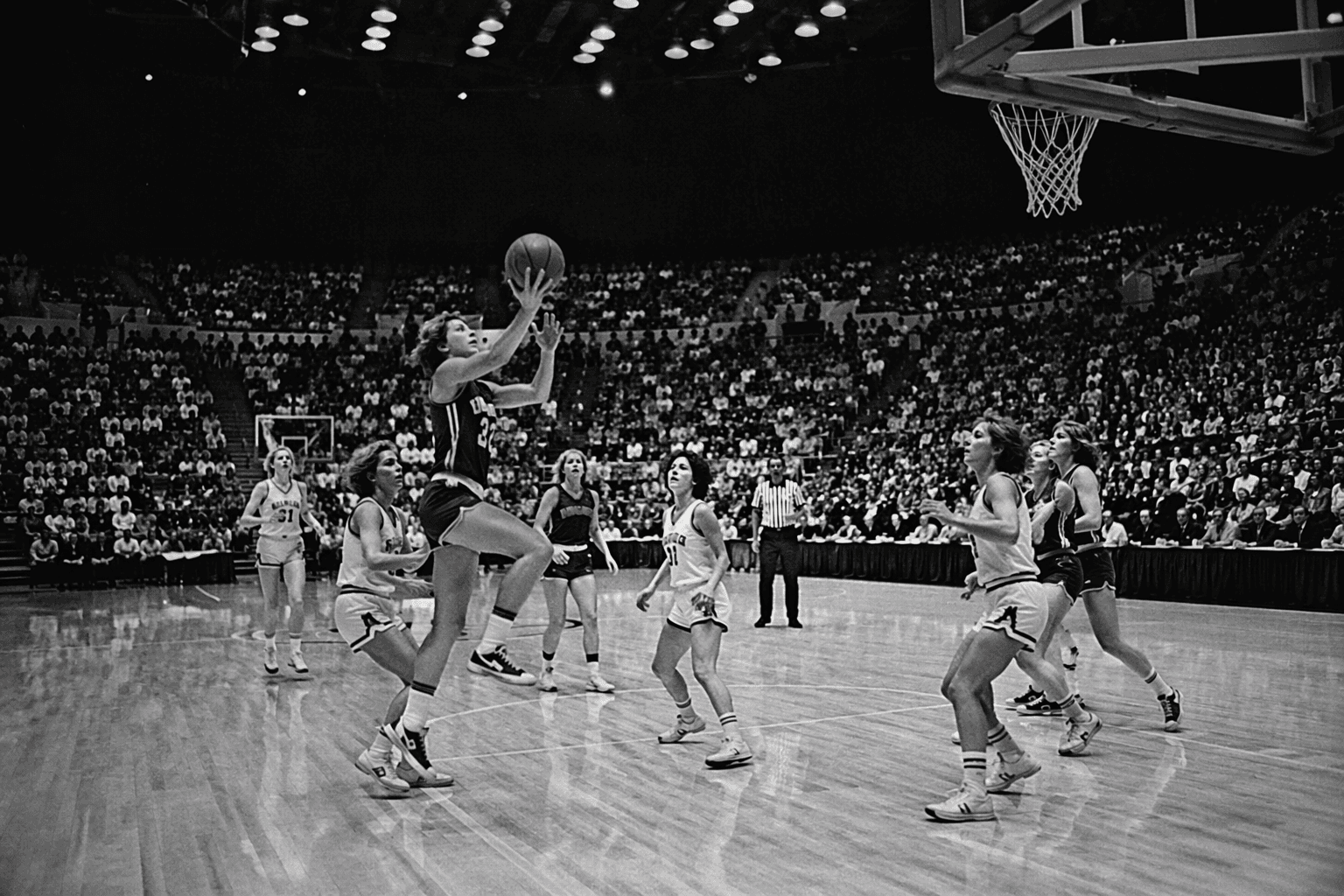
The move to Market Square Arena from 1980 through 1999 marked the next step in the game’s rise. By shifting into a bigger, more prominent setting, the tournament was no longer simply an experiment in official recognition. It was an event with enough weight to move, grow, and claim a larger audience, and that progression helped girls basketball build its own identity beyond the men’s game that had long defined Indiana’s hoops culture.
Those venue changes also tell a business story as much as a sports story. A tournament that can move from Hinkle to Market Square Arena is a tournament that has earned visibility, scheduling priority, and the kind of institutional support that turns a new competition into a durable asset. Indiana did not just sanction girls basketball in 1976. It invested in a platform that could carry it.
The first stars gave the game a face
Championships create memory, but players create legacy. The IHSAA’s Silver Era selection recognized that by placing early standouts at the center of the sport’s first 25 years, including Judi Warren of Warsaw, LaTaunya Pollard of East Chicago Roosevelt, Maria Stack of Columbus East, and Stephanie White McCarty of Seeger. Their names matter because they show how quickly the girls game produced its own stars across different schools and regions of the state.
White McCarty stands out even among that group. At the time the Silver Era publication was produced, her 2,869 career points made her Indiana’s all-time leading scorer in girls basketball. That kind of number is a reminder that the sport was not waiting for legitimacy before it delivered elite production. The talent was already there, and the tournament simply gave that talent a larger audience and a permanent statistical trail.

The early years also built a map of Indiana girls basketball that extended beyond one powerhouse or one city. Warsaw, East Chicago Roosevelt, Columbus East, and Seeger represent different parts of the state and different kinds of programs, which is part of why the sport grew so quickly. Once the tournament existed, the state could compare, remember, and celebrate players across school lines in a way that local play alone never could.
The Silver Era selection turned a new sport into a historical record
The IHSAA did not treat those first 25 years as a blur of games. It organized them into a history worth preserving, and the Silver Era team was chosen by a 19-person panel that included coaches, broadcasters, sportswriters, officials, and athletic administrators. That selection process matters because it shows girls basketball had moved from novelty to institution. A sport that can assemble that kind of panel is a sport that has already earned its archives.
The point of that recognition was not just nostalgia. It was to identify the standards that later generations would chase, from scoring totals to championships to the status attached to certain names and schools. Once the first finals had a champion, once the venue list started to grow, and once the early stars were formally honored, girls basketball in Indiana no longer needed to prove it belonged. The tournament had already done that work for it.
That is why 1976 remains the cleanest marker of the modern era. It is the year Indiana stopped treating girls basketball as a separate conversation and started building it into the state’s main basketball story, one championship, one venue, and one generation of stars at a time.
This article was produced by Prism’s automated news system from verified source data, official records, and press releases, then run through automated quality and moderation checks before publishing. The system is built and supervised by the people who set the standards it runs under. Read our full AI policy.
Did this article answer your question?