Indiana's Trester and Craft Awards Honor Character Beyond the Court
Indiana's oldest high school basketball character honor traces to a 1916 Vincennes businessman's proposal; here's who votes, how winners qualify, and what the award signals to colleges.

Two awards close out every IHSAA boys basketball state finals: the Arthur L. Trester Mental Attitude Award, given to a senior in the larger classifications, and the Ray Craft Mental Attitude Award, presented in the smaller ones. Both are presented annually to a senior participant in each classification who was nominated by his principal and coach and has demonstrated excellence in mental attitude, scholarship, leadership, and athletic ability. Neither is a scoring title. Neither goes automatically to the player who made the biggest shot. Together they represent something the state of Indiana has been formally measuring at its tournament since before Prohibition ended.
A 110-Year-Old Idea
The award dates to 1916, when Jacob (Jake) Gimbel, a Vincennes businessman and philanthropist, approached the IHSAA Board of Control with a proposal to give a cash prize and medal to the boy at the state basketball tournament who showed the best mental attitude. Gimbel was clear about his intent: he did not have in mind the quality of any boy's playing, but rather the qualities that belong to a real gentleman, recognizing the mental and moral strain under which players compete during the tournament. The Board of Control formally accepted the proposal at its November 17, 1916 meeting.
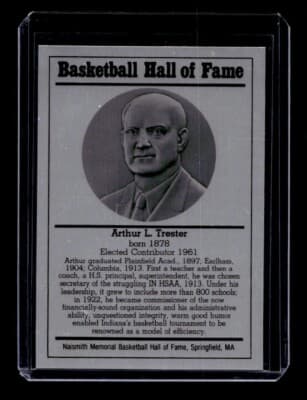
The award is named for Arthur L. Trester, the first commissioner of the IHSAA, who served from 1922 until his passing in 1943, and who designed Indiana's famous boys basketball tournament as it rose to national prominence under his leadership. His name was attached to the award beginning in 1945. The Ray Craft award carries a more recent legacy: it is named in honor of former IHSAA Associate Commissioner Ray Craft, who served at nearly every level of Indiana secondary education and interscholastic athletics during his career from 1983 to 2008.
The tradition has also spread beyond basketball. During the 1960s, mental attitude awards were presented for the first time in sports other than boys basketball: a boys track and field recipient was announced in 1962, boys wrestling in 1964, and baseball in 1968, with even more sports added through the 1970s.
Who Votes and How Nominees Qualify
A senior student-athlete participating in the state finals, nominated by his or her principal and coach, is selected by the IHSAA Executive Committee for demonstrating excellence in mental attitude, scholarship, leadership, and athletic ability during their high school career. The nomination requirement is deliberate: it filters for players whose entire school community, not just a coach, can vouch for their standing. A student-athlete must be on a state-finalist squad to be eligible, which means the recognition is reserved for programs that have already survived sectional, regional, and semistate competition.
The IHSAA Executive Committee evaluates nominees across four specific pillars:
- Mental attitude: work ethic, sportsmanship, and composure under adversity throughout the season and tournament
- Scholarship: academic performance and classroom citizenship over the full high school career
- Leadership: team leadership and mentorship of younger players
- Athletic contribution: on-court role and impact, with an emphasis on intangibles alongside statistics
The award is deliberately not a statistical honor. Recipients often are players who elevated teams through resilience and model behavior as much as through box scores.
Ceremony Details and Timeline
During the awards presentation, a member of the IHSAA Executive Committee announces the name of the mental attitude award recipient, and the recipient's parents are then invited to join them in the presentation, oftentimes in front of thousands of spectators. That student is then presented a plaque made of walnut in the shape of the state of Indiana and, depending on the sport, a $1,000 scholarship from one of the IHSAA's presenting sponsors, including Indiana Farm Bureau Insurance, the Indianapolis Colts, Indiana Pacers, or Indiana Fever.
A separate award is given in each of the four classifications at Gainbridge Fieldhouse, meaning four Trester or Ray Craft recipients are named across the boys basketball state finals weekend every March. The postgame ceremony is typically the first formal recognition of the evening, before championship nets are cut and team trophies are distributed.
Past Winners: What the List Looks Like
The range of recipients over the decades illustrates how broadly the criteria are applied. Jason Holsinger of Lapel, the 2005 Arthur L. Trester Mental Attitude Award winner, scored 14 points in the Class A championship game, including five during a decisive run. His performance that afternoon was central to the game, but his selection reflected the full picture of his senior year.
More recently, Brady Webber of Mt. Vernon (Fortville) received the Arthur L. Trester Mental Attitude Award in Class 4A Boys Basketball, selected by members of the IHSAA Executive Committee. At the Class 1A level, Orleans High School's Bryce Jones, the first recipient of an IHSAA mental attitude award in any sport in school history, was a member of the National Honor Society and worked with younger children through the "Bullpups" athletic department program. In basketball, Jones was a four-year varsity letterwinner, senior captain, and third in Orleans school history in assists, while also competing in cross country and track and field. Jones's profile is representative of what the award consistently rewards: a senior whose contributions ran across the athletic department, the classroom, and the community simultaneously.
What the Award Signals to Colleges and Communities
For programs and recruiting, the distinction carries practical weight. Coaches and athletic directors regularly reference Trester and Ray Craft recognition in scholarship recommendation letters and in materials submitted alongside a National Letter of Intent. College programs recruiting from Indiana understand what the designation means and what the selection process required. For athletic directors, it is a credential that reflects the entire program culture, not just one player's talent.
For small Indiana towns, the impact is compounded. Recipients' names appear in program histories, local newspaper archives, and community record books in ways that outlast any single season's win total. The award ceremony at Gainbridge Fieldhouse, with parents called onto the court in front of the state finals crowd, gives that recognition a public weight that a letter or plaque delivered in a gymnasium cannot replicate.
Coaching staffs also use the awards in offseason messaging: that building responsible citizens is as deliberate a goal as installing an offensive system. A program that routinely produces nominees, even without winning the award, signals to its players and parents that the school expects more than athletic performance from its seniors. That expectation, reinforced year after year, is exactly what Jake Gimbel had in mind when he walked into the IHSAA Board of Control meeting in 1916.
This article was produced by Prism’s automated news system from verified source data, official records, and press releases, then run through automated quality and moderation checks before publishing. The system is built and supervised by the people who set the standards it runs under. Read our full AI policy.
Did this article answer your question?