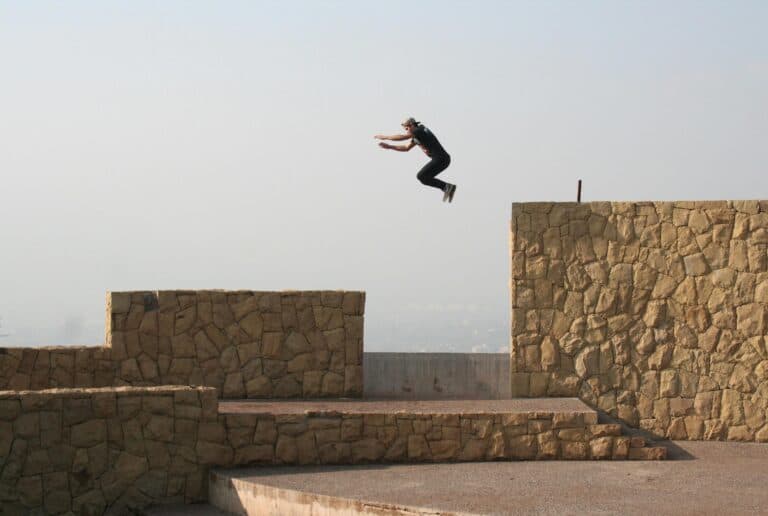
Parkour Generations pushes coaching standards as sport professionalizes
ADAPT is becoming parkour's real backstop: better coach training, clearer safeguards, and a pathway that touches every gym, school class, and youth program.

ADAPT certifications are now delivered in more than 25 countries. On the floor, a coach’s judgment changes how quickly a beginner advances, how a youth class handles risk, and how a facility owner decides who is ready to lead a session. Parkour Generations has spent years turning that judgment into a shared standard as parkour moves beyond small crews and into schools, community programs, and structured competition.
Why ADAPT matters as parkour expands
Parkour Generations was central to creating Parkour UK, which it identifies as the world’s first national governing body for parkour, and founder Dan Edwardes created the A.D.A.P.T. coaching certifications.
The scale was visible in 2019, when ADAPT had its busiest year yet, with hundreds of practitioners certifying as coaches across countries as far apart as Australia, Bolivia, Italy, China, the United States, Peru, Taiwan, the Netherlands, Finland, Mexico and Malaysia. China alone produced more than 120 certified coaches, while Italy added another 60. Parkour’s growth has created demand for coaches who can teach progression consistently, not just perform the movements themselves.
ADAPT sits inside Parkour Generations’ broader education and training work for parkour coaches, fitness trainers, school teachers, and other professionals.
The pathway is designed as a progression
ADAPT is built to separate entry-level exposure from actual coaching authority. The Ground Level Award is a two-day movement and theory course, it is optional, and it is not a coaching certification. From there, the pathway moves to Level 1 Foundation Coach, Level 2 Lead Coach, Level 3 Master Coach, and Coach Educator.
The age gates are built into that structure. Level 1 is for candidates aged 16 and older, and Level 2 is for candidates aged 18 and older. The system also leans on intensive practical coaching, theory sessions, micro-teach feedback, and rigorous assessments where passing is not guaranteed.
In parkour, movement style can be mistaken for readiness to teach. A good jumper is not automatically a good instructor, and ADAPT’s structure is built around that gap by asking coaches to demonstrate how they explain skills, manage progression, and correct mistakes in real time.
Safeguarding is part of coaching, not a side rule
Parkour Generations treats safeguarding as a coaching standard rather than bureaucracy. Its position starts from the power imbalance in any class: the coach controls the space, the pace, and often the confidence of the group in front of them.
The practical rule is straightforward. ADAPT-certified coaches working with children, young people, or adults at risk must hold a recognized safeguarding qualification that fits their country of practice, and they must renew it in line with national guidance, typically every three years. That requirement gives parents, schools, and venue operators a clearer benchmark when they are deciding who should be trusted with minors or vulnerable participants.
It changes how a coach handles physical contact, supervision ratios, and the boundaries of a session, especially in mixed-age or school-based settings where the stakes are higher than a casual gym meet-up.
Parkour’s other governing systems are formalizing too
ADAPT is not operating in isolation. Parkour Generations Americas presents ADAPT as the industry standard for parkour instruction, and the global ADAPT network supports coaches in both personal and professional development.
The World Freerunning Parkour Federation designed its certification program to preserve parkour’s grassroots nature while establishing safe practices and a common vocabulary of movement. By 2025, it had certified more than 3,000 instructors globally. At the governance level, the International Parkour Federation was established in 2014 and identifies itself as the sport’s world governing body.
What better coaching changes for the people inside the sport
For athletes, the payoff is cleaner instruction. Better coaches explain progression more clearly, spot unsafe choices earlier, and create sessions that develop precision jumps, vaults, movement efficiency, and decision-making instead of just chasing spectacle.
For parents, certification offers a quicker way to judge whether a class is serious about responsibility. For facility owners and school partners, it reduces guesswork when hiring instructors or setting up programs, because the pathway makes age requirements, assessment standards, and safeguarding duties visible.
This article was produced by Prism’s automated news system from verified source data, official records, and press releases, then run through automated quality and moderation checks before publishing. The system is built and supervised by the people who set the standards it runs under. Read our full AI policy.
Did this article answer your question?