Parkour vs freerunning, the key difference explained
Parkour is about the cleanest path through an obstacle. Freerunning keeps the same roots, but adds flips, flair, and performance.
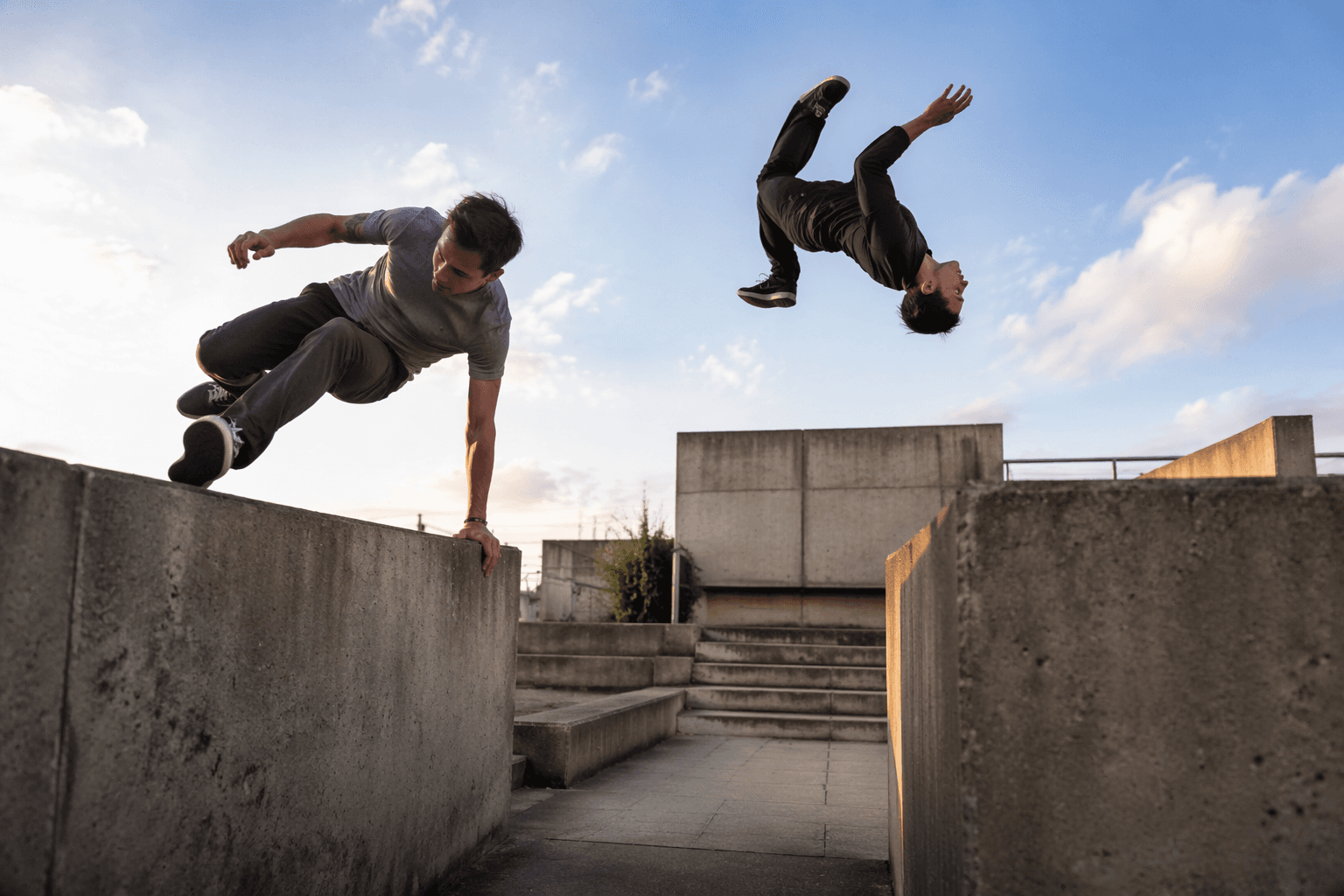
A wall run, a vault, and a rooftop line can all look similar, but parkour asks how fast and cleanly you can get from point A to point B. Freerunning asks what else you can do with that line once efficiency is already solved.
The split starts with the goal
That difference begins with purpose, not with tricks. Parkour emerged in France in the late 1980s as a discipline built around direct movement, the quickest and most efficient way to negotiate obstacles. Freerunning grew out of the same culture, but the emphasis shifted toward expression, with twists, flips, and aerial style taking on a bigger role.
Parkour is efficiency-focused; freerunning is creativity-focused. If the movement is designed to conserve momentum and clear space with the fewest wasted motions, you are watching parkour at work. If the line is built to impress as much as to travel, freerunning has entered the frame.
Why the names diverged
The terminology matters because the split was personal as well as technical. Sébastien Foucan introduced the movement in Britain, where it became known as freerunning, and he and David Belle disagreed about where the discipline should go. Both men left the original group, and that separation became part of the sport’s identity.
The original organized group tied to the movement was Yamakasi, and that history still hangs over every modern discussion of the labels. Once the movement left its French core and spread through Britain, the name freerunning gave the style a wider, more international feel. Parkour kept its focus on speed, efficiency, and obstacle management, while freerunning opened the door to greater creativity and more expressive movement.
How the discipline went mainstream
Parkour did not stay underground for long. The discipline spread through Internet videos, television commercials, and films, including Casino Royale in 2006. That exposure changed how the public saw it: not as a niche training method, but as a visually striking way to move through urban space.
That visibility also blurred the vocabulary for casual viewers. A clip of a precision jump, a vault over a rail, and a backflip off a wall can all get filed under the same broad label online, even though the intent behind each movement is different. One prioritizes efficiency; the other layers performance on top of traversal.
What competition changed
The sport’s institutional life pushed the conversation into a new phase. The Fédération Internationale de Gymnastique gave the green light in February 2017 to develop parkour as a new sport, and FIG now organizes events into two categories: Speed and Freestyle. That split mirrors the same philosophical divide seen on the street. Speed rewards the cleanest, fastest route, while Freestyle makes room for style, variety, and controlled risk.
FIG held its second Parkour World Championships in Kitakyushu, Japan, from November 15-17, 2024. Parkour was also included among the gymnastics disciplines at The World Games 2025 in Chengdu, China.
A practical test for readers
The easiest way to tell parkour from freerunning is to ask what the line is trying to prove. If the athlete is taking the shortest useful route across the obstacle, that is parkour. If the athlete is using the obstacle as a stage for creative movement, then the line is freerunning, even if the same wall, rail, or ledge appears in both.
There are a few useful cues to watch for:
- Utility first: the route is chosen for speed, safety, and efficiency.
- Creativity first: the route is chosen to add flair, style, or a signature trick.
- Obstacle management: parkour tends to strip movement down to the minimum required to get through.
- Performance value: freerunning often keeps the travel function, but adds spins, flips, and showmanship.
A front flip off a ledge may be impressive, but if the cleanest line was a simple vault, the movement has moved from parkour logic into freerunning expression.
This article was produced by Prism’s automated news system from verified source data, official records, and press releases, then run through automated quality and moderation checks before publishing. The system is built and supervised by the people who set the standards it runs under. Read our full AI policy.
Did this article answer your question?