Asia qualifier in Japan spotlights tightening pickleball pipeline ahead of World Cup
Mauro Garcia and Bobbi Oshiro left Utsunomiya with gold, but the bigger story was Asia’s qualifier circuit showing how much closer local players are getting to the touring elite.
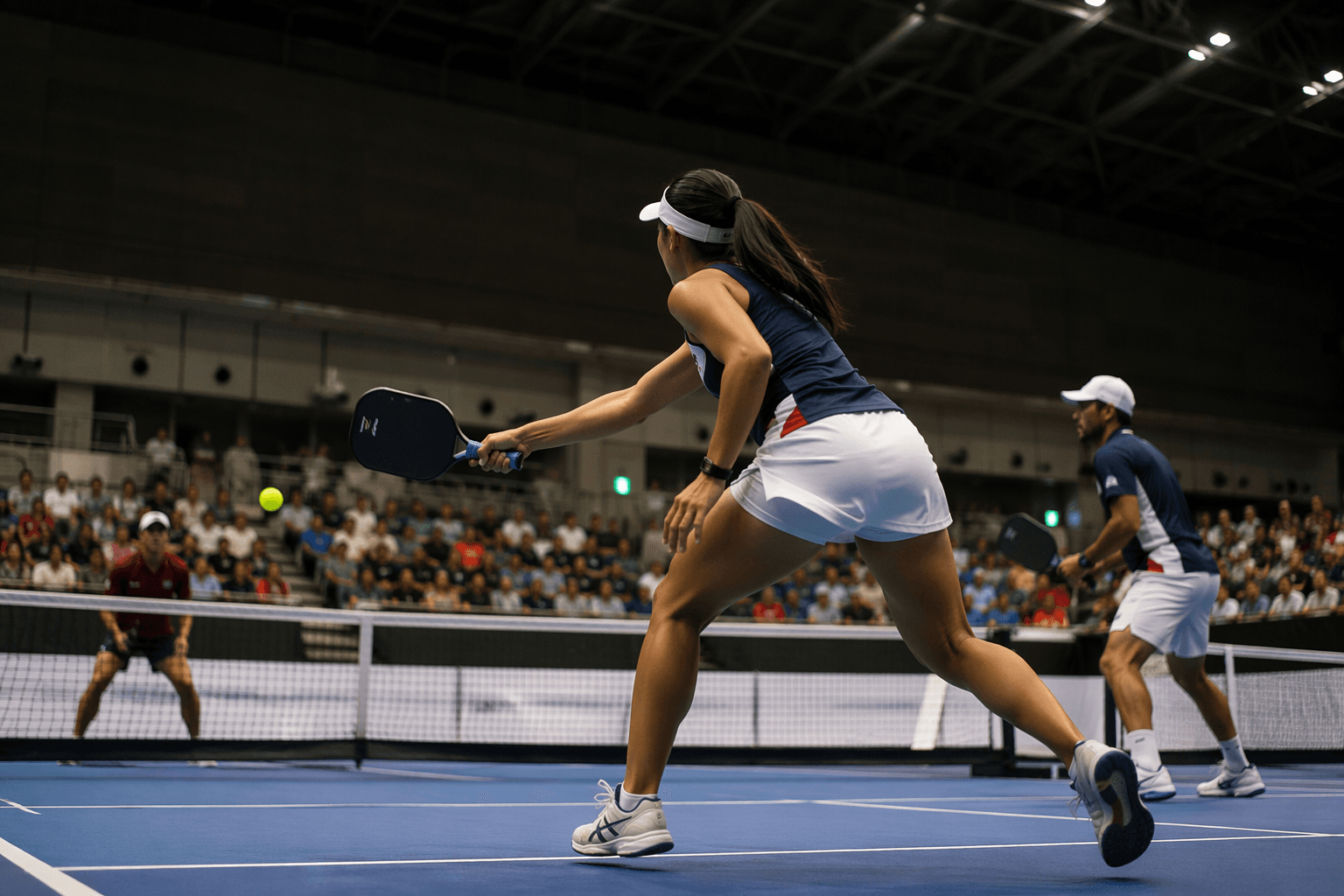
The sharpest signal from Utsunomiya was not just who won, but who had to be beaten to get there. Mauro Garcia, an 18-year-old from Spain, and Bobbi Oshiro again carried the day against a field built to mix Japan’s best with a deliberate wave of overseas talent, turning the KINTO APP Asia Qualifier Series into a stress test for the region’s next level.
A qualifier built to measure Asia against the world
The tournament ran July 10-12, 2026, at Nikkan Arena Tochigi in Utsunomiya, Tochigi Prefecture, under a name that had already shifted from the provisional APP JAPAN KINTO Open UTSUNOMIYA 2026 to KINTO APP ASIA Qualifier Series UTSUNOMIYA 2026. It was staged with Pickleball Japan in partnership with APP and used pickleballjapan.org software to manage entries and draws, a reminder that the event was built like a serious pro stop, not a local exhibition.
The structure mattered. Singles were played on Friday, gender doubles on Saturday, and mixed doubles on Sunday, with a total prize purse of 2 million yen. The pro fields were also intentionally narrow and internationalized: singles brackets held 24 players each, with 8 overseas slots, 14 general pro slots and 2 wild cards, while doubles brackets held 32 pairs each, with 10 overseas slots, 20 general pro slots and 2 wild cards. Official materials said the pro categories awarded five times the usual PJ points, giving the results extra weight in Japan’s new selection ladder.
That ladder now reaches beyond a single tournament win. One official notice described the event as part of the pathway for Japan’s Pickleball World Cup 2026 selection, and post-event rankings and results were also set to feed that process. The field was not limited to the pros either: amateur 19+, 35+ and 50+ divisions ran alongside wheelchair and unified competition, showing a federation trying to build depth while the elite game accelerates around it.
Men’s singles delivered the cleanest read on the gap
Men’s pro singles came down to the top two seeds, Jake Bower and Mauro Garcia, after a draw that was mostly based in Japan but punctuated by the overseas slots that changed the ceiling of the bracket. Garcia, whose calm under pressure matched the pace of his rise, beat the 23-year-old Floridian in straight games to take the title.
That result mattered because it showed how the imported standard is shaping the local conversation. Utsunomiya was not a closed national championship with a few foreign guests. It was set up to pull in elite travel players, and the final reflected exactly that design. For Japan and the broader Asia circuit, the question is no longer whether overseas pros will show up. It is whether the best regional players are getting enough of these repeated, high-pressure matchups to close the distance.
Women’s singles and doubles showed Asia’s closer range
The women’s pro singles bracket was tighter to the region in some places, but it still finished with the familiar names of traveling standouts in the late rounds. Bobbi Oshiro and Brooke Revuelta moved through the draw as expected, while Nicola Schoemann and Taiwan’s Yu-Chieh Hsieh emerged as the regional names that pushed the bracket hardest.
Hsieh’s semifinal win over Revuelta, 9-3, was one of the loudest swings of the event and the clearest sign that Asia-based players are not just filling out draws anymore. Oshiro answered by recovering from dropping the first game in the final and still taking gold, a familiar pattern in a tournament where one clean disruption could force a title match to turn on composure rather than reputation.
The doubles draws carried the same theme, only with even more volatility. In mixed pro doubles, Oshiro paired with Keven Wong to beat David Bieger and Lauralei Singsank, and the title gave both Oshiro and Wong double golds for the week. Men’s doubles produced the biggest upset line of the event: Wong and Daniel Moore knocked out top seeds Will Wimbish and Roman Estareja in the semifinals before finishing off Bower and Bieger in the final. In women’s doubles, Brooke Revuelta teamed with Australia’s Nicola Schoemann to beat top seeds Bobbi Oshiro and Fukunaga Hinano.
That pattern is important because it shows where the regional field is tightening fastest. The names pushing the bracket were not always the seeded stars, and they were not always from Japan. Taiwan’s Hsieh, Australia’s Schoemann and pairings like Wong and Moore were able to turn seeding into a movable target. That is what a maturing circuit looks like: not parity, but enough strength in enough places to force the elite to survive real tests.
Why Utsunomiya matters for Japan’s new system
The institutional backdrop is just as important as the results. Pickleball Japan said it was created by the merger of the Japan Pickleball Association and the Japan Pickleball Federation in April 2026, and Utsunomiya became one of the first major international exams for the unified body. A merged federation is supposed to do more than collect logos and titles; it is supposed to align rankings, selection, and event staging into one pathway.
That is why the five-times PJ points format and the World Cup selection role matter beyond one weekend. The event was not only a showcase for imported pros. It was also an early look at whether Japan’s new structure can turn a high-profile stop into a development tool for local players, rather than just a stage where outsiders set the standard and leave with the trophies.
For Asia, that tension is the real story. The Utsunomiya fields were intentionally capped, internationally stocked, and weighted toward the professional end of the sport, but the outcomes showed a region closer to the benchmark than it was a year ago. The circuit is still being driven by traveling elite players, yet the pressure from Hsieh, Schoemann, Wong and others suggests the pipeline is tightening fast enough to make the next qualifier matter even more.
This article was produced by Prism’s automated news system from verified source data, official records, and press releases, then run through automated quality and moderation checks before publishing. The system is built and supervised by the people who set the standards it runs under. Read our full AI policy.
Did this article answer your question?