Gulf Region's Commercial Pickleball Boom Offers Blueprint for Asian Growth
Private capital has turned Dubai into pickleball's most instructive commercial lab outside the US, and the playbook is already replicable from Singapore to Riyadh.
The Gulf's Pickleball Gold Rush
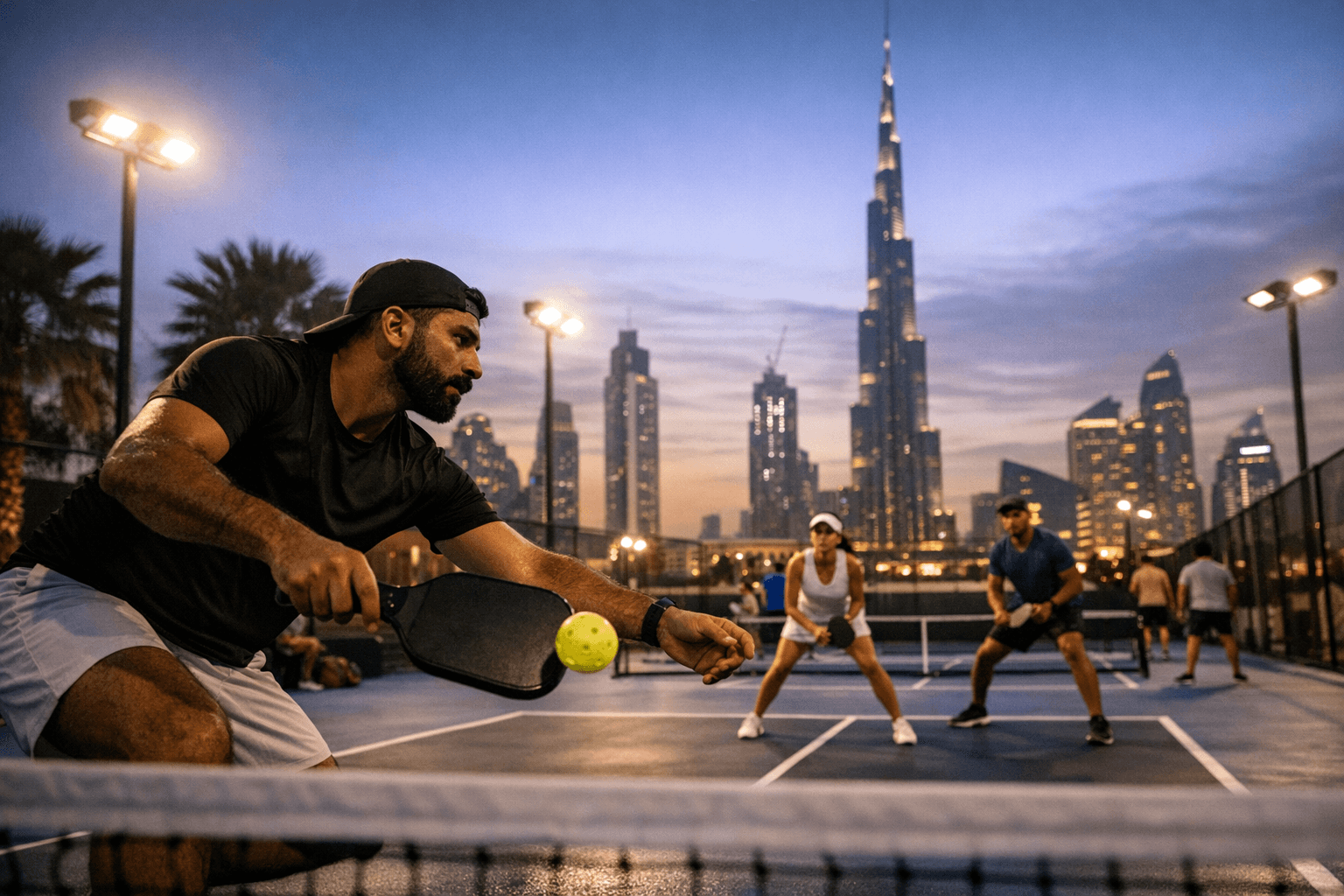
When Picklers Dubai opened its doors with professional-grade flooring, a designer pro shop, a café, and full youth and adaptive programming baked into the launch plan, it signaled something bigger than a new sports venue. It was a declaration that pickleball in the Gulf was bypassing the grassroots scrappiness that defined the sport's early years in North America and going straight to premium. The facility is not an outlier. Across Dubai, operators including Pickle Turf, which runs courts at both the Port Rashid and Danube Sports World locations, and Dubai Sports World, which offers three courts alongside an academy structure built around camps, club play, and leagues, have staked the same bet: in a market where the customer base is largely affluent expatriates and wellness-conscious hospitality visitors, quality-first is the only viable opening position.
Over the last 24 months, the Gulf and wider Middle East region has seen an accelerated, commercially driven adoption of pickleball. The driving forces are three distinct demand pools: a large, sports-literate expatriate community already familiar with racket sports; hotel and leisure operators integrating pickleball as a premium amenity; and real estate and entertainment developers using the sport as an anchor for mixed-use activations. Understanding how those demand pools interact, and what each one pays, is the starting point for any Asia-based investor sizing up a comparable opportunity.
Where the Demand Actually Comes From
The expatriate community is the deepest and most reliable demand source. Dubai's population is roughly 90% non-national, and a significant share comes from markets, including the United Kingdom, India, South Asia, and the United States, where pickleball has already reached mainstream recreational status. That pre-conditioned audience dramatically compresses the education cycle: operators do not need to teach the sport from scratch, they need to provide the courts and the social infrastructure around them. Court fees at venues like Delano Dubai on Bluewaters Island are priced accordingly, running AED 120 for 60 minutes on weekdays and AED 150 on weekends, a rate that translates to roughly US$33–41 per session and signals a clear premium positioning.
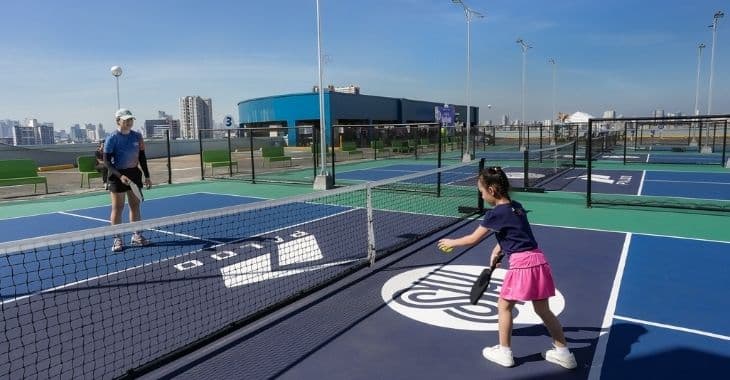
Hotel and leisure operators represent the second demand pool, and it is expanding fastest. Waterfront properties and resort-linked venues are installing courts as part of broader lifestyle amenity packages, treating pickleball the way they once treated padel or rooftop tennis: as a differentiator that justifies premium room rates and attracts non-staying guests willing to pay court fees or minimum spends. The business logic is clean. A single court footprint of approximately 20 by 44 feet is compact enough to fit into rooftop or poolside spaces that would otherwise generate minimal revenue, and an indoor commercial court typically costs between US$50,000 and US$150,000 to build, a relatively low barrier compared to the lifetime revenue potential of a well-trafficked amenity court.
The third demand pool, corporate and institutional, is arguably the most valuable for long-term revenue stability. Corporate leagues and wellness programming generate predictable, block-booked revenue that smooths the seasonal volatility inherent in leisure-dependent markets. Gulf operators are actively packaging this, and the model has direct precedent in Southeast Asia. In Singapore, Play! Pickle has delivered corporate sessions for institutions including DBS Bank, OCBC Bank, Apple, Nike, Decathlon, and the Singapore Tourism Board, demonstrating that pickleball's low entry barrier and social format make it one of the most sellable team-bonding products in the market.
Business Models: What Is Actually Winning
Three distinct revenue structures are competing for dominance in the Gulf right now, and each maps to a different operator profile.
The premium membership club model, exemplified by Picklers Dubai, monetizes through a layered offering: court hire, coaching packages, pro shop retail, and food and beverage, all wrapped into a membership that creates recurring revenue and community lock-in. The risk is that the model self-limits the addressable market to higher-income players and risks low court utilization during off-peak hours if the member base does not grow fast enough.
The pay-per-play model, dominant at hotel-integrated venues like the Delano Dubai and at multi-sport facilities like Dubai Sports World, captures transient and tourist demand without requiring the capital investment of a full membership operation. Yield per court is lower but risk-adjusted returns can be superior, particularly for operators that already own the real estate. The comparable in Southeast Asia is Singapore's Kings Pickleball Arena, which opened at the Holiday Inn Singapore Atrium with four outdoor courts designed specifically to capture hotel guest traffic alongside the broader residential catchment.
The academy-led model is the third structure, and in the Gulf it is increasingly being viewed as both a revenue line and a strategic hedge. Dubai Sports World's academy program bundles camps, club play, and competitive leagues into a structured pathway. University programs and junior academies serve a dual function: they generate coaching revenue and program fees in the near term, while building the local participation base that makes the broader facility economics sustainable over a five-to-ten-year horizon.
The Asia Comparison: Unit Economics Across Markets
For investors benchmarking the Gulf against established Asian markets, the pricing spread is instructive. Singapore public courts run as low as S$3.30 per hour while premium hotel-linked courts, like those at The Fullerton Hotel, command S$40 per hour. In Hong Kong, public facility pricing sits around HK$204 per session while private commercial courts charge HK$400 to HK$700 per hour depending on facility quality and membership status. Dubai's AED 120–150 per hour positions it at the upper end of the Asian premium tier, roughly comparable to Hong Kong's top private venues, but serving a market where willingness to pay is structurally high because of the expat income profile and the absence of heavily subsidized public court alternatives.
The coaching rate gap is equally significant. The Gulf is actively recruiting international coaches and building curated junior programs precisely because local coaching depth does not yet exist. That talent bottleneck is not unique to the Gulf: it is the single most consistent capacity constraint across Asia's emerging pickleball markets, and it is the variable most likely to determine which cities scale fastest.
Three Replicable Playbooks
The Gulf's trajectory distills into three specific playbooks that Asia-based operators can adapt directly.
First, the hospitality anchor: partner with a hotel or resort to install one to four courts, price them at a meaningful premium above public-court alternatives, and use the hotel's existing marketing infrastructure to drive initial bookings. The court investment is recoverable within two to three years at moderate utilization, and the ongoing operating cost is low.
Second, the corporate league: build a structured corporate league product with a fixed season, team branding, and a finals event. Block-booked by companies as a wellness benefit, this model generates predictable revenue that is largely weather and seasonality-independent when courts are indoor, and it creates a natural pipeline into individual memberships as players develop personal attachment to the sport.
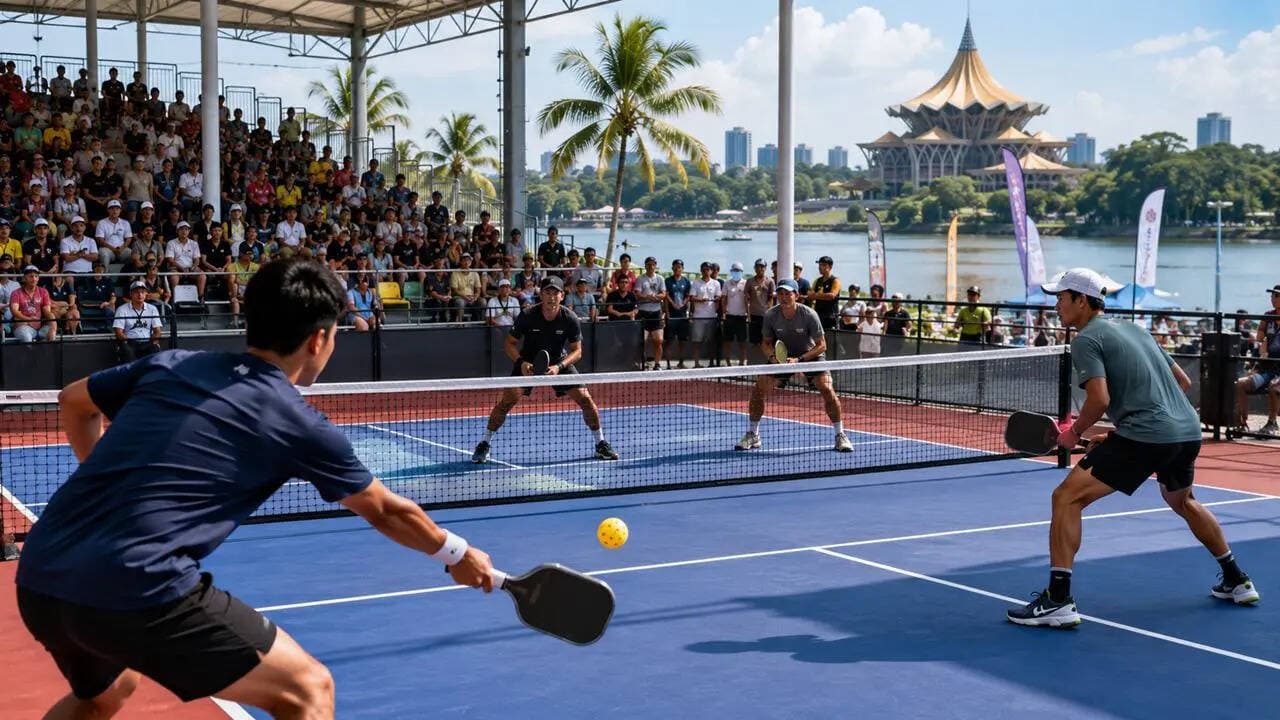
Third, the spectacle-to-pipeline conversion: the Gulf's use of stadium rooftop exhibitions, celebrity tennis crossover matches, and drone-assisted production has generated sponsorship visibility and tourism partnerships. The critical discipline, and the point where several Gulf activations have fallen short, is connecting that spectacle directly to measurable registration events, beginner coaching packages, and competition pathway sign-ups. Spectacle without a downstream enrollment mechanism is marketing spend with no retention multiplier.
The Biggest Risk: Oversupply and Seasonality
No Gulf market analysis is complete without acknowledging the structural risks, and there are two that matter most to external investors. Seasonal demand concentration is the first. Outdoor pickleball in the Gulf is largely a winter sport: summer temperatures routinely exceed 40°C, compressing the high-season window to roughly October through April. Indoor facilities absorb that risk but require higher capital outlay and add air conditioning operating costs that do not exist in Singapore, Bangkok, or Hong Kong.
The second risk is oversupply. The Gulf's early operators benefited from compressed competition and a demand base that outpaced supply. As more hotel operators, real estate developers, and standalone club operators enter simultaneously, the premium pricing that currently underwrites the economics will face compression. Dubai is already showing early signs of this dynamic, with operators moving from premium-only positioning toward broader community programming specifically to widen the addressable market before a price war erodes margin.
The talent bottleneck deserves its own flag. Coaching exports and shared-academy models are emerging as a potential solution, with the Gulf and adjacent South Asian markets working to scale international coach recruitment. For Asia markets building their own programs, the lesson is to invest in coach certification infrastructure early, before the demand curve outruns the supply of qualified instruction. The operators that control the coaching pipeline will control the participation pipeline, and in a market where competition for court hours is intensifying, that is a durable competitive advantage.
This article was produced by Prism’s automated news system from verified source data, official records, and press releases, then run through automated quality and moderation checks before publishing. The system is built and supervised by the people who set the standards it runs under. Read our full AI policy.
Did this article answer your question?