Kathmandu Pickleball Grows From Portable Nets to 30 Courts
Nepal's capital went from portable nets to 30+ reported courts, with Flash Pickleball Nepal's Samir Pokhrel helping turn Kathmandu into the country's emerging competitive pipeline.
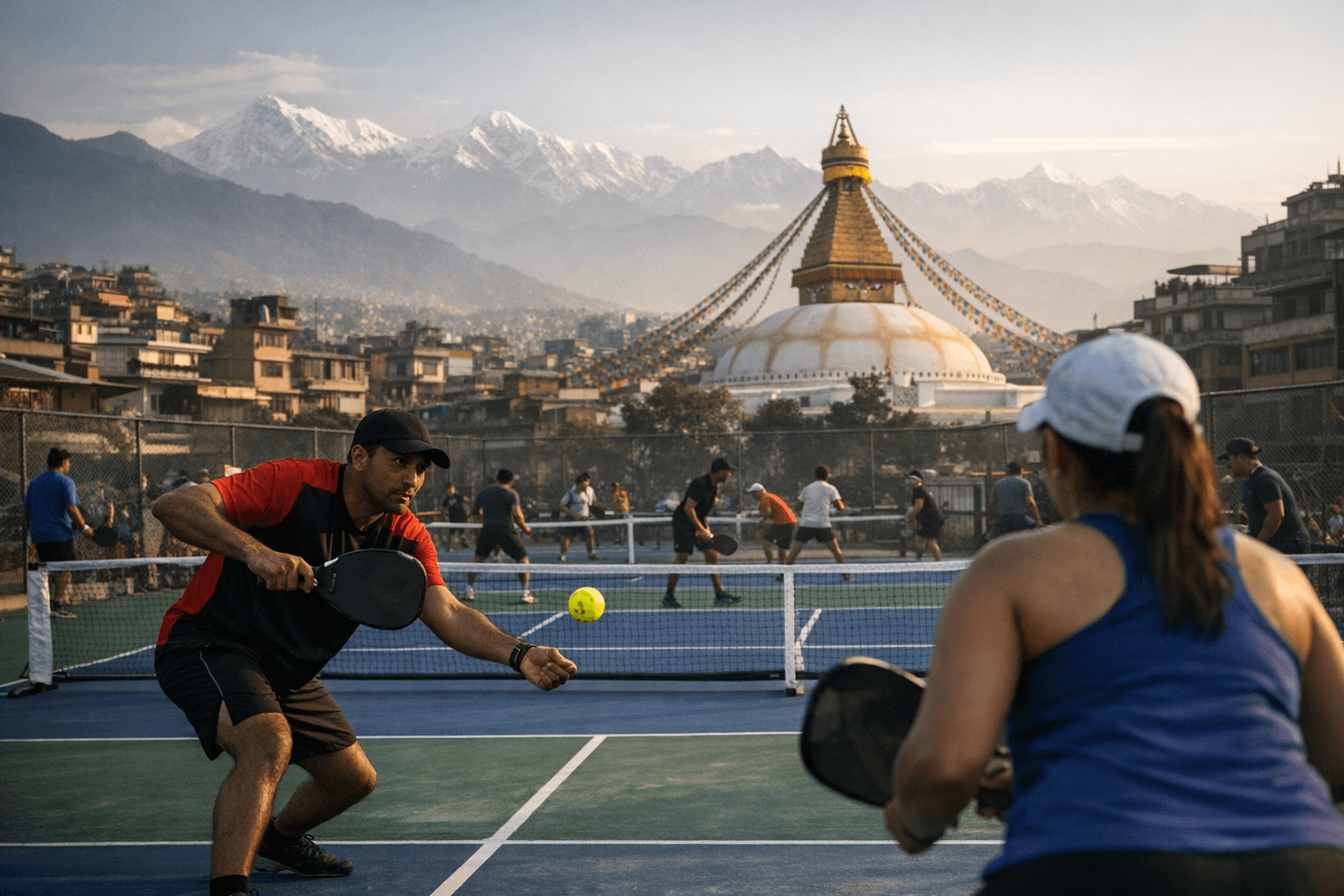
When Pickleball Nepal staged the country's first national championship at Dasharath Stadium in Kathmandu, more than 200 players arrived to compete from across the country. The picture just a few years earlier was entirely different: a handful of travelling enthusiasts returning to the city with portable nets and a small cache of paddles, running ad hoc sessions wherever space allowed.
The gap between those two moments captures how quickly a sport can scale in a space-constrained city when the infrastructure happens to fit. A pickleball court occupies a fraction of the footprint demanded by tennis or badminton, making it one of the few racquet sports that can be inserted into Kathmandu's dense urban fabric without displacing anything else. The sport's playability indoors or outdoors adds another layer of utility in a climate where outdoor options narrow through winter.
Samir Pokhrel, co-founder of The Flash Pickleball Nepal, emerged as one of the central figures in that scaling process. Alongside fellow top-ranked athlete Subarna Shah, Pokhrel built a coaching and tournament operation that gave the sport a structured home in the capital. That institutional backbone, combined with the Pickleball Association Nepal's court-development programme, pushed the reported court count in Kathmandu past 30 by January 2026, though that figure encompasses multi-use conversions that operators have not uniformly confirmed. The broader association now lists courts in Lalitpur, Bhaktapur, and Biratnagar as well.
Some venues have moved definitively past the portable-net era. Dunkmandu Covered Hall, one of the capital's most active facilities, runs two permanent indoor wood courts with fixed lines. But purpose-built pickleball infrastructure remains the exception; the majority of courts are adapted spaces painted over existing surfaces, a pragmatic beginning that serves uptake but creates scheduling conflicts as demand grows.
The national championship, inaugurated by Minister of Youth and Sports Anup Raj Joshi, confirmed that competitive appetite already exists at scale. The Pickleball Association Nepal has since launched a junior training programme at Satdobato Sports Complex in Lalitpur and school-based curricula across Kathmandu, Pokhara, and Chitwan. The missing layer remains human infrastructure: certified coaches are scarce, and referee development has barely begun. Without both, the sport can accumulate participants while stalling below the threshold needed to attract sponsors or produce internationally competitive players.
That threshold is now within reach. Thirty-plus courts across the Kathmandu Valley represent enough density for a structured city ranking system and the kind of inter-city format that draws broadcast interest. Sponsorship in Nepal's emerging sports market tends to follow attendance milestones, and a national championship that drew more than 200 competitors in its inaugural edition is precisely the proof-of-concept that converts local enthusiasm into external investment. Kathmandu arrived at pickleball by accident, via luggage and portable nets. The sport's next journey out of the city looks considerably more deliberate.
This article was produced by Prism’s automated news system from verified source data, official records, and press releases, then run through automated quality and moderation checks before publishing. The system is built and supervised by the people who set the standards it runs under. Read our full AI policy.
Did this article answer your question?