Pipinya Pickleball Club Builds Sri Lanka's Sport From the Ground Up
Fazi Jameel "fell in love" with pickleball on YouTube during COVID, then built Sri Lanka's first club on an abandoned Moratuwa lot; two years later, Pipinya has hosted eight tournaments and a Skechers grand slam.
The Abandoned Lot That Started a National Sport
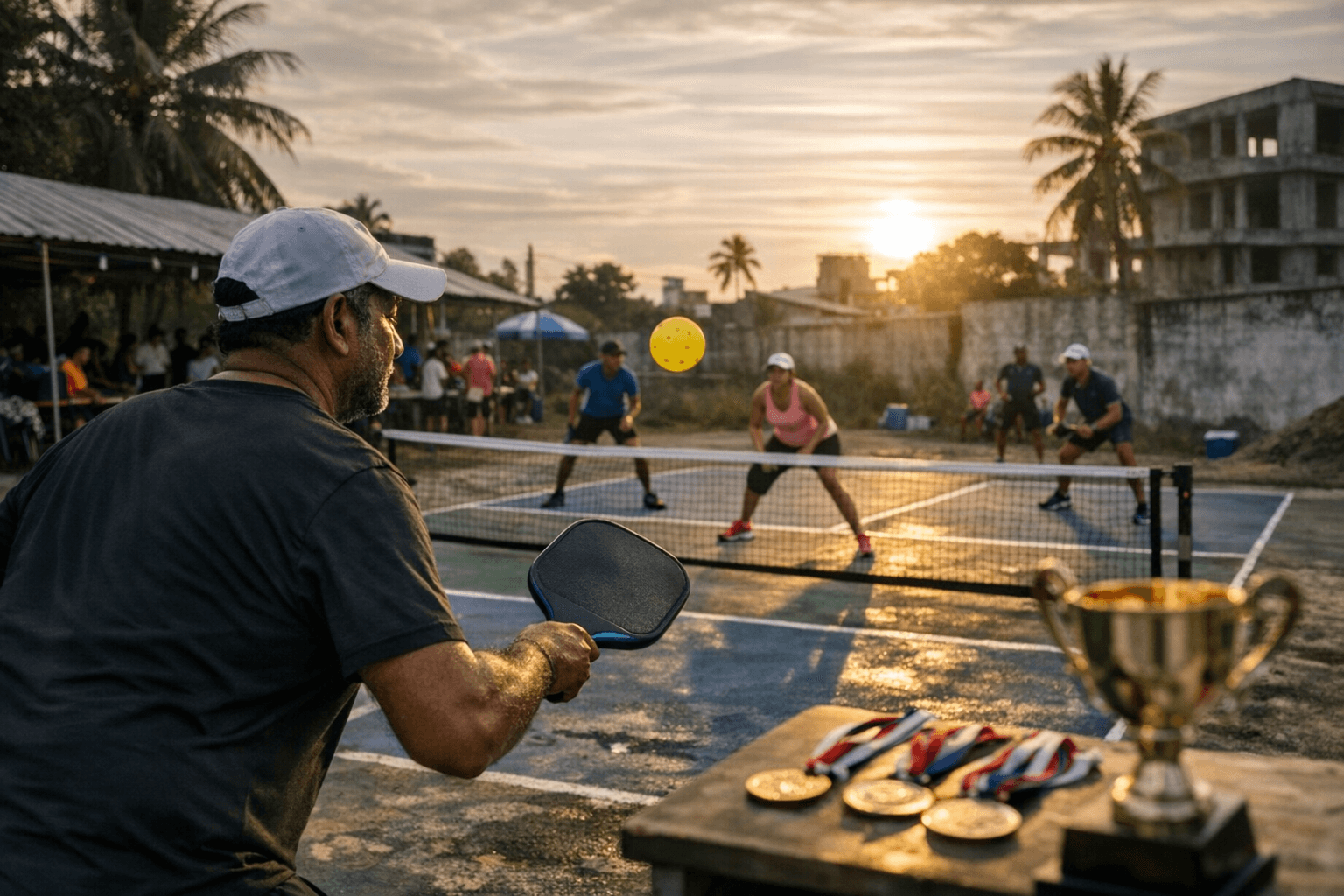
Fazi Jameel first saw pickleball on YouTube during the COVID-19 lockdowns and, by his own account, "fell in love with the sport." He had no paddles, no local community, and no purpose-built court. What he had was an abandoned industrial site in the Moratuwa suburb along Sri Lanka's southern coastline, two collaborators in Zafi Jameel and Dilan Hamid, and an appetite to build something from nothing. Before they invited a single guest, the three founders constructed a makeshift outdoor court they named "Pickalos Cage" and played on it relentlessly: through equatorial heat, monsoon rain, and lightning storms, in shoes with broken soles and sometimes bare feet. That period of committed self-education, before any public opening, established the operating philosophy that would define everything Pipinya built afterward.
The club formally opened to the public on 27 January 2024 at 670 Galle Road, Moratuwa. Its name is itself a statement of local intent: "Pipinya" is the Sinhalese word for cucumber, a knowing linguistic nod to the sport's famously eccentric name and a deliberate signal that this was a Sri Lankan brand building something indigenous rather than simply importing a foreign pastime.
The Infrastructure Decisions That Made It Work
The physical setup at Moratuwa was modest by global standards but immediately functional: three hard courts with permanent lines, nets, and lighting, comprising two indoor and the original outdoor court. Where most emerging venues in the region required players to source their own equipment through informal channels or expensive imports, Pipinya put racquets and balls in newcomers' hands from the first day of public play. In a country where pickleball had virtually no retail footprint and no established supply chain, that single decision resolved the sport's biggest participation barrier before it had a chance to calcify.
Scheduling reinforced the access-first philosophy. Courts were open Tuesday through Sunday, and every session came with access to onsite trainers who taught fundamentals. This distinction matters: open court time generates hours played, but trainer-led sessions generate players who return. The consistent daily structure gave first-timers not just an introduction to pickleball, but a repeatable reason to come back until the game became a habit. Family-friendly programming deepened that effect, positioning Pipinya as a community anchor rather than a high-performance enclave accessible only to serious athletes.
The Tournament That Created a Calendar
Less than 83 days after opening to the public, Pipinya organised the island's first-ever locally promoted pickleball tournament on 20 and 21 April 2024. The design was deliberately inclusive: open to all ages, all skill levels, two full days of competition. The aim was not to produce champions but to crystallise an informal community of practitioners into something with a calendar, a competitive identity, and a sense of occasion. Putting any player, regardless of experience, on a tournament court gave pickleball a social weight that casual play sessions alone could never generate.
The effect was visible in how public conversation around the sport shifted. Pipinya's own community documentation traces the trajectory from "What is Pickleball" to "I'd like to build a court of my own" within the same calendar year. That progression, from passive curiosity to ownership ambition in under twelve months, is the clearest evidence that a well-staged inaugural event can compress a sport's development timeline in ways that years of informal programming cannot.
From Eight Tournaments to a Skechers Grand Slam
Pipinya has now hosted eight tournaments since its 2024 opening, a figure reported by The Sunday Times of Sri Lanka. The club has expanded well beyond the original Moratuwa location: courts now operate in Negombo and Ratmalana, extending Pipinya's footprint across Sri Lanka's western coast. The founders have also launched their own line of pickleball paddles in multiple colorways, evolving from a venue operator into a vertically integrated brand with explicitly global ambitions.
The sharpest illustration of how much the landscape has changed came with the Skechers Pickleball Grand Slam 2025, hosted by Pipinya from May 30 to June 1 at the Moratuwa Pickleball Club. Skechers' involvement, a global footwear brand that has become one of the sport's most visible international sponsors, represented a commercial validation that would have been unthinkable sixteen months earlier when three founders were quietly laying lines on an abandoned industrial yard. The event featured men's, women's, and mixed doubles categories alongside an over-40s division, a format that preserved the inclusive spirit of Pipinya's earliest programming while operating at a scale that put Sri Lanka on the regional pickleball map.
Five Lessons the First-Club Playbook Encodes
Pipinya's arc from passion project to Skechers-sponsored host encodes a repeatable pattern for clubs across Asia working to move from casual sessions to sanctioned events:
- Repurpose underutilized space rather than waiting for purpose-built infrastructure. Pipinya's first court was a converted industrial site. Rooftops, warehouse floors, and redundant tennis courts offer the same shortcut in high-cost urban markets. The goal is a playable surface with permanent lines, not an aspirational facility.
- Remove the equipment barrier on opening day. In markets where pickleball paddles are unavailable at retail, requiring players to own equipment before they can participate kills adoption before it starts. Lending gear at the door converts visitors into returning players. Pipinya built its player base before it built a paddle brand.
- Anchor every operational day with trainer access. Structured coaching sessions give first-timers a development path and accelerate the skill depth that makes competitive events viable. Without trainers on court, casual play stalls at the beginner ceiling and tournament participation becomes too intimidating to attempt.
- Stage the inaugural tournament early and make it unconditionally inclusive. Pipinya's first event arrived within 83 days of opening. It accepted every player regardless of ability and ran for two full days. The competitive format creates a community milestone that no number of open-play sessions can replicate; it gives the club a history players can be part of.
- Let consistent tournament delivery build the partner pipeline. Skechers did not sponsor Pipinya's first event; they arrived after eight tournaments had demonstrated reliable event-running capability. Sponsors follow a documented track record. A single inaugural event starts building that record from the first weekend, and each subsequent event compounds it.
The community Fazi Jameel and his co-founders assembled in a Moratuwa industrial yard now spans multiple cities, carries an internationally branded tournament on its record, and is generating the kind of demand where players across Sri Lanka are expressing interest in building courts of their own. The first-club playbook exists. For organizers across Asia navigating the same early-stage constraints Pipinya faced in early 2024, the distance between a makeshift court and a grand slam sponsorship turns out to be a matter of sequencing, not resources.
This article was produced by Prism’s automated news system from verified source data, official records, and press releases, then run through automated quality and moderation checks before publishing. The system is built and supervised by the people who set the standards it runs under. Read our full AI policy.
Did this article answer your question?