Malaysia pickleball boom exposes governance crisis and federation conflict
Malaysia’s pickleball surge has outgrown its governing body, turning a popularity story into a test of authority, credibility, and control.
Governance crisis, not just growth
Malaysia’s pickleball boom has reached the point where the biggest risk is no longer whether the sport can attract players. The real question is whether the sport can build enough structure to govern them. If the federation fight drags on, the people who lose first are obvious: players, tournament organizers, sponsors, and Malaysia itself, which has been trying to position the country as a regional hub for one of Asia’s fastest-rising sports.
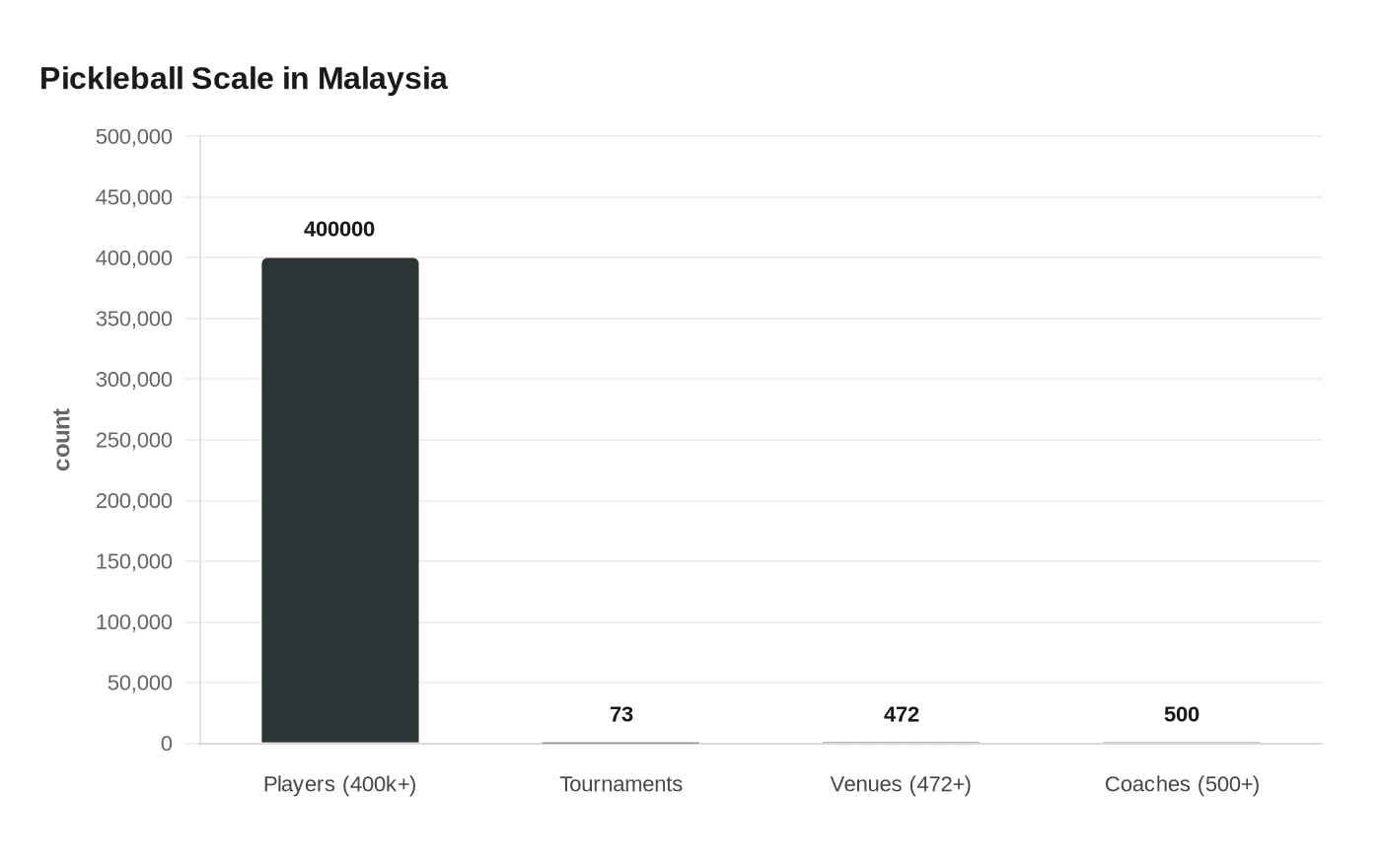
That is what makes this conflict different from a routine administrative dispute. In a market that already claims 400,000-plus players, 73 tournaments, 472-plus venues, and more than 500 certified coaches, leadership confusion is not a side issue. It is the central issue. A sport that big needs clear rules, a recognized authority, and a stable path for competition. Without that, rapid growth starts to look less like momentum and more like drift.
Why the numbers change everything
Malaysia is no longer dealing with a niche pastime. The scale published by the Malaysia Pickleball Association tells its own story: 400,000-plus players and hundreds of venues mean the sport has moved well beyond casual weekend play. That kind of footprint creates pressure for standardization, from coaching and officiating to rankings, tournament sanctioning, and player development.
The problem is that growth has arrived faster than the institution built to manage it. That is the broader lesson here, and it applies well beyond Malaysia. In emerging Asian pickleball markets, participation often comes first, commercial interest follows, and governance is left to catch up. But once the player base reaches this level, the sport can no longer survive on enthusiasm alone. It needs a rulebook that matches the size of the crowd.
What the federation fight means on the ground
The current dispute has moved from internal friction into formal regulation. The Sports Commissioner’s Office has said the Malaysia Pickleball Association remains the country’s recognized national body unless it is deregistered. At the same time, World Pickleball Magazine reported that the association was suspended under the Sports Development Act 1997 and given a 30-day deadline to resolve constitutional violations or face deregistration.
That is not bureaucratic background noise. It affects whether Malaysia’s players can compete under a clear national structure, whether events can be organized with confidence, and whether international affiliations hold real weight. The association has also claimed links with the Asian Federation of Pickleball and the Unified World Pickleball Federation, which makes the stakes even higher. If a national body is in question, then the entire pathway from local courts to international play becomes harder to trust.
For players, that uncertainty can mean fewer clean entry points into competition and less confidence that rankings, selections, or tournament outcomes will be recognized. For organizers, it means more risk every time they build an event calendar. For sponsors, it raises the question no brand likes to ask: who exactly is in charge here?
Malaysia’s sport has already crossed into national policy
This is not a backroom issue anymore. Pickleball has already entered Malaysia’s mainstream sports conversation, including state and national planning. Selangor wanted pickleball included in SUKMA 2026, and later reporting said the sport could be featured as a demonstration event at the 2026 Malaysia Games in Selangor. Sports Minister Hannah Yeoh also said it was still too early to decide whether pickleball would be a medal sport at SUKMA 2026.
Those details matter because they show how quickly the sport has moved into the formal sporting calendar. A demonstration slot is not a trophy, but it is a threshold. It signals recognition, opens doors for infrastructure planning, and gives the sport a place inside the country’s biggest development pipeline. The fact that only a handful of states, including Selangor, Sarawak, Perak, and Penang, were said to have the necessary infrastructure and more active participation only reinforces the point: Malaysia is now deciding where pickleball belongs, not whether it exists.
The cultural friction underneath the boom
Every fast-growing sport creates a few broken relationships along the way, and pickleball in Malaysia has not escaped that. Reporting has shown friction between pickleball and established racquet-sport communities, especially tennis and badminton circles. The tension is not hard to understand. When courts are converted, established players feel displaced, and when a new sport grows quickly, old institutions feel their space shrinking.
Datuk V. Subramaniam of the Badminton Association of Malaysia has urged people to celebrate the sport while also acknowledging concerns about the conversion of traditional racquet courts. That is the real fault line: pickleball is being welcomed as a new opportunity, but it is also being judged by how it affects the sports already sharing the same facilities. The conflict is not just about popularity. It is about space, identity, and who gets priority when a new game starts filling up the schedule.
The pipeline is expanding anyway
Even with the governance fight hanging over it, Malaysia keeps pushing pickleball deeper into the sporting system. Selangor has launched Picklespark 2026/2027, a development programme aimed at school students. That is exactly the kind of move that turns a fad into a feeder system. If the courts are full and the schools are involved, the sport is no longer just surviving on social buzz. It is building a pipeline.
The tournament side is expanding too. The official Malaysia Pickleball Association tournament site has promoted the inaugural Gatorade Malaysia Open Pickleball Championship. Bernama reported that the Malaysia Closed 2025 would award ranking points and help determine the country’s best players. Berita Harian also reported that the Malaysia Pickleball Championship would offer RM66,000 in prize money and attract teams from 10 countries.
That combination is important. Prize money draws attention, ranking points create hierarchy, and international participation gives the event credibility beyond Malaysia’s borders. Put together, those are the building blocks of a real sporting structure. They also make the governance crisis harder to ignore. The more serious the events become, the less room there is for institutional uncertainty.
Asia’s bigger test is still ahead
Malaysia’s situation is a warning shot for the rest of Asia. The sport’s growth story is real, but growth alone does not make a durable ecosystem. The next phase is about permanent homes, national benchmarks, elite pathways, and institutions that can survive the jump from novelty to serious competition.
That is why the Malaysian conflict matters beyond one federation’s future. It is a stress test for the region’s pickleball boom. If Asia’s new favorite sport can outpace its rulebook, it will keep expanding. If it cannot build governance fast enough, the same surge that made it famous could become the thing that slows it down.
This article was produced by Prism’s automated news system from verified source data, official records, and press releases, then run through automated quality and moderation checks before publishing. The system is built and supervised by the people who set the standards it runs under. Read our full AI policy.
Did this article answer your question?