Matt Nola helps launch pickleball in Laos from the ground up
Matt Nola's path to Laos ran through family history, embassy diplomacy and taped court lines. The country’s early pickleball growth shows how Asia's fringe markets really take root.

Matt Nola did not arrive in Laos with a flashy launch or a polished facility. He arrived with a family story tied to the country, a plan to build trust one relationship at a time, and a willingness to tape lines on the floor when there were no proper courts to use. That is what makes Laos such a revealing case study for pickleball in Asia: the sport is spreading here through personal history, local access and stubborn community-building, not through a mature sports machine.
How a personal connection became a market entry
Nola first found pickleball in the United States after moving over from tennis, but his long-term aim was always bigger than playing a new racquet sport. Lunar Pickleball’s team page roots his journey in a Thai refugee camp after his family fled Laos, a detail that gives the Laos project a different weight from a standard brand expansion. This was not a company looking for another flag on a map. It was a player using family history to re-enter a country and try to seed a sport that had almost no structure around it yet.
That matters in Asia, where new sports often spread fastest when they are attached to a human story people already trust. Lunar’s own mission is framed around empowering overlooked athletes and communities, which fits the Laos project neatly. In a market where pickleball was still unfamiliar to most people, the backstory gave the effort credibility before the first ball was struck.
The actual sequence mattered more than the announcement
The Laos entry did not start with a tournament calendar or a sponsorship reveal. In July 2022, Nola wrote to Laos’s ambassador to the United States. By August, he had met with the Laos Minister of Sports and Education to talk about how pickleball might serve Laotian communities. Those two steps show the real mechanics of market entry in places without a built-in sports ecosystem: first the relationship, then the permission, then the court.
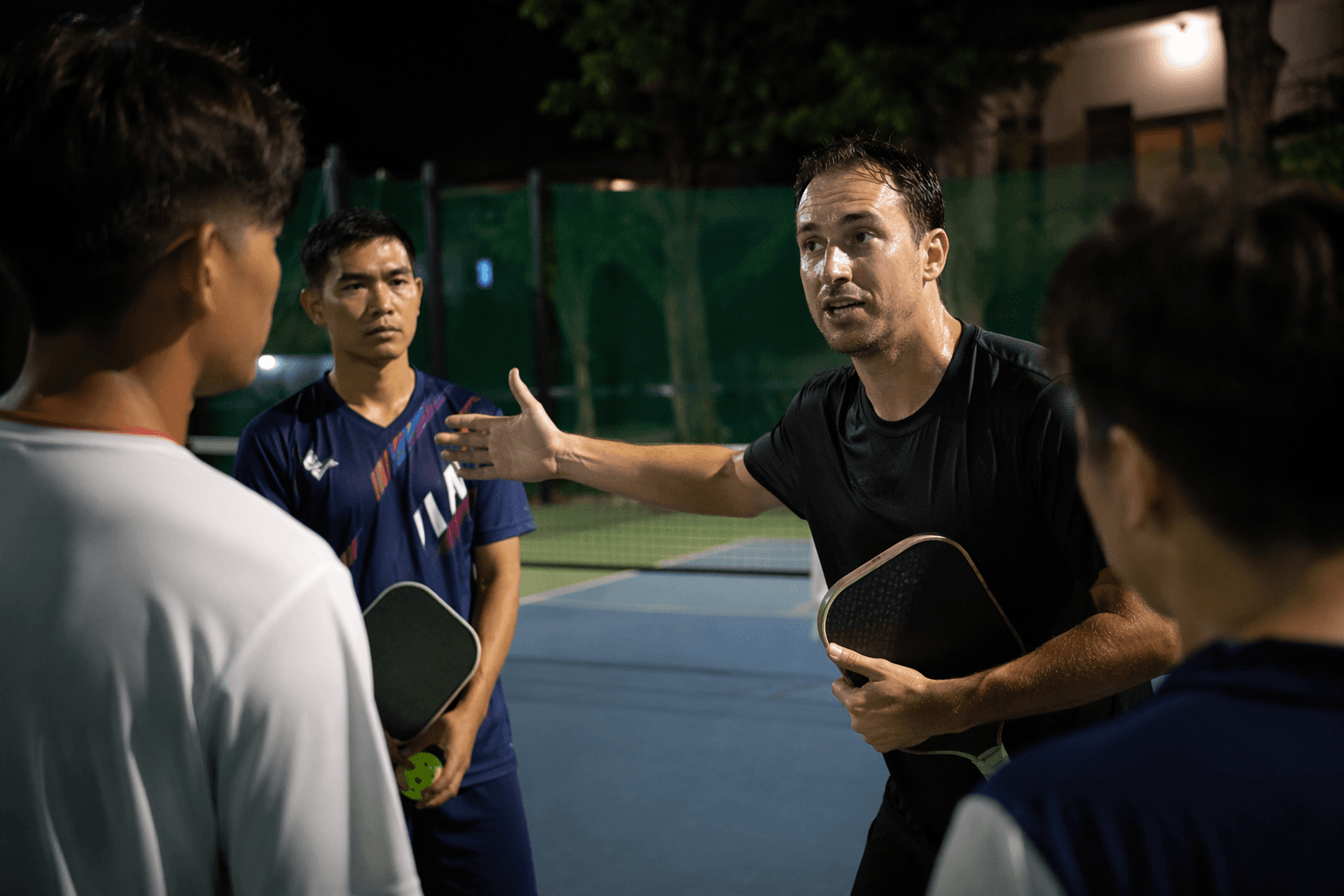
By May 2023, Nola and his team had organized Laos’s first official open-play pickleball event in Vientiane. The detail that stands out is not just that the event happened, but how it happened. They literally taped lines to create two courts. That is the kind of improvisation that defines early-stage expansion in overlooked markets, where the first barrier is often not demand but infrastructure. Before there is a league, a federation structure or a retail channel, there has to be a playable space.
Why gear and court access are the real bottlenecks
Nola’s experience at the Asia Open in Phuket sharpened the lesson. He saw worn-down equipment and came away convinced that one of pickleball’s biggest needs in Asia was basic access to proper gear and tournament-ready resources. That is a more useful lens than the usual focus on trophies and social-media moments. In a country like Laos, growth depends on whether players can get paddles, balls, nets and markings that survive repeated use.
That is why the Laos story reads less like a one-time activation and more like the start of a supply problem being solved from the ground up. If the court is improvised and the gear is fragile, the sport does not advance through slogans. It advances when someone keeps showing up with usable equipment, a place to play and enough local patience to let the community form around it.
Lunar’s footprint suggests that the company understands this regional reality. Its local or distributor presence spans India, Thailand, the Philippines, Vietnam, Laos and Taiwan, which points to a network strategy rather than a single-country push. In practice, that means Asia is being built market by market, not treated as one uniform opportunity.
What Laos looks like after the first launch
The Vientiane launch did not stay frozen as a novelty. By 2025, local reporting described the Vientiane Vipers Pickleball Club as newly formed to help players compete regionally and support the sport’s growth in Laos. That is a significant shift from a taped-floor first event to an actual club structure with competitive ambitions. It suggests that the early open play created enough momentum for players to think beyond casual introduction and into regional play.
The same reporting pointed to the MITS Laos Social Pickleball Program, which had expanded from one weekly session to four weekly play days, with daily play expected soon. That is the clearest marker of a sport finding a real base. When a program moves from once a week to four times a week, it means the problem is no longer simply awareness. It means there are enough players to create repeat demand.
There was also a dedicated court at Le Society Sports Lounge & Cafe in Vientiane, a concrete sign that pickleball had moved from borrowed space into a more recognizable local home. In a young market, one court can do the work of an entire institution. It becomes the meeting point, the recruiting tool and the proof that the sport is not just an imported idea.
Why Laos matters inside Asia’s bigger pickleball surge
Laos is small on the regional map, but the wider numbers show why this kind of foothold matters. UPA Asia and YouGov say about 1.9 billion people across 12 Asian territories have heard of pickleball, about 812 million have played at least once, and about 282 million play at least monthly. The same research used at least 1,000 respondents per market and extrapolated results by population size, which gives the findings enough weight to explain why companies and organizers are moving aggressively across the continent.
Vietnam led the awareness figures at 88 percent, while India produced the largest base of frequent players, with over 178 million playing at least monthly. Those numbers show where the sport is already hot. Laos shows something different: how pickleball can still take root in a smaller, less-developed market if the entry point is built carefully enough. That makes it a useful frontier, especially for brands and organizers looking beyond the obvious growth centers.
The regional structure around the sport is tightening
The Asian Pickleball Association describes itself as the governing body advancing pickleball across Asia, and the Global Pickleball Federation recognizes it as the Asian continental federation. That kind of formal structure matters because it gives the sport a clearer path from local play to cross-border competition. But Laos also shows that formal recognition comes after the grass is already taking hold.
The sequence in Laos is the part worth watching. A family connection created the motive, diplomacy opened the door, taped lines created the first courts, and local clubs and programs turned a launch into an ecosystem. That is how pickleball is likely to spread in overlooked Asian countries: not through a single announcement, but through the patient work of making the first court usable, the first players welcome and the first community durable.
This article was produced by Prism’s automated news system from verified source data, official records, and press releases, then run through automated quality and moderation checks before publishing. The system is built and supervised by the people who set the standards it runs under. Read our full AI policy.
Did this article answer your question?