Pickleball Kingdom Tests US Franchise Playbook in India's Grassroots Market
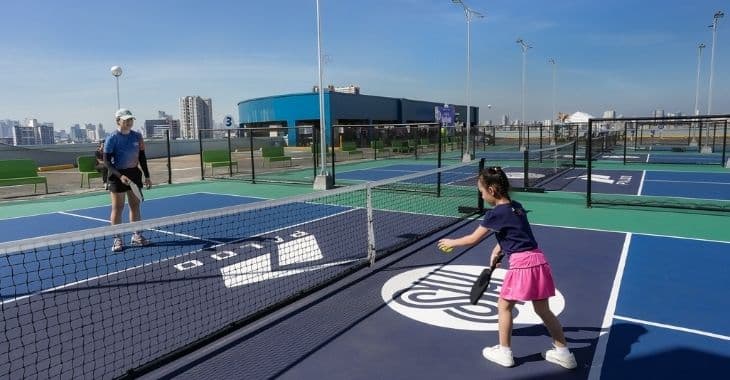
For the first time, a US pickleball franchise has landed on an Indian rooftop, and Pickleball Kingdom's Okhla court in Delhi is the bluntest stress test yet of whether American playbook pricing survives India's grassroots market.
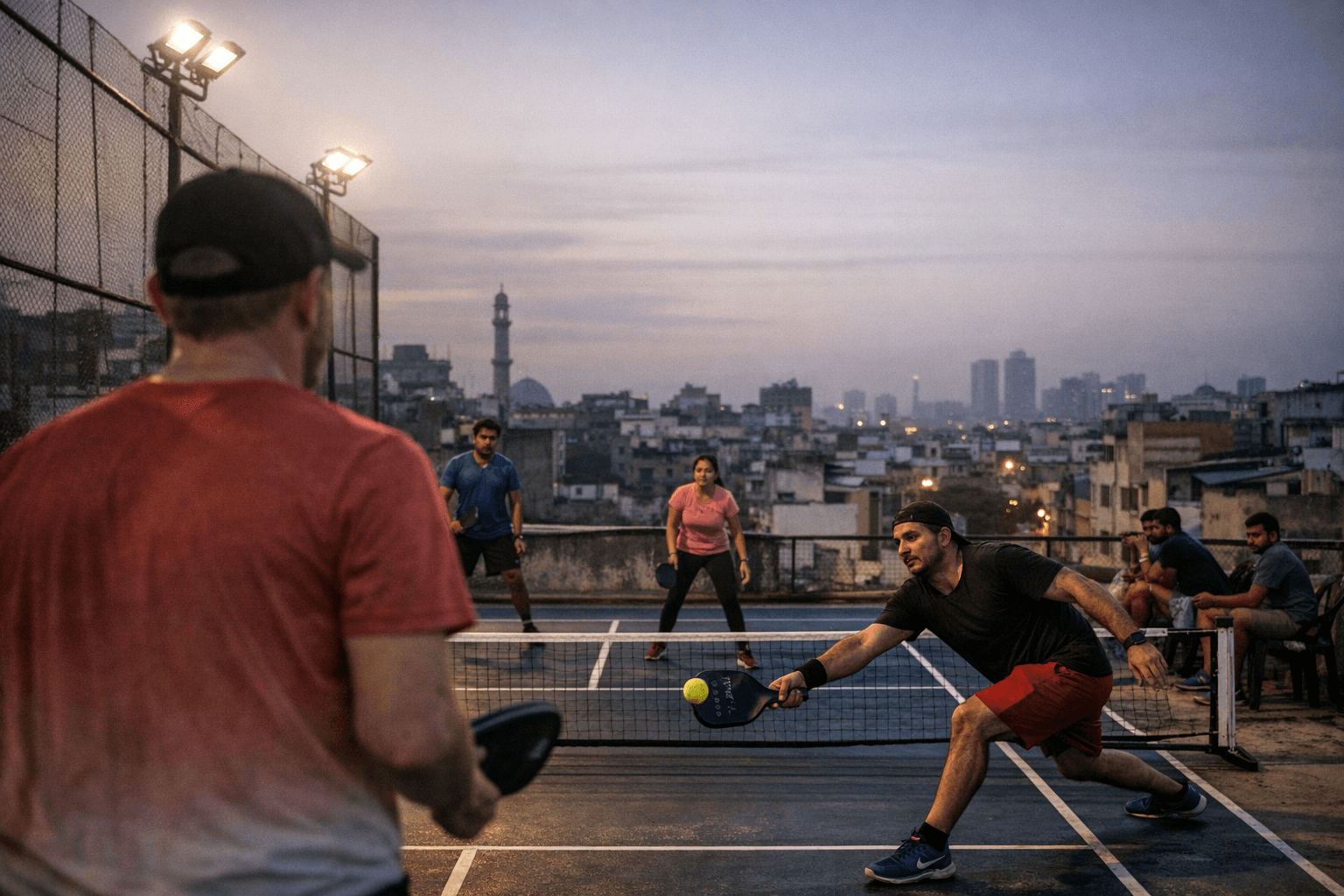
A single rooftop court in Okhla, New Delhi is carrying an outsized commercial question: can the world's largest indoor pickleball franchise, built on standardised American unit economics, win over a market where shared schoolyard courts and community club organisers have driven every rupee of growth so far? Pickleball Kingdom's first facility in India, developed in partnership with real estate developer Max Estates and local franchise partner BAQ Wizards Private Limited, is not simply a market entry. It is a live stress test of whether the US franchise playbook, refined across more than 400 North American locations, can be transplanted to a high-density, price-sensitive, community-first city like Delhi without breaking.
The Partnership Behind the Bet
Leading the India push are BAQ Wizards founders Bhanu Gulati, Anuj Duggal, and Qudrath Ali, a trio the franchise describes as bringing more than 30 years of combined experience in leadership, business, and sales. Their buy-in carries weight: they are not passive licensees but active operators who have publicly staked their reputation on localising the model. "Pickleball Kingdom's spirit of joy, inclusivity, and well-being mirrors our own values," said Gulati. "For us, it is about more than launching a brand, it is about creating a movement that builds community, connection, and balance across India." Duggal has framed the venture in similarly ambitious terms: "We are bringing together the American vision of dreaming big and Indian empathy for community. This is more than a business venture, it is the start of a sustainable, scalable, and joyful ecosystem for pickleball throughout India."
Pickleball Kingdom Founder and CEO Ace Rodrigues named India as the company's top international priority from the outset. "From day one, India has been our number one choice for international expansion," he said. "India's energy, athletic spirit, and love for community mirror everything Pickleball Kingdom stands for." The real estate angle is equally deliberate: the Max Estates partnership at Okhla signals an attempt to embed the franchise within premium urban development, a strategy that controls site quality but immediately raises questions about whether the resulting court fees will price out the recreational players who built the Delhi pickleball scene in the first place.
What the US Playbook Actually Demands
Back in America, opening a Pickleball Kingdom franchise carries a capital commitment of $867,000 to $2,238,000. The model depends on membership revenue driven by unlimited-play tiers that eliminate per-court and per-player fees, creating incentives for frequent visitors and predictable monthly income for operators. That structure works in North American suburbs where disposable sports spending is higher and the competition for a player's wallet is narrower.
In Delhi, the arithmetic is different. India's pickleball growth from roughly 200 courts in early 2024 to an estimated 1,200 by mid-2025 happened almost entirely outside the franchise model. Club organisers converted badminton halls, farmhouses, and schoolyards into courts at a fraction of Western build costs. Sammir Kapoor, director of Rebound Ace India, which manufactures and supplies sports flooring, has watched this expansion up close. "Delhi-NCR has nearly 150 pickleball venues, yet the demand continues to outpace supply," he said. His firm now receives at least three calls daily from entrepreneurs seeking to build or convert courts. That pipeline represents both an opportunity for Pickleball Kingdom and its stiffest competition: a fragmented, low-overhead operator base that competes primarily on accessibility and price rather than brand standards.
The Make-or-Break Variable: Price Sensitivity
Of the three primary risk factors analysts have identified, the single most decisive variable for the Okhla court's first twelve months is price elasticity, not structural safety or seasonal weather exposure. A franchise pricing structure that mirrors North American membership tiers will immediately position Pickleball Kingdom as a premium pay-to-play provider in a city where community court access is the baseline expectation. India's pickleball base has grown to more than 50,000 participants on the strength of accessible, low-cost programming. A membership price point that feels modest in Arizona can represent a significant monthly commitment for a Delhi professional.
This does not make premium pricing unworkable, but it does demand a tiered local response. The analytical case for Pickleball Kingdom to succeed in India rests on a hybrid model: preserving the franchise's standard operating procedures and quality benchmarks while introducing local pricing flexibility and community membership programmes calibrated to Delhi's income spectrum. Without that flexibility, the risk is brand damage before the first satellite facility even opens. Players who cannot afford the Okhla membership fee will simply return to the 150 other Delhi-NCR venues that are already meeting demand at lower price points.
Rooftop Realities and the Monsoon Calendar
The rooftop format at Okhla is elegant urban problem-solving on paper. Land costs in Delhi's commercial corridors make ground-level, dedicated sports facilities economically prohibitive for most operators, and rooftops represent underutilised real estate in the city's denser precincts. The Max Estates partnership addresses the lease side of this equation; the operational side is harder. Favourable terms mean little if the facility cannot guarantee evening access, adequate lighting, and weather protection across Delhi's full playing calendar. A North Indian monsoon season that runs from late June through September turns an uncovered rooftop court from an asset into a liability for three to four months of the year, compressing revenue into the remaining eight months and straining the unit economics that the franchise must demonstrate to attract the next wave of Indian investors.
Safety and permissions for rooftop sports facilities also sit in a regulatory grey zone that varies by municipal ward and building classification. The Okhla court's ability to operate consistently across all time slots and weather conditions will be watched closely by any entrepreneur considering a second or third Pickleball Kingdom site in Mumbai, Bengaluru, or Hyderabad.
Coaching Supply and the Academy Pipeline
Pricing and real estate are the immediate tests, but the medium-term franchise question is whether Pickleball Kingdom can generate enough certified coaches to staff a national expansion. India's current pickleball coaching infrastructure has developed organically, with community instructors running informal sessions rather than certified programmes. A franchise model that depends on consistent, branded coaching quality across all sites requires a talent pipeline that simply does not yet exist at scale.
The strategic opportunity here is significant: if the BAQ Wizards team can invest in coaching certification programmes and build structured tournament partnerships with the Indian Pickleball Association or the All India Pickleball Association, Pickleball Kingdom would not merely be a facility operator. It would become the infrastructure layer for competitive player development, creating career pathways that no rooftop club organiser can credibly offer. That distinction, more than branded courts or American branding, would be the most defensible moat in the Indian market.
What Success Unlocks for Everyday Players
If the Okhla court demonstrates viable unit economics within six to twelve months, including a membership structure that blends premium and community tiers, the downstream effect on ordinary players across Delhi is substantial. A replicable city-level playbook would attract structured commercial investment into pickleball infrastructure across major metros at a speed that grassroots operators cannot match alone. Courts in Bengaluru, Pune, and Hyderabad, built to a consistent standard with certified coaching and tournament pipelines, would accelerate the sport's competitive ladder in ways that informal club growth cannot.
Conversely, an early stumble on pricing or community integration would not merely wound Pickleball Kingdom's India ambitions. It would slow the entire conversation about franchise-style investment in Asia's high-density sports markets, reinforcing the perception that American playbooks require markets that already look like American suburbs. The Okhla rooftop, improbably, is carrying both outcomes simultaneously.
This article was produced by Prism’s automated news system from verified source data, official records, and press releases, then run through automated quality and moderation checks before publishing. The system is built and supervised by the people who set the standards it runs under. Read our full AI policy.
Did this article answer your question?