Pickleball vs Padel: Hottest Games in India, Accessibility Debated
At ₹150 per player per hour versus padel's aspirational ₹400, pickleball's cost edge is undeniable — but India's real estate crunch may decide which sport dominates by 2027.
The Price of Entry
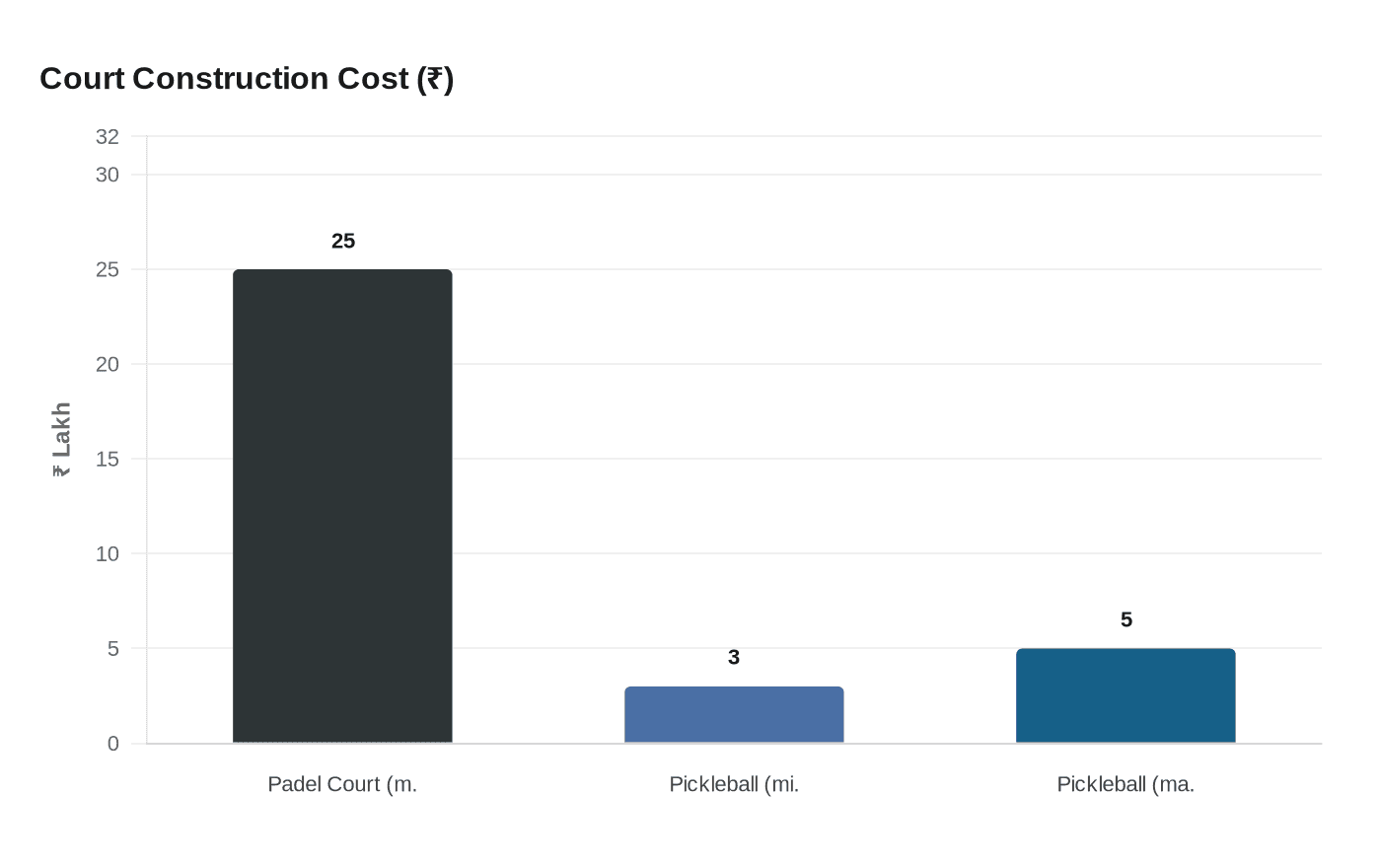
A single padel court costs at least ₹25 lakh to build in India — glass walls, metal framing, artificial turf, all of the highest grade. A pickleball court runs ₹3 lakh to ₹5 lakh. That one number, a roughly 10x construction gap, explains most of what is playing out across Delhi, Mumbai, and Bengaluru right now, as both sports compete for the same finite supply of urban land, investor money, and first-time players.
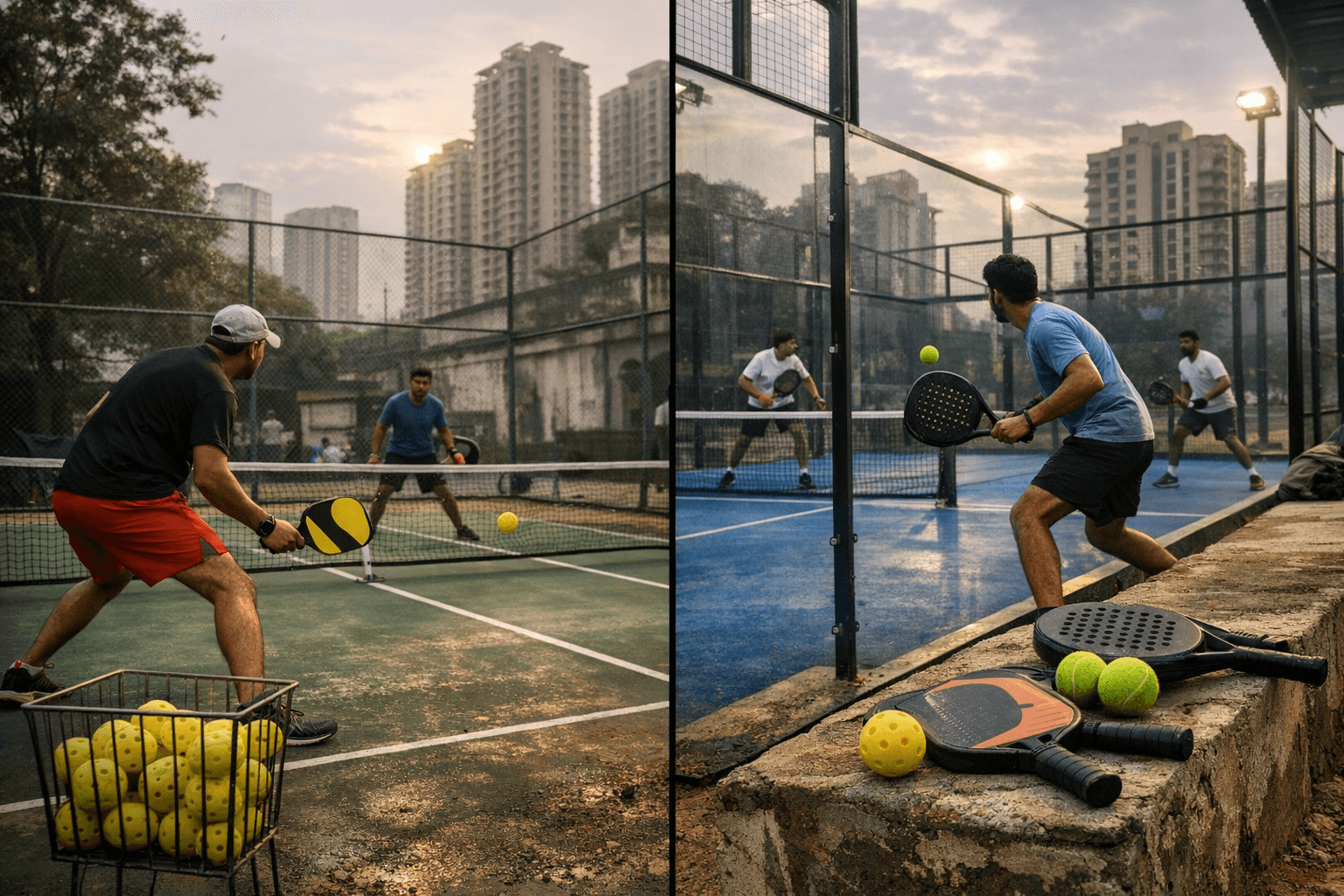
The accessibility debate is not just academic. Pickleball currently has a larger base in India, due in large part to its lower cost to play, while padel has taken off rapidly in urban areas and upscale sports clubs. The question for anyone picking up a paddle in 2026 is: which sport actually fits your city, your wallet, and your schedule?
Equipment: A Clear Winner Before You Step on Court
Start with gear, because the gap opens before you ever book a slot. Starter pickleball paddles in India are available from ₹1,500 to ₹3,000, and a pack of three balls costs around ₹400. Composite paddles run ₹2,000 to ₹4,000, suitable for beginners to intermediate players, while graphite paddles for advanced players climb to ₹5,000 to ₹10,000 and above. A complete beginner setup, including paddle, balls, and a bag, lands comfortably under ₹4,000.
Padel equipment carries a steeper premium. Padel rackets, built from carbon fibre or fibreglass to withstand the sport's glass-wall bounces, typically start above ₹5,000 and rise sharply from there. Add specialist padel balls and you are looking at an entry cost at least double that of pickleball before a single court fee is paid.
Court Fees and the ₹ Per Player Per Hour Calculation
This is where the accessibility arithmetic gets interesting. At Panchshila Club in South Delhi, pickleball court slots are available from 6 AM to 11 PM, priced at ₹599 per hour onwards, with equipment rental charged separately. With four players sharing a court, that works out to roughly ₹150 per person per hour — competitive with a gym session and cheaper than most badminton clubs in premium South Delhi neighbourhoods.
Padel's per-player math is harder to hit. According to Shyam Mehta, a private equity investor active in Indian sports, bringing the price per hour down to ₹400 per player would make padel accessible to an IT professional earning ₹1 lakh a month — but that target remains aspirational. At current premium-venue rates, padel slots at established clubs in Mumbai and Delhi run considerably higher, especially during peak morning and evening windows.
The Real Estate Pinch: Where the Sport War Is Actually Won
Both sports are land-hungry in a country where urban square footage is the scarcest commodity of all. A standard padel court of 20 metres by 10 metres requires about 200 sqm — far more compact than a tennis court. But a viable commercial padel facility needs at least 1,000 to 1,200 sqm to accommodate multiple courts, walkways, and amenities. The challenge of finding the right real estate for the right price in Indian urban centres is especially pronounced for padel.
Pickleball sidesteps this constraint more cleanly. Its court footprint matches a standard badminton court, meaning existing multi-sport halls, housing society terraces, and school playgrounds can be converted rather than purpose-built. In Mumbai and Bengaluru, where demand is booming, pickleball court operators report break-even in as little as three months. No padel venue in India can yet claim that timeline.
Venue Spotlights: Delhi, Mumbai, Bengaluru
The three metros illustrate how differently each sport has embedded itself. In Delhi-NCR, House of Padel (HOP) operates as a premier padel sports facility, sitting comfortably in the premium bracket alongside golf clubs and five-star fitness centres. Pickleball, by contrast, has already pushed into neighbourhood sports clubs like Panchshila, with 11 bookable courts now documented across the capital.
Mumbai tells a similar story of parallel tracks. PadelPark Bandra operates near Lilavati Hospital in Bandra West, serving the city's western suburbs. Pickleball has meanwhile colonised terraces and multi-sport halls across the suburbs, with budget-friendly venues rated highly by local players on booking platforms like Hudle.
Bengaluru is the most contested battleground. GoRally, a Bengaluru-based pickleball startup, raised ₹6.46 crore ($750,000) from major investors, signalling serious institutional backing for the sport's infrastructure push. On the padel side, Padel India is building a seven-court facility in Bengaluru's Koramangala and a separate six-court project elsewhere in the city, the largest concentrated padel infrastructure investment in India to date.
Time to Competence: Which Sport Can You Actually Play on Week One?
Pickleball's learning curve is genuinely short. The court is smaller, the ball is slower than a tennis ball, and the rules reward placement over power. Most recreational players are functionally competitive within two to four sessions. The sport's crossover appeal — blending elements of tennis, badminton, and table tennis — means that anyone with basic racket experience adapts quickly.
Padel demands more spatial intelligence. The glass walls introduce a third dimension to every rally, and reading a ball rebounding off the back panel is a skill that takes weeks to develop. Coaching is close to essential in the first month, adding to the total cost-to-play calculation. For newcomers to India with no prior racket sport background, pickleball gets you into a real game far faster.
Which Sport Wins the Next 24 Months?
The global pickleball market is projected to grow from ₹16,388 crore in 2023 to ₹68,138 crore by 2033, at a compounded annual growth rate of 15.3%, and India's domestic operators are positioning aggressively to capture that wave. Padel's growth story is equally compelling in absolute terms, but its dependence on expensive, purpose-built infrastructure in cities where land prices are already punishing means it will remain a premium niche unless the economics shift.
The sport that cracks the rooftop-and-society-court market at under ₹200 per player per hour is the sport that wins the next decade in India. Right now, only one of them is consistently clearing that bar.
This article was produced by Prism’s automated news system from verified source data, official records, and press releases, then run through automated quality and moderation checks before publishing. The system is built and supervised by the people who set the standards it runs under. Read our full AI policy.
Did this article answer your question?