PPA Tour Asia 2026 Calendar Reshapes Career Paths for Professional Pickleball Players
Ten stops, seven markets, and a $1.1M Hong Kong Slam: the PPA Tour Asia 2026 calendar is the most ambitious structural bet yet that Asia can sustain a full professional pickleball season.
A US$1.1 million prize purse sitting at the end of a six-month continental circuit is not a promotional gimmick. It is a signal, sent clearly to every top-ranked professional pickleball player on the planet, that Asia is no longer a side trip. The PPA Tour Asia 2026 calendar, built around ten confirmed stops across seven markets and capped by the Hong Kong Slam on October 19-25, is the most coherent regional season the sport has ever produced in this part of the world, and its consequences for player careers, commercial structures, and the global competitive order are still coming into focus.
The Architecture of a Ten-Stop Season
The calendar runs from April through October, giving it a natural spine that mirrors elite sporting seasons elsewhere. It opens with the MB Hanoi Cup (April 1-5), the tour's first foray into Northern Vietnam, staged at My Dinh Indoor Athletics Arena with 1,000 PPA ranking points on offer. From there, the tour moves through the Kuala Lumpur Open (May 13-17), the Macao Open (May 27-31), China Open 1 (June 17-21), the Tokyo Open (July 1-4), the Singapore Open (July 23-26), the Ho Chi Minh City Open (August 6-9), China Open 2 (August 20-23), the Kuala Lumpur Cup (September 9-13), and finally the Hong Kong Slam. The geographic sweep is significant: Vietnam appears twice (Hanoi and Ho Chi Minh City), Malaysia twice (two separate events in Kuala Lumpur), China twice, with Japan, Singapore, Macao, and Hong Kong each holding one stop.
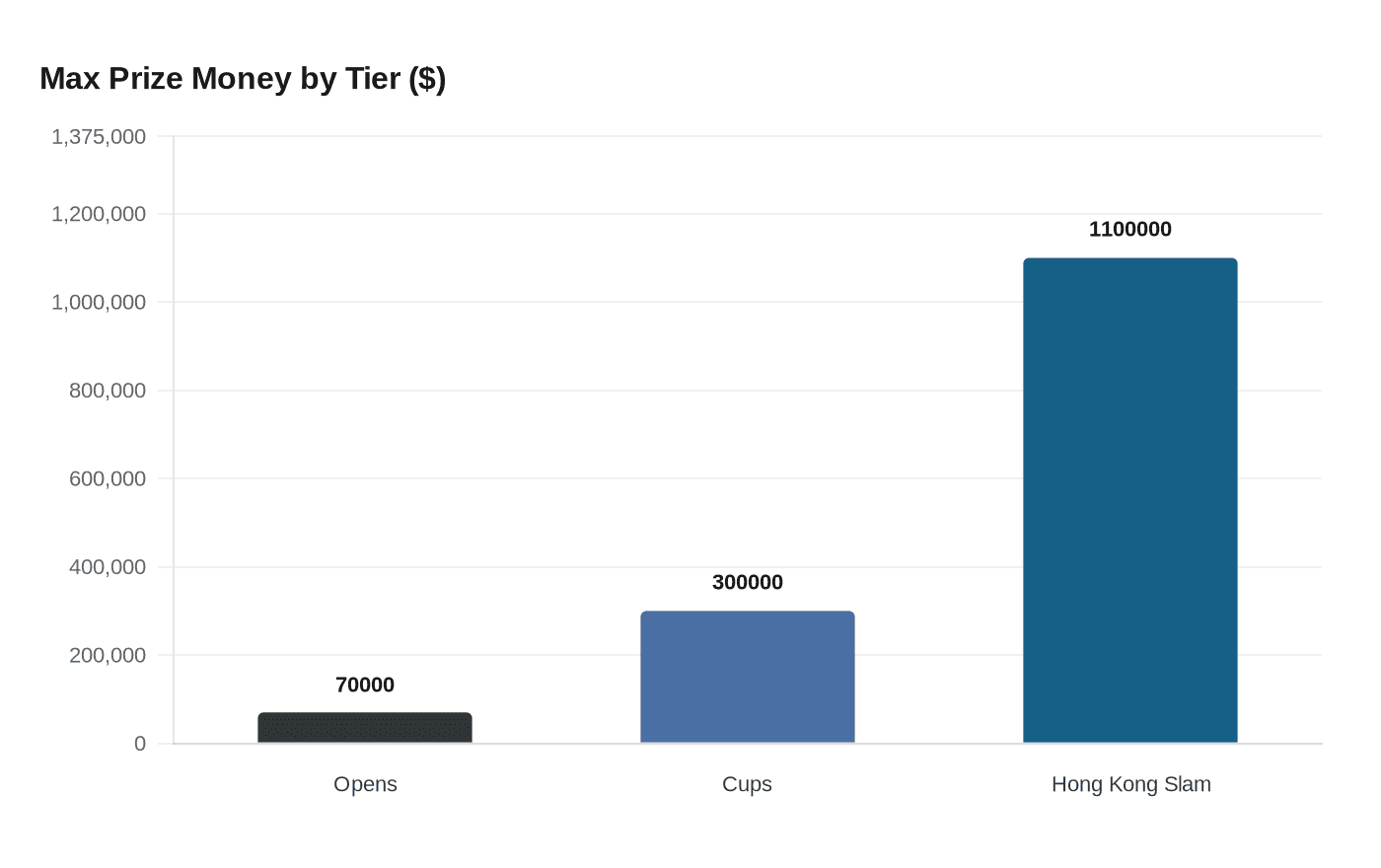
That layout is not accidental. A player who commits to the full circuit is managing seven distinct markets, building ranking points progressively across a tiered prize structure, and positioning themselves for a legitimate season narrative rather than a series of disconnected trips. The three-tier format, Slams, Cups, and Opens, anchors the calendar's competitive logic: Opens in the US$50,000-70,000 range keep the schedule populated and accessible; Cups at up to US$300,000 (both the MB Hanoi Cup and the Kuala Lumpur Cup qualify) elevate the mid-tier; and the Hong Kong Slam, carrying 1,500 PPA ranking points and up to US$1.1 million, provides the season-defining payoff.
Prize Money That Rewrites the Calculus
For years, the unspoken truth about Asian professional pickleball was that the prize money could not compete with what North American events offered. That calculation is shifting fast. The Hong Kong Slam's purse places it in the company of the most lucrative events anywhere in the sport. When players at the top of the world rankings weigh their travel calendars, a single event offering US$1.1 million in available prize money commands serious attention regardless of geography.
The downstream effects ripple outward from that headline number. Events anchored by global stars drive higher ticket sales, stronger broadcast interest, and more attractive sponsorship propositions. For local Asian professionals, the more immediate impact is the realistic possibility of full-time professionalization within the region. A player who can earn meaningfully across multiple Asian stops, with a shot at a major Slam payout in October, no longer needs to treat North America as the only viable career market.
Kimberly Koh, Managing Director of UPA Asia, put it plainly: "The 2026 calendar reflects the incredible growth of professional pickleball across Asia. We're expanding into new cities and bringing the PPA experience to more players, both Pros and Amateurs, across the region."
Retaining Talent and Reversing the Brain Drain
The structural impact on Asian player development may be the calendar's most lasting contribution. Historically, top-tier talent from across the continent faced a difficult choice: remain regionally based and accept lower competition levels and prize exposure, or relocate to North America to chase higher-caliber play. A ten-stop continental circuit, awarding internationally recognized PPA ranking points at every event, removes the core logic of that migration.
A player based in Tokyo, Kuala Lumpur, or Ho Chi Minh City can now build a competitive ranking, earn substantive prize money, and develop rivalries with international professionals without uprooting their career infrastructure. That stability benefits the entire regional ecosystem. Academies gain the prospect of coaching players who remain in the market long enough to generate local fanbases. Coaches can plan long-term development cycles around a predictable competitive calendar. Local sponsors, always more willing to invest in athletes they can activate across multiple touchpoints, find that the multi-stop tour creates exactly the kind of prolonged regional visibility that makes sponsorship compelling.
Commercial Architecture: Cities, Sponsors, and the Recurring Tour Stop
Beyond individual player careers, the calendar creates a different kind of commercial conversation with host cities and corporate partners. A recurring annual tour stop transforms a one-time event into a civic brand asset. Cities like Hanoi, which hosts the season opener at My Dinh Indoor Athletics Arena, gain both short-term tourism activity and the longer-term positioning that comes with being a recognized stop on a professional international circuit.
For corporate sponsors, the multi-stop calendar unlocks season-long partnership structures that single events simply cannot offer. A brand activating across Vietnam, Malaysia, Japan, Singapore, Macao, China, and Hong Kong within the same six-month window gets geographic reach, sustained audience exposure, and hospitality opportunities across multiple premium markets. That proposition is structurally different from, and more valuable than, the spot-buy approach that fragmented calendars historically forced upon sponsors.
The Hong Kong Slam adds a unique layer: its collector hardware, specifically the dragon head trophy that completes the 2026 tour medal set, is exclusive to the season finale. That design creates genuine narrative tension across the calendar's full arc. Players and fans alike are invested in the season-long medal chase, not just the individual event outcomes.
Broadcast Narratives and Serialized Coverage
Season-long competitive structures generate the kind of storytelling that broadcast partners can actually sell to advertisers. Continental ranking battles, evolving rivalries between international stars and regional challengers, mid-season form swings, and the slow build toward a high-stakes October finale are all ingredients of coherent serialized sports content. Asian broadcasters and streaming platforms, which have historically struggled to build sustained pickleball audiences around disconnected events, now have a full narrative arc to program around.
The amateur dimension of the tour, particularly the Play Where the Pros Play format that places recreational participants on the same courts as professionals, broadens the potential audience beyond hardcore followers. That crossover is a proven driver of engagement in markets where the sport is still establishing its footprint.
Managing the Risks of a Compressed Calendar
The benefits of calendar density come with real operational risks that tour organizers and national federations cannot afford to ignore. Ten stops across seven markets in roughly six months creates genuine pressure on player travel budgets, physical recovery windows, and logistics. Insufficient gaps between events can erode performance quality and strain athlete welfare, particularly for players who lack the support infrastructure of elite North American programs.
Smaller markets on the circuit also face specific challenges. Meeting pro-standard requirements for court infrastructure, timing systems, and broadcast production is non-trivial, and events that fall short risk diluting the quality signal the calendar is designed to project. Overlapping national federation calendars pose an additional coordination challenge: domestic championships that collide with PPA Tour Asia windows can fragment athlete availability and split spectator attention rather than amplifying it.
The solution requires sustained coordination between PPA Tour Asia, national federations, and city hosts, particularly around tiered pathway events such as PWR 100-1000 tournaments and local qualifiers. Those events need to feed the pro calendar, not compete with it, and the scheduling architecture that makes that possible takes deliberate planning rather than reactive management.
Why the Hong Kong Slam Is More Than a Grand Final
The decision to close the season in Hong Kong, one of the world's most recognized sporting and entertainment cities, carries symbolic as well as structural weight. The Slam's October 19-25 window, at the tail of the typhoon season and within Asia's major convention and event calendar, positions it for genuine global visibility. With 1,500 PPA ranking points and up to US$1.1 million at stake, it guarantees that the world's best players will need to assess seriously whether the Asian circuit belongs in their annual planning. That assessment, repeated by enough players, at enough management levels, is how a regional tour becomes a permanent fixture in the global competitive calendar. The 2026 season is where that argument gets made in full.
This article was produced by Prism’s automated news system from verified source data, official records, and press releases, then run through automated quality and moderation checks before publishing. The system is built and supervised by the people who set the standards it runs under. Read our full AI policy.
Did this article answer your question?