Ramsports ties pickleball to diplomacy, youth exchange, and China’s sports model
Ramsports is turning pickleball into a diplomacy and youth-exchange platform in Shenzhen, testing whether China’s institution-led model can scale across Asia.
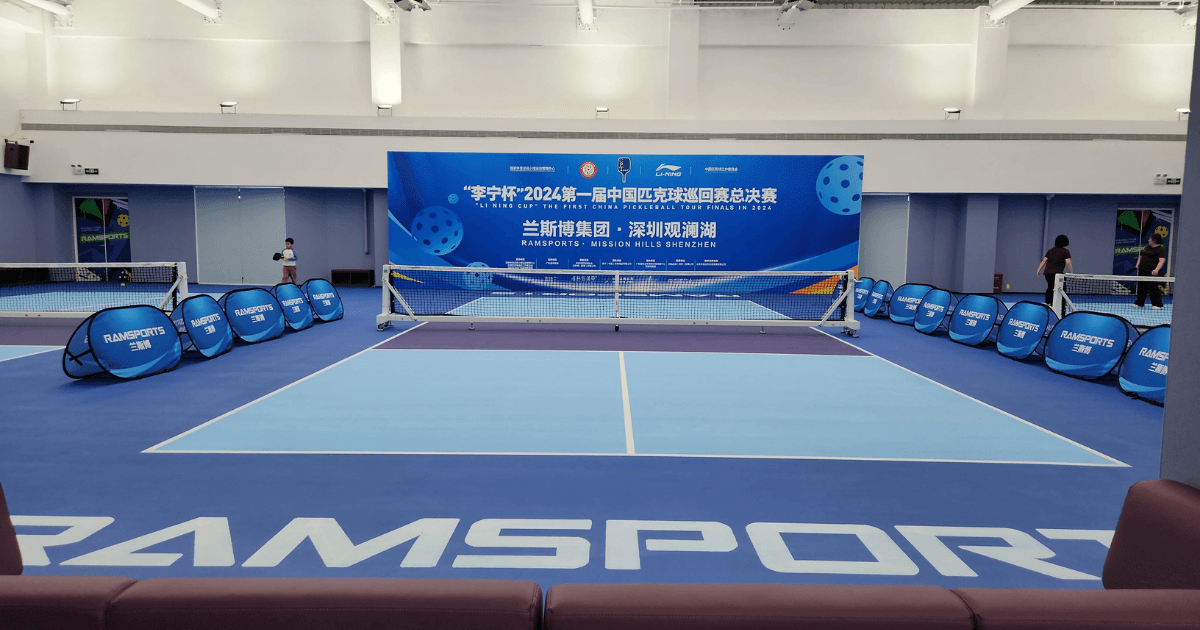
Pickleball in Shenzhen is being built as more than a business. Ramsports is using courts, coaching, school outreach, and youth exchange to turn the sport into a China-specific growth model, one that leans on institutions and public purpose as much as on private venue demand.
A different kind of pickleball expansion
The key difference in Ramsports’ approach is simple: it is not behaving like a pop-up court operator or a mall amenity provider. In PickleAsia’s June 9 analysis, the company is framed as a full-industry-chain institution that connects pickleball to sports diplomacy, youth exchange, and APEC-era international cooperation. That means the sport is being positioned as an ecosystem, not a product, with facilities, coaching, youth participation, cross-border visibility, and a civic narrative all working together.
That framing matters because it reflects China’s broader sports-development style. Instead of relying mainly on consumer demand, Ramsports is tying pickleball to schools, universities, city branding, and government-adjacent programming. The result is a model that looks less like a rental business and more like a coordinated pathway for long-term participation and talent development.
Shenzhen is the proving ground
The strongest evidence of that strategy came on June 5, 2026, when the Asia-Pacific Youth Pickleball Competition opened at the Ramsports Group Pickleball Club in Shenzhen. The event was co-hosted by Shenzhen News Group Global Communication Center, the Pingshan District Government, and Ramsports Group, under the theme “Friendship through sports, youth without borders.”
Shenzhen Daily said the competition is part of APEC “China Year” youth exchange programming, and it is not being treated as a one-off event. The structure is year-round: monthly training camps, a mid-year friendship competition, and finals scheduled for Pingshan in the second half of 2026. That format signals something bigger than a tournament calendar. It suggests pickleball is being used as a repeatable civic platform, where youth development and international messaging are designed into the sport’s growth path.
For Asia’s pickleball scene, that is a notable departure from the more commercial, venue-led expansions common in parts of Southeast Asia. Those models often depend on rapid court buildout, membership traffic, and event activation. Shenzhen’s version is more embedded, with local government, media, and a private operator working in the same lane.
Youth exchange is part of the operating model
Ramsports’ diplomacy angle did not begin with the June competition. On Feb. 15, 2026, the 2026 U.S. Youth Pickleball People-to-People Exchange Tour to China arrived in Shenzhen, marking the first stop of that year’s visit. Local reporting described the exchange in two ways: one Shenzhen report said 45 American teachers and students took part, while another said 38 American students began a 10-day exchange visit.
The overlap is important because it shows how the exchange was understood on the ground: not just as a sports trip, but as a people-to-people program. The participants used pickleball as a bridge to visit communities, campuses, and scenic spots, turning the sport into a social connector rather than a standalone competition. In that sense, Ramsports is helping China present pickleball as a cultural and educational channel, not just an imported leisure trend.
That is exactly where the company’s model starts to look distinctive. Youth exchange gives pickleball a story line that can travel well in Asia: friendship, education, and institutional cooperation. It also gives city governments a reason to support the sport beyond recreation, because the return is measured in visibility, school engagement, and international image as much as in court utilization.
The business case is built around infrastructure and legitimacy
Ramsports says its Shenzhen flagship is designed to set a benchmark for pickleball in Asia. The venue includes professional-grade courts, retractable roofing, team lounges, changing rooms, and open concourses. The company also says its coaches are certified by international bodies, and it offers outreach programs in schools and universities as part of its growth strategy.
That combination is central to the company’s pitch. It is not just selling court time, but a package that can be plugged into education systems, team development, and community programming. In practical terms, that makes the venue more than a site for play. It becomes a platform for recruiting new players, training coaches, and linking local participation to regional competition.
Ramsports’ role as the official venue partner of PCL Asia reinforces that ambition. The PCL Asia Season 2 Grand Finals in Shenzhen brought together 28 club teams from Thailand, Indonesia, India, Japan, the Philippines, Malaysia, and China, underscoring Shenzhen’s pull as a regional hub. PickleAsia also reported a $30,000 champion’s check for Team Zhuhai at those finals, a reminder that the sport is already developing a real competitive economy alongside its cultural messaging.
Haikou shows the scale of the ambition
The Shenzhen model is not the company’s only bet. In October 2024, Mission Hills Group and Ram Sports announced plans for the world’s largest indoor pickleball court in Haikou, along with a training center, academy, and annual World Pickleball Forum Summit. That plan was said to target 100 million new players in China over five years and 10,000 courts nationwide.
Those numbers show how far the ambition reaches. Haikou is not just a second venue market, but part of a broader national rollout strategy that folds in tourism, elite training, and industry convening. If Shenzhen is the proof of concept for diplomacy and youth exchange, Haikou is the scale play: a place where pickleball can be tied to destination development and a wider national sports economy.
The strategy also helps explain why Ramsports has emphasized international branding. In January 2026, the company announced American professional player Thomas Yu as its first international brand ambassador. Yu said Ramsports’ well-organized competitions and high-standard courts made it a meaningful platform for pickleball’s long-term development. That endorsement matters because it gives the company a cross-border face while reinforcing the idea that Chinese venues can meet international expectations.
Can this become Asia’s template?
Ramsports’ model is attractive because it solves several problems at once. It creates courts, but also builds coaching pipelines. It attracts players, but also gives governments a youth and diplomacy story. It offers a venue business, but one tied to schools, universities, and regional branding. In that sense, it may be the most institutionally coherent pickleball strategy emerging in Asia.
But it may also be uniquely Chinese. The model depends on strong relationships with district governments, state-adjacent media, educational institutions, and city branding machinery. That makes it powerful in Shenzhen and potentially in other Chinese cities, but harder to copy in markets where pickleball growth is driven mainly by private operators, commercial landlords, and event promoters.
The bigger lesson is that pickleball in Asia is no longer just about adding courts. Ramsports is showing how the sport can be used as a soft-power asset, a youth-development tool, and a city-building instrument at the same time. If that formula holds, Shenzhen and Haikou could become reference points for how Asia grows the game next, with China setting the pace through institutions rather than just inventory.
This article was produced by Prism’s automated news system from verified source data, official records, and press releases, then run through automated quality and moderation checks before publishing. The system is built and supervised by the people who set the standards it runs under. Read our full AI policy.
Did this article answer your question?