Teenage Prodigy Alix Truong Rises to Top of Vietnamese Pickleball
From a pandemic hobby in Falls Church to four PPA Tour Asia gold medals, Alix Truong maps Vietnam's talent pipeline precisely, and reveals where it still breaks down.

Four PPA Tour Asia gold medals. A No. 1 ranking in women's mixed doubles across the inaugural PPA Tour Asia season. A world No. 7 position in mixed doubles on the global tour. The numbers attached to Alix Truong by early 2026 are specific enough to stop a conversation and precise enough to start a more useful one: what actually produced this, and can Vietnam replicate it?
The honest answer requires tracing three distinct inputs rather than celebrating a single prodigy. Truong's profile is instructive not because she emerged from Vietnam's domestic circuit, but because she represents, in structural terms, what happens when a player with Vietnamese heritage gains simultaneous access to American coaching infrastructure, U.S.-based professional tours, and a maturing Asian circuit. For talent scouts and academy operators watching the region, understanding that combination is more valuable than the headline.
A tennis base converted at exactly the right moment
Truong grew up in Falls Church, Virginia, where she starred on her high school tennis team at the No. 1 singles and doubles positions. Tennis built her fundamentals, but it was pickleball that captured her imagination. Her father John, who had served as her tennis coach, introduced her to the sport during the COVID-19 lockdowns. Truong never imagined that pandemic pastime would become a professional career, but as they continued competing together, her skills quickly improved and eventually surpassed his.
She transitioned to homeschooling to fully dedicate herself to the sport, made her professional debut in 2021, signed with Major League Pickleball in 2023, and secured a full PPA Tour contract in 2024. The speed of that progression is the first concrete input: a racquet-sport pedigree that transferred almost directly to the pickleball court, compressed by family infrastructure and unencumbered by a conventional academic schedule.
At just 5'3" and 105 pounds, Truong is one of the smallest women on the professional tour, but what she lacks in size she compensates with speed, reach, and surprising power. Her game, as described in the Pickleballers podcast Season 3 Episode 8, is built around quick third-shot transitions, cross-court angles, and footwork that carries the DNA of her racquet-sport background while adapting to pickleball's compressed geometry. Coaches who have worked with her identify conditioning and point construction as the primary differentiators: not raw athleticism, but the ability to translate athleticism into repeatable patterns under pressure. The podcast also documents how Truong's competitive schedule reflects deliberate event selection, prioritising ranking points and progressive exposure to top-level opponents rather than an exhaustive tournament calendar.
The 2025 PPA Tour Asia season: a learning curve that compounded fast
Truong opened her Asia campaign with back-to-back bronze medals at the MB Vietnam Open in Ho Chi Minh City and the Panas Malaysia Cup in Kuala Lumpur, solid results but short of her ambitions. Then she caught fire. Truong surged to two statement victories: first striking gold with her brother Jonathan Truong at the MB Vietnam Cup, then closing the season with another title alongside Federico Staksrud in Hangzhou. Two wins, delivered when it mattered most.
The Truongs broke through at Da Nang with brilliant chemistry and consistency throughout the draw, defeating Chao Yi Wang and Tyson McGuffin convincingly in an 11-1, 11-6 statement win. The scoreline was not close; it was categorical. Jonathan Truong ultimately claimed the No. 1 men's mixed doubles ranking, his 1,500-point gold at the MB Vietnam Cup laying the foundation, with two additional bronzes closing it out. The sibling pairing at Da Nang was not accidental chemistry; it was a product of shared training history and the kind of competitive familiarity that money cannot purchase directly.
The atmosphere in Vietnam added a dimension that standard rankings cannot capture. "Asia is amazing, especially in Vietnam. I literally feel like a princess out there. It almost feels like the Olympics with how the fans root for you. When I play in Vietnam, everyone is going nuts because I'm Vietnamese-American. I wasn't born and raised there, but I'm one of the players representing the flags and it's just a huge honor," Truong has said of playing in the country. For a player whose Vietnamese-American identity is central to her public profile, Da Nang represented more than home-field advantage.
Brand architecture: what sponsors actually bought
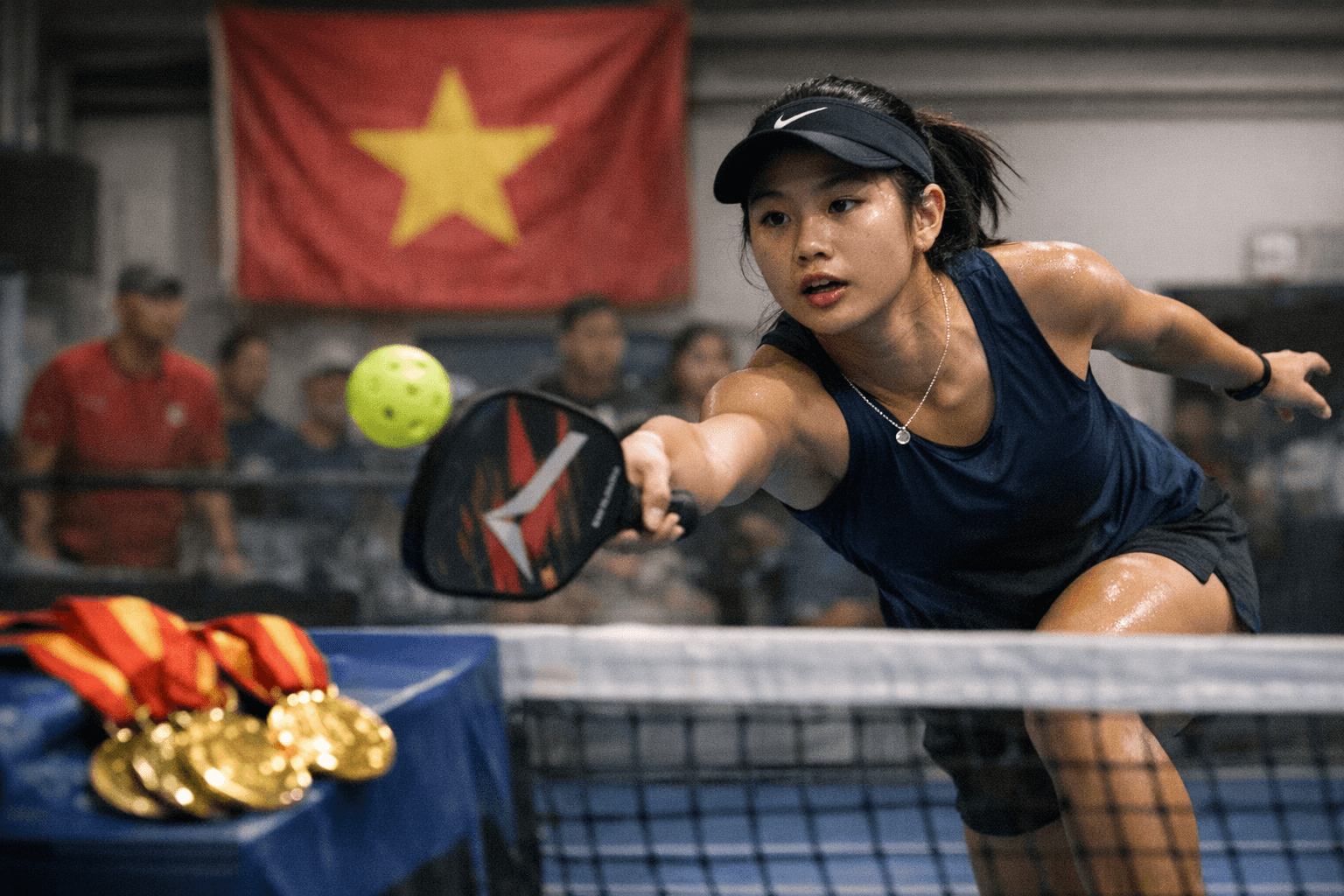
Alix is the No. 1 Vietnamese-American player and No. 1 on PPA Tour Asia, where she has earned four gold medals, one silver, and two bronze. She currently holds the No. 7 world ranking in mixed doubles and sits inside the top 20 in women's doubles. By early 2026, her commercial portfolio included KT Tape and Kamito Pickleball as primary sponsors, alongside her Columbus Sliders MLP affiliation. KT Tape's athlete marketing explicitly positions her as the top Vietnamese-American player, tethering a performance-sports brand to a diaspora identity that resonates simultaneously across Southeast Asia and the Vietnamese-American community. Her 30,000 Instagram followers represent an audience that is not merely pickleball-interested but culturally invested.
This dual positioning, elite PPA competitor and cultural representative, is the brand asset that ranking metrics alone cannot capture. For sponsors evaluating Asian pickleball exposure, Truong functions as a bridge between the established U.S. professional circuit and a market where crowd data from Ho Chi Minh City and Da Nang has demonstrated demand that outpaces available infrastructure. Vietnam showed why its pickleball scene is generating some of the best crowds and atmospheres professional pickleball has ever seen.
What Vietnam still lacks: the supply chain bottleneck
Truong's rise is a product of access that Vietnam's domestic scene cannot yet replicate at scale. Her development required U.S. training infrastructure, a father-coach with a tennis background, proximity to American professional competition from the outset, and the financial capacity to travel across two continents for tournaments. The Asia Federation of Pickleball has begun building a junior pipeline, hosting the inaugural Asia Pickleball University Championship in Da Nang in July 2025. The AFP Junior Program also ran in Vietnam's Quang Nam Province, but the gap between these grassroots structures and the competitive standard required for PPA Tour Asia qualification remains substantial.
The bottleneck is not enthusiasm. The MB Vietnam Cup in Da Nang offered a share of $150,000 in prize money and 1,500 ranking points at the top, while the MB Vietnam Open carried $50,000 and 1,000 points. Prize structures that size confirm real commercial investment. What the country still lacks is the middle layer: qualified coaches capable of bridging tennis and pickleball fundamentals, a sustainable travel budget to get juniors to international qualifying events, and a structured pathway from AFP junior competition to PPA Tour Asia wildcards. Truong benefited from all three by virtue of geography and family circumstance. A domestically-based Vietnamese junior has access to none of them by default.
The next 12-18 months and the market signal they carry
The 2026 PPA Tour Asia season opens with stops in Hanoi, Kuala Lumpur, and Macao, giving Truong three immediate opportunities to defend her regional rankings while the circuit tests whether local talent has begun closing the gap. The AFP's Rising Stars U19 pathway and regional qualifier structure remain the primary route for juniors into continental finals, but consistent international travel, the prerequisite for accumulating the necessary ranking points, still sits beyond the financial reach of most Vietnamese families without external support.
The market signal from Truong's 2025 season is precise: Vietnam can generate elite-level crowds and authentic cultural investment, but it requires an external talent injection to produce the players those crowds come to watch. The commercial opportunity is not in backing the next Alix Truong after she has already won four golds. It is in funding the coaching residencies, tournament travel grants, and technical training camps inside Vietnam that could develop a player who never had to leave the country to become one.
This article was produced by Prism’s automated news system from verified source data, official records, and press releases, then run through automated quality and moderation checks before publishing. The system is built and supervised by the people who set the standards it runs under. Read our full AI policy.
Did this article answer your question?