Plimpton’s 1863 skate patent transformed roller skating into a sport
Plimpton’s quad skate solved the sport’s biggest problem: it made turning, balance, and speed control repeatable. That one mechanical fix turned roller skating from novelty into competition.
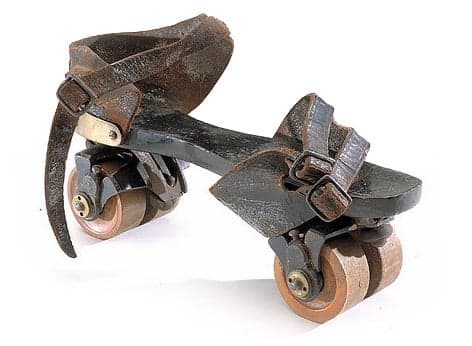
Roller skating turned into a sport when skates finally let the body do the work cleanly. James Leonard Plimpton’s January 6, 1863 patent solved the three things early skates could not: turning, balance, and speed control, with a pivoting four-wheel frame cushioned by rubber that curved when the skater leaned. That shift, from awkward novelty to controlled movement, is why the quad skate became the machine that made lessons, rinks, and competition possible.
The patent that gave skaters real control
Plimpton’s design was filed as U.S. Letters Patent No. 37,305, and the patent text described it as an improvement in roller and other skates. The skate broke from earlier in-line construction and used two parallel pairs of wheels, mounted so the frame could pivot. That pivoting action, dampened by a rubber cushion, let the skate curve when the skater leaned weight in the direction of travel.
That sounds like a small mechanical tweak, but it fixed the core problem. Earlier roller skates, modeled on ice skates, were awkward to turn and stop, which kept them closer to a parlor novelty than a usable athletic tool. Plimpton’s quad changed the equation by giving skaters a predictable response underfoot: lean left, and the skate followed; lean right, and it followed again. Once that became reliable, skating stopped being a stunt and started behaving like a sport.
Why the quad changed the learning curve
The real genius of the quad was not just speed, it was repeatability. A skate that can bend into a curve gives beginners something they can learn, coaches something they can teach, and organizers something they can build events around. That is why Plimpton’s design mattered far beyond the patent office: it made skating easier to learn, easier to perform in groups, and far better suited to organized competition.
Britannica identifies Plimpton’s 1863 model as the first practical four-wheel skate, and the Library of Congress says the quad skate dominated the industry for more than a century. That dominance tells you everything about the design’s staying power. If the hardware cannot hold a line, cannot turn cleanly, and cannot return the skater to balance, the sport never gets past the novelty phase. Plimpton’s skate did all three.
How the sport spread after 1863
Plimpton did not just patent the idea and wait for the market to catch up. He built a skating floor in his office and leased skates, turning the invention into a working demo instead of a paper claim. He also sent engraved personal invitations to New York’s social elite for a free demonstration, and that push helped launch an exclusive New York Roller Skating Association with Plimpton as its first president.
The timeline matters here. A Medfield Historical Society account says his original patent protection lasted 17 years and expired in 1880. When that protection ended, new manufacturers and new rinks broke his hold on the market. Plimpton also patented improvements in 1866, which shows he kept refining the technology after the first breakthrough rather than treating the 1863 model as a finished product.
The rink boom followed the equipment. By the late 1870s, the Strong National Museum of Play says, most towns had skating rinks with hard wooden floors. Those floors mattered because they rewarded the same thing Plimpton’s skate unlocked: clean edge control and stable turning. By the early 20th century, skating venues in Chicago and New York could accommodate thousands of visitors, a scale that only makes sense once the sport had become repeatable, not improvised.
What Plimpton’s design still means now
Modern roller-skating competition still runs on the logic Plimpton built into the quad. Britannica’s overview of the sport now includes speed skating, hockey, figure skating, and dancing, all disciplines that depend on controlled turns, balance under pressure, and the ability to repeat the same movement cleanly lap after lap or step after step. That is the quiet legacy of the 1863 patent: it gave skating a mechanical grammar.
Plimpton’s place in the record also reflects how quickly one useful design can reshape a sport. The patent documents list him in New York City, while Britannica identifies him as being of Medford, Massachusetts, and those two details map the spread of his influence across place and industry. In January 1863, he patented a four-wheeled turning skate with a rubber-cushioned pivot; after that, the sport had something it had never had before, a platform that could carry lessons, clubs, rinks, and competition without falling apart under the first hard turn.
This article was produced by Prism’s automated news system from verified source data, official records, and press releases, then run through automated quality and moderation checks before publishing. The system is built and supervised by the people who set the standards it runs under. Read our full AI policy.
Did this article answer your question?