World Skate defines Skate Cross as roller skating’s obstacle race
Skate Cross is not just speed on wheels. It is a four-skater elimination race where seeding, obstacle lines, and split-second passes decide who survives.
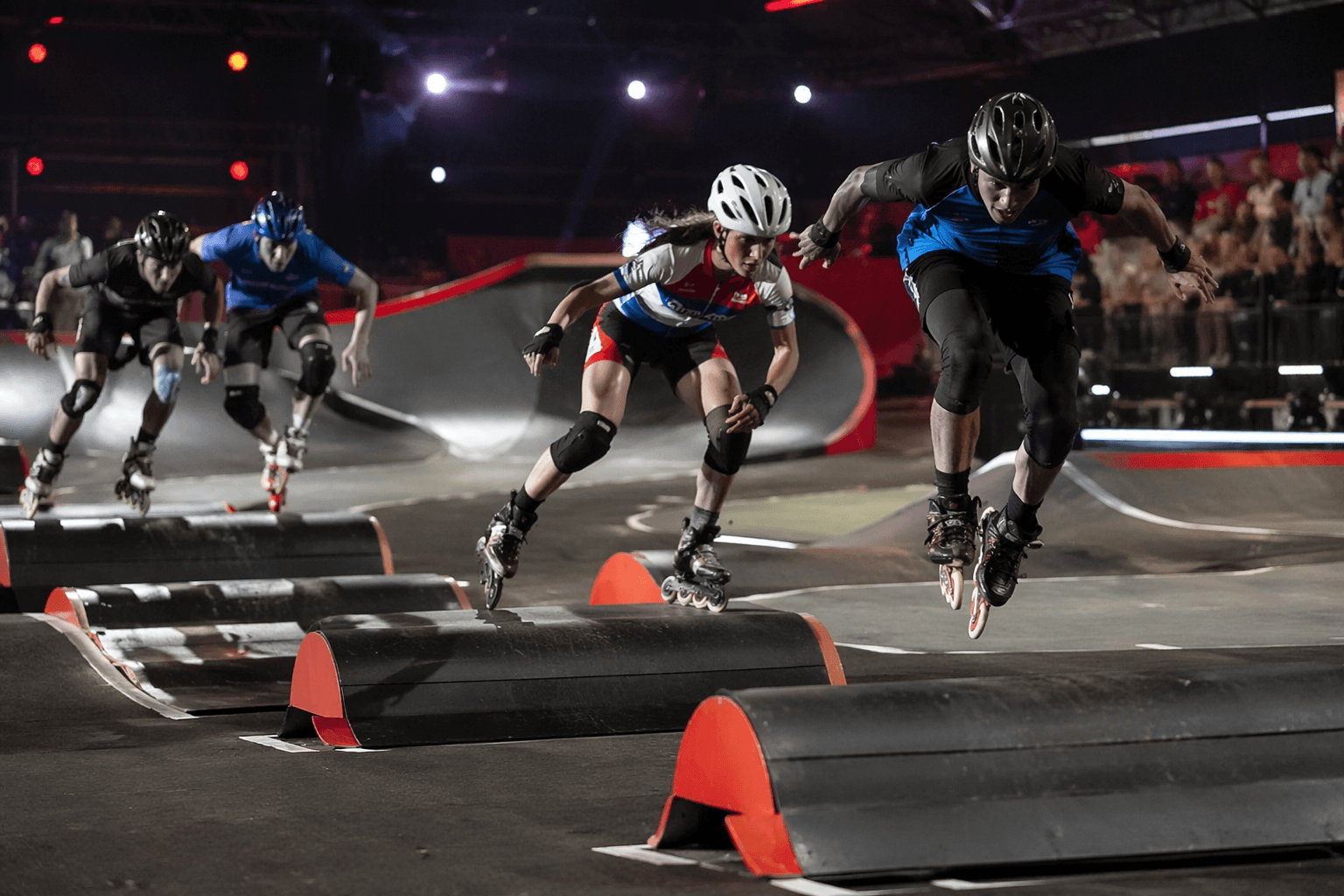
World Skate’s 2026 regulations define Skate Cross as a series of races for three or four skaters on a course built with ramps, fun-boxes, pyramids, waves, and turns. Once the gate drops, the format is brutally simple: line up, survive the first scramble, and finish in one of the two advance spots. Every heat is part sprint, part obstacle test, part contact chess.
How the bracket really works
The classic format starts with qualification, usually time trials, before the head-to-head racing begins. Those solo runs are not a warm-up act; they decide seeding, which determines who lands in which race group and how brutal the early rounds will be. In the standard knockout flow, four skaters start together, the top two finishers move on, and the field keeps shrinking until the final, where the four best skaters race for the win.
Skate Cross is not scored like a figure event or decided like a long road race. You do not get bonus time later for aggressive intent. You get one shot to make the right decisions in real time, and the heat only rewards the two skaters who stay fast, clean, and upright enough to advance.
Why the obstacles create passing chances
The obstacles are not decoration. They are the places where speed differences can vanish, where one line choice can open a lane, and where a racer with better balance can steal position from a faster starter. Under World Skate’s regulations, the track is generally around 300 to 400 meters long and can be flat or sloped, so the race compresses acceleration, technique, and decision-making into a short, high-pressure space.
A skater who carries momentum over a ramp or through a wave can close on an opponent who hesitates, over-brakes, or takes too cautious a line. On a course with turns, chutes, and changing surfaces, the fastest skater on paper is not always the one who survives the traffic.
For that reason, Skate Cross rewards versatility more than pure top-end speed. You need the burst of a sprinter, the control of a freestyle skater, and the nerve to commit when the track forces close-quarter racing.
The mistakes that usually decide advancement
Because only two skaters advance from a four-skater heat, the discipline punishes small errors immediately. A weak qualifying run can dump a skater into a tougher lane assignment before the knockout rounds even begin. A slow start can leave a racer boxed in behind a rival who gets the first clean line into the obstacles.
The biggest tactical mistakes are usually the ones that cost speed at the wrong moment: a hesitant takeoff, a poor landing off a ramp, drifting too wide in a turn, or failing to recover after being forced off the preferred line. In a format where the field is moving together and the track is full of features that interrupt rhythm, even a brief loss of momentum can hand the advancing spots to somebody else.
The margin between advancing and going home is often a single clean section through the obstacles, not a dramatic fall.
From French side event to World Skate discipline
Skate Cross emerged at the end of the 1990s in France, first as a side event during Roller Freestyle competitions. Its early influences came from roller freestyle, speed skating, and inline downhill, and that history still shapes the way the event feels today.
World Skate now lists dedicated Skate Cross World Championships and World Cup events, which places the format inside a real championship calendar rather than a novelty circuit.
Why the ranking system matters season to season
World Skate’s ranking system updates monthly, every competing skater earns at least one point, and only the best four events from the last 12 months count toward a skater’s standing. Points also expire after 12 months or when the same event is held again the following year, which keeps the rankings fluid and forces consistency.
The World Cup series is sanctioned and ties results directly to the official world ranking. It also breaks the circuit into event levels, from Starter events up to 3-star Main events, so every stop carries different weight in the season-long picture. In practical terms, one race can shape not just a podium result, but the next month’s seeding and the next year’s ranking position.
What the recent championships showed
The 2023 World Championships in Shanghai ran on November 10 and 11, and Italy’s Francesca Conzi and France’s Florian Petitcollin won the individual world titles.
World Skate put the Skate Cross field at about 130 athletes from around the world at the 2024 World Skate Games in Rome, and the course featured chutes, ramps, and obstacles. The start line was at Casina Valadier and the finish line at the Pincio terrace overlooking Piazza del Popolo, turning the race into a public spectacle in the middle of one of Rome’s most recognizable settings.
World Skate called the finals day “pure adrenaline,” and the location backed up that framing by putting the sport in front of casual spectators, not behind arena walls. The broader World Skate Games Italia 2024 awarded 156 world champion titles across 12 sports, which shows Skate Cross living inside a larger festival of roller and wheel-based disciplines rather than fighting for attention alone.
What to watch in a heat
- Watch the qualifying time first, because it shapes the bracket before the first head-to-head start.
- Watch the opening scramble, because the first clean line into the obstacles often decides track position.
- Watch how each skater handles ramps, fun-boxes, waves, and turns, because those features create the passing chances.
- Watch who keeps speed after contact or congestion, because a brief slowdown can knock a skater out of the top two.
- Watch the final lap, where one mistake or one decisive move can rewrite the entire heat.
This article was produced by Prism’s automated news system from verified source data, official records, and press releases, then run through automated quality and moderation checks before publishing. The system is built and supervised by the people who set the standards it runs under. Read our full AI policy.
Did this article answer your question?