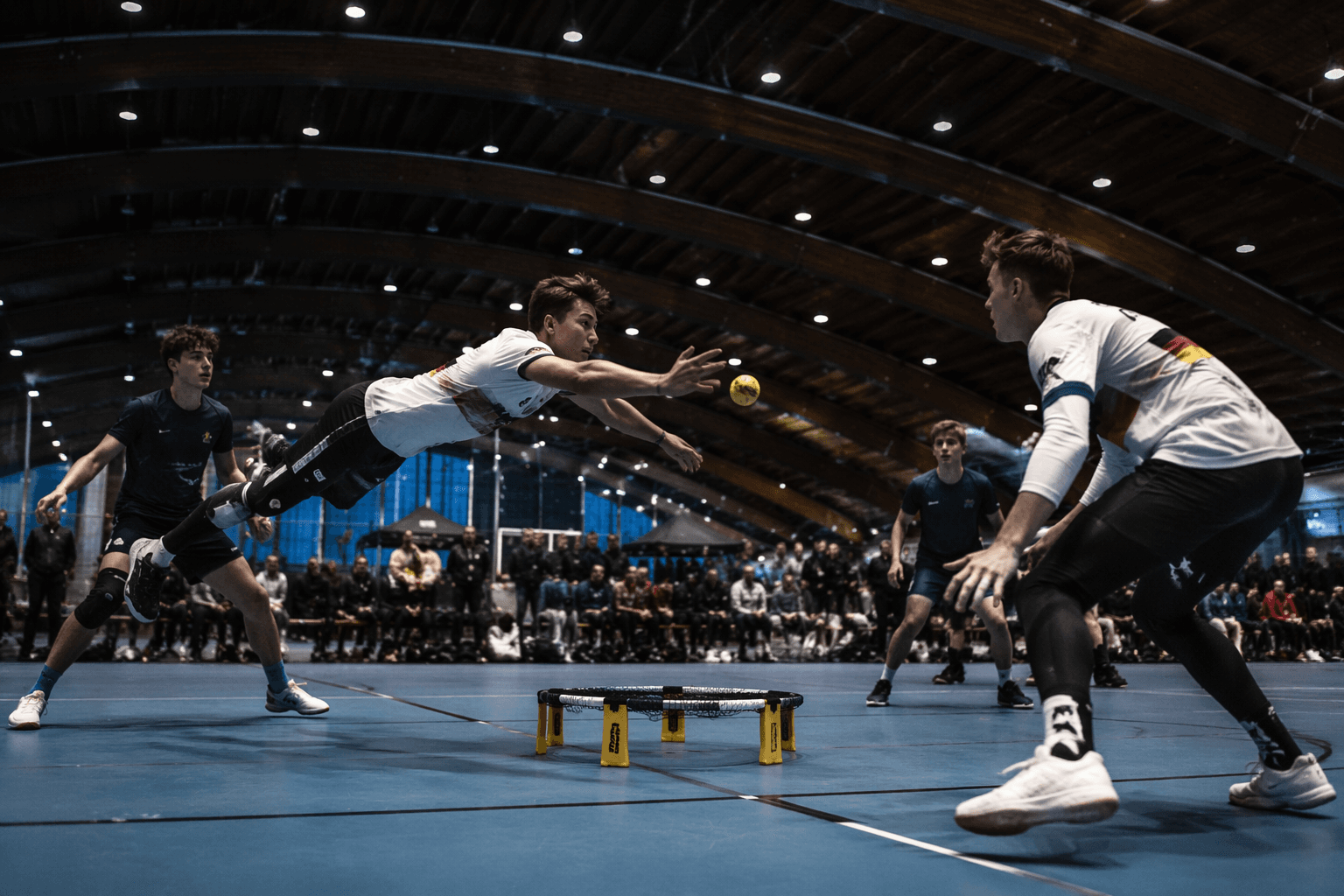
College roundnet grows into a nationwide campus pipeline
College roundnet's real breakthrough is structural: sectionals, nationals, and club rules now turn campus teams into Spikeball's most reliable feeder system.

College roundnet is no longer a loose collection of campus games. USA Roundnet says organized college play has existed since 2017, and the most recent season reached more than 150 college clubs across the United States, a scale that gives the sport a repeatable path from student organizer to elite competitor.
The campus circuit that made roundnet stick
USA Roundnet describes the college series as a national competition circuit for collegiate clubs, built around regional tournaments that lead to a national championship at the end of the school year. That structure matters because it gives roundnet something many emerging sports never secure: a season, a calendar, and a destination that clubs can plan around months in advance.
The Spikeball Tour Series has pushed the same idea from another angle, saying the goal is to generate more local competition, create access to tournaments, and support club growth. Its college ecosystem data shows how broad that footprint already is: 1,100+ players, 125+ clubs, and 21 U.S. events in the 2023 season. In other words, college roundnet is no longer just a championship scene, it is a full competitive network with enough volume to sustain programs from one school year to the next.
That network also now extends across 10 U.S. sections, with an international element in the college competition structure. The result is a sport that can give a student first contact through a nearby sectional, then keep that player engaged through the rest of the season instead of losing them after one weekend bracket.
How the format widens the base
The real strength of the college system is that it is built to absorb different roster sizes and different levels of experience. USA Roundnet says clubs may attend any sectional, and there is no limit on how many sectionals a club can enter. That means a campus club does not have to wait for a perfect lineup before joining the competitive circuit, and strong programs can test themselves repeatedly without being boxed into a single shot at qualification.
The 2026 structure goes further. USA Roundnet says D1 teams can send unlimited squads to sectionals but only one D1 squad to nationals, while the D2 division requires each squad to include at least one woman player. The current Spikeball college season page says the 2024-2025 season offered D1 Squads, D2 Squads, and Individual 2.0-4.0 divisions, while five-team D1 squad formats included three Open teams, one Women’s team, and one Mixed team.
Those rules do more than fill brackets. They create lanes for schools with different levels of depth, and they make it easier for clubs to keep more athletes involved in meaningful competition. A large club can build multiple squads and spread out responsibility; a smaller club can still enter the ladder through individual play or a narrower team structure. That is the kind of design that keeps college sports healthy after the first burst of novelty fades.
Why the club model keeps players around
Spikeball’s college materials make the retention logic explicit by framing clubs as a way to increase local competition and support club growth. The college landing page also pitches the scene as open to everyone from large clubs with hundreds of members to a player and a roommate, which says a lot about how the sport grows on campus: by making the first step easy and the next step obvious.
That matters culturally, not just competitively. College roundnet works because it blends social sport and structured sport in the same setting. Students can show up for the atmosphere, then stay for sectionals, rosters, and a realistic shot at nationals. Recruitment becomes the engine, but the club itself becomes the institution, with teammates bringing in new players, building event turnout, and widening the base of people who know the rules well enough to keep playing after graduation.

The format also creates a natural leadership pipeline. Club officers are not just running a social group, they are managing travel, recruiting, squad selection, and tournament participation across a season. That kind of responsibility gives college roundnet a durability advantage, because each graduating class leaves behind not just players but operators who understand how to keep the club active.
A championship trail with real destinations
The official college results archive shows that nationals go back to 2017, with early titles contested at Clemson, then Ohio State, and then the University of Georgia in 2019. Those host sites tell the story of a sport spreading through familiar college towns and major campus centers before the circuit expanded further. The archive turns the college game into a documented history, not just a series of weekend events.
The schedule now has a concrete end point, too. The 2026 College Roundnet Nationals were scheduled for May 23-24, 2026 at Mecklenburg County Regional Sportsplex in Charlotte, North Carolina. The 2024-2025 season had already pointed to Indianapolis for nationals on May 24-25, showing how the championship has become a predictable annual prize rather than an occasional showcase.
That predictability is the point. College roundnet now has the ingredients that keep a sport from stalling out: sectional access, national stakes, flexible divisions, club-based recruitment, and a growing archive of results that gives every season a place in the record. For a sport still proving how far it can travel, the campus pipeline has become its most reliable engine.
This article was produced by Prism’s automated news system from verified source data, official records, and press releases, then run through automated quality and moderation checks before publishing. The system is built and supervised by the people who set the standards it runs under. Read our full AI policy.
Did this article answer your question?