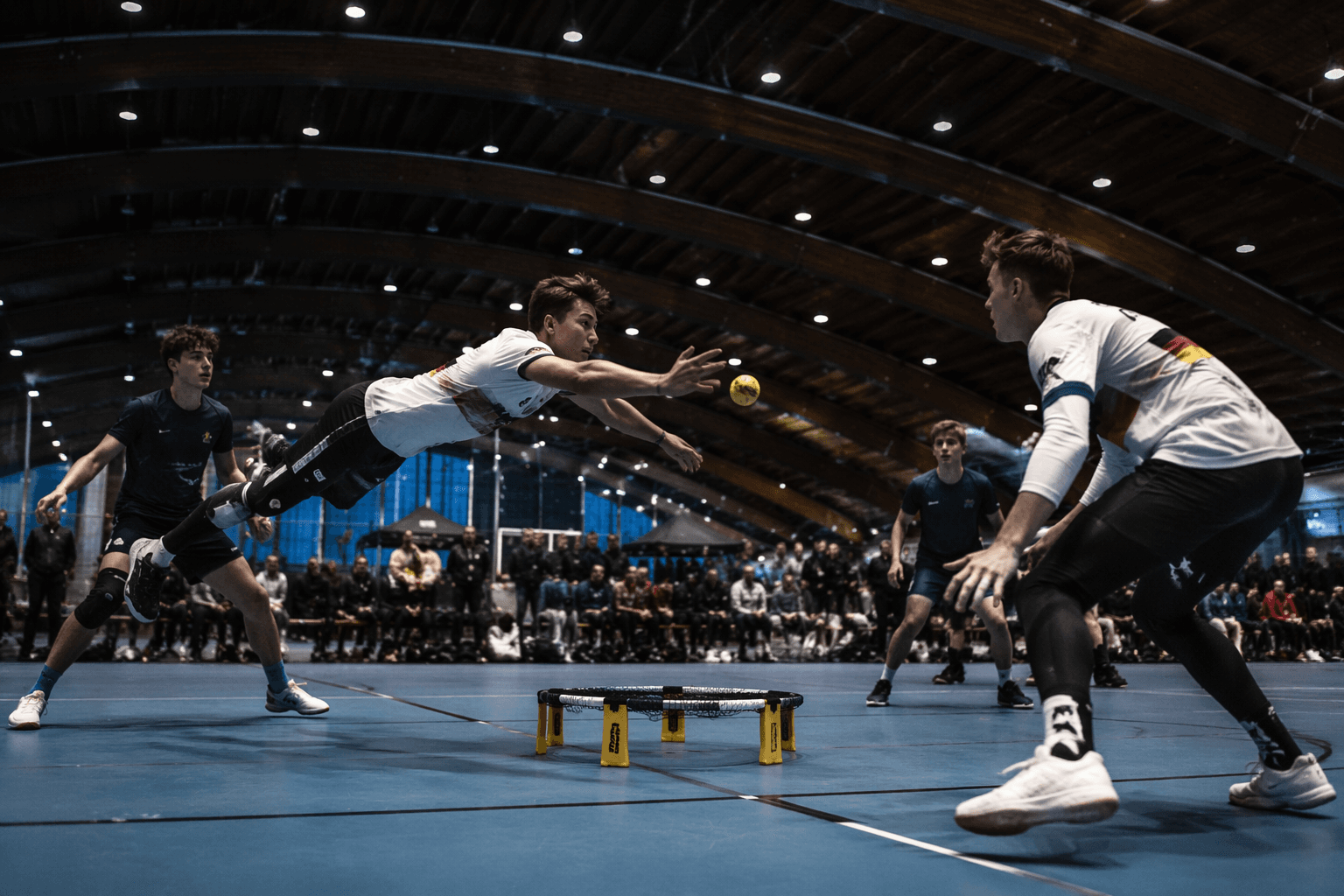
Roundnet began as a 1989 toy before becoming a global sport
Roundnet started as Jeff Knurek’s 1989 toy, then vanished before Spikeball revived it into a global sport with tournaments, broadcasts and 4 million players.

Roundnet did not begin as a startup-era invention or a social-media fad. It began as Jeff Knurek’s 1989 toy, marketed by Tomy, then faded after a brief run before returning as Spikeball, the competitive sport now played around the world. That gap between obscurity and modern visibility is the key to understanding the game’s rise: roundnet was revived, standardized, and branded into a sport without losing the playful core that made the original concept work.
From toy shelf to forgotten novelty
Knurek created the original game in 1989 while working in toy invention and industrial design, and the design drew on volleyball concepts that still define the sport’s rhythm today. The early version had a short burst of popularity from 1989 to 1995, then disappeared as the equipment came to feel outdated. That arc matters because it shows roundnet did not emerge fully formed as a modern competitive scene. It existed first as a commercial toy with a limited shelf life, long before anyone was talking about national titles or world championships.
Tomy’s role also shaped the first life of the game. The Japanese company helped market the original release, placing roundnet inside the toy market rather than the sports world. That distinction helps explain why the original version did not build the institutions, broadcast presence, or player infrastructure that define the sport today. The equipment was unusual, the audience was narrow, and the game’s identity was tied to novelty rather than competition.
What Spikeball changed
The modern version begins with Chris Ruder, who founded Spikeball Inc. in the late 2000s and turned the game from a dormant toy into a portable team sport. Early company growth centered on Chicago, where local tournaments helped build a player base before the sport spread more broadly. By 2014, the company had launched a competitive season, a turning point that pushed roundnet from casual backyard play into a structured sports ecosystem.
That shift changed more than ownership. Spikeball recast the game as a brand built around competition, fun, and inclusivity, and that language mattered because it gave the sport a social identity beyond the product itself. Instead of being remembered as a 1989 novelty, roundnet became something players could organize around, travel for, and treat as a real discipline. Beaches, backyards, parks, and campuses became the sport’s natural venues, but the game’s new brand gave those settings a shared purpose.
The leap into real competition
The clearest sign that roundnet had crossed into serious sport came at Clemson University, where the first College Spikeball National Championship was held on April 29, 2017. College play gave the game structure, rivalries, and a recognizable pipeline, all of which helped roundnet feel less like a backyard pastime and more like a sport with stakes. Once a college title existed, the rest of the ecosystem had something concrete to organize around.

Broadcast visibility followed quickly. In May 2018, a tournament in Lancaster, Pennsylvania became the first Spikeball event to air on ESPN2. ESPN also noted that the 2018 tournament series stretched across major U.S. cities from Boston to San Diego, and that many of those events grew organically rather than being imposed from the top down. One of the clearest examples was the Coney Island event, which began in 2013 with Jack Scotti and friends. That matters because it shows how roundnet spread through local enthusiasm first, then earned national exposure.
Rules, governance, and the sport’s new structure
The next major change was administrative. The International Roundnet Federation stepped in to establish uniform rules and coordinate international play, giving the sport a governing backbone that the original toy never had. It also helped sanction world championships, which gave elite players a shared competitive benchmark instead of a loose collection of local events.
The numbers show how quickly that structure expanded. A 2025 reference summary counted 44 member nations in the International Roundnet Federation, and the first Roundnet World Championship was held in 2019. British Roundnet now serves as the national governing body for the sport in Britain, which shows that roundnet has moved beyond a single brand and into country-level organization. That evolution is a major reason the game can now be discussed as a sport rather than a product category.
Scale, culture, and why the origin story still matters
Roundnet’s reach is now measured in players, clubs, and countries rather than toy-store placement. Coverage of the sport says it now has more than 4 million players worldwide, while club listings show communities in 64 countries. Those figures do not just signal popularity. They show a sports culture that has grown through schools, campuses, parks, and organized leagues, with enough momentum to support national bodies and international events.
The culture is still distinctively roundnet. The game keeps the DIY energy of its toy roots, but the modern version adds competition, formal rules, and a much larger public stage. That combination explains why players who discovered the sport in the social era often assume Spikeball invented it from scratch. In reality, Spikeball revived a 1989 invention, polished the brand, built the rules, widened the audience, and helped turn a forgotten toy into a lasting global sport.
The story of roundnet is not that a brand created a game out of nowhere. It is that an old idea found better timing, better organization, and a much bigger stage the second time around.
This article was produced by Prism’s automated news system from verified source data, official records, and press releases, then run through automated quality and moderation checks before publishing. The system is built and supervised by the people who set the standards it runs under. Read our full AI policy.
Did this article answer your question?